

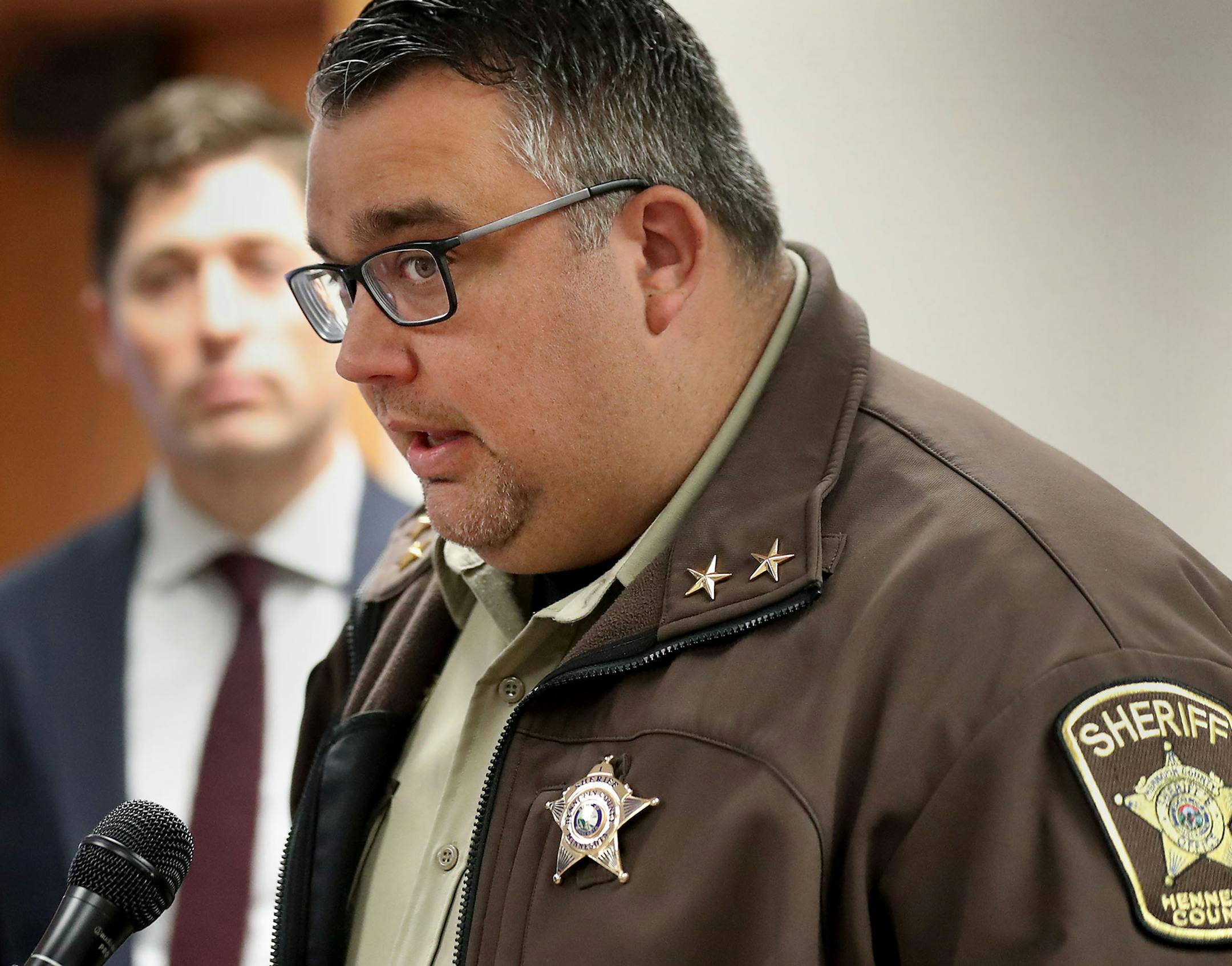
I was deeply disturbed by the article about Hennepin County Sheriff Dave Hutchinson's car crash near Alexandria in December 2021 ("Drunken sheriff going 126 mph before his crash," front page, Jan. 21).
I wonder what my sentence would be if I found myself in the same situation as the sheriff. That is, driving drunk (blood alcohol level almost twice the legal limit in Minnesota), going 50 or 60 miles an hour over the speed limit (if not more), not wearing a seat belt while driving, lying to the police about who was driving the car, and carrying a loaded weapon.
Is the "standard" sentence for ordinary Minnesota residents merely probation and a relatively small fine for such egregious and dangerous behavior? If this is the law, it is time for a change. If a judge made this decision knowing all the information in that article, the judge should resign.
Sheriff Hutchinson, do something honorable as your last act in office: Resign.
Leonard Lichtblau, Edina
LEGISLATURE
Consider these three reforms
This February, Minnesota's legislators should take a moment to offer the voters three simple amendments to our state's Constitution to reduce future wasteful gridlock of state government:
1) Stagger state senators' four-year terms so that odd-numbered Senate districts' two-year terms will follow just after each 10-year reapportionment, and even-numbered Senate districts' short terms will fall just before it. This will refresh half the Senate every two years and make it more responsive to swings in community sentiment. It will also make sure that all but the first biennial general election of the five in the reapportionment cycle will leave half the state Senate in place as ballast against wild swings in public policy. (To prevent gaming the location of even- and odd-numbered Senate districts, number them continuously; zigzag across the state.)
2) Provide that if a necessary appropriations bill hasn't passed both state House and Senate by a prescribed number of days before adjournment, then for purposes of deciding the appropriations bill the Legislature will act as a single unicameral body, with each senator having two votes and each representative one vote. (There are two representatives for each state senator.) Such unicameral action could also be provided as a fallback if the two chambers fail to agree on a reapportionment bill by some specified deadline.


