

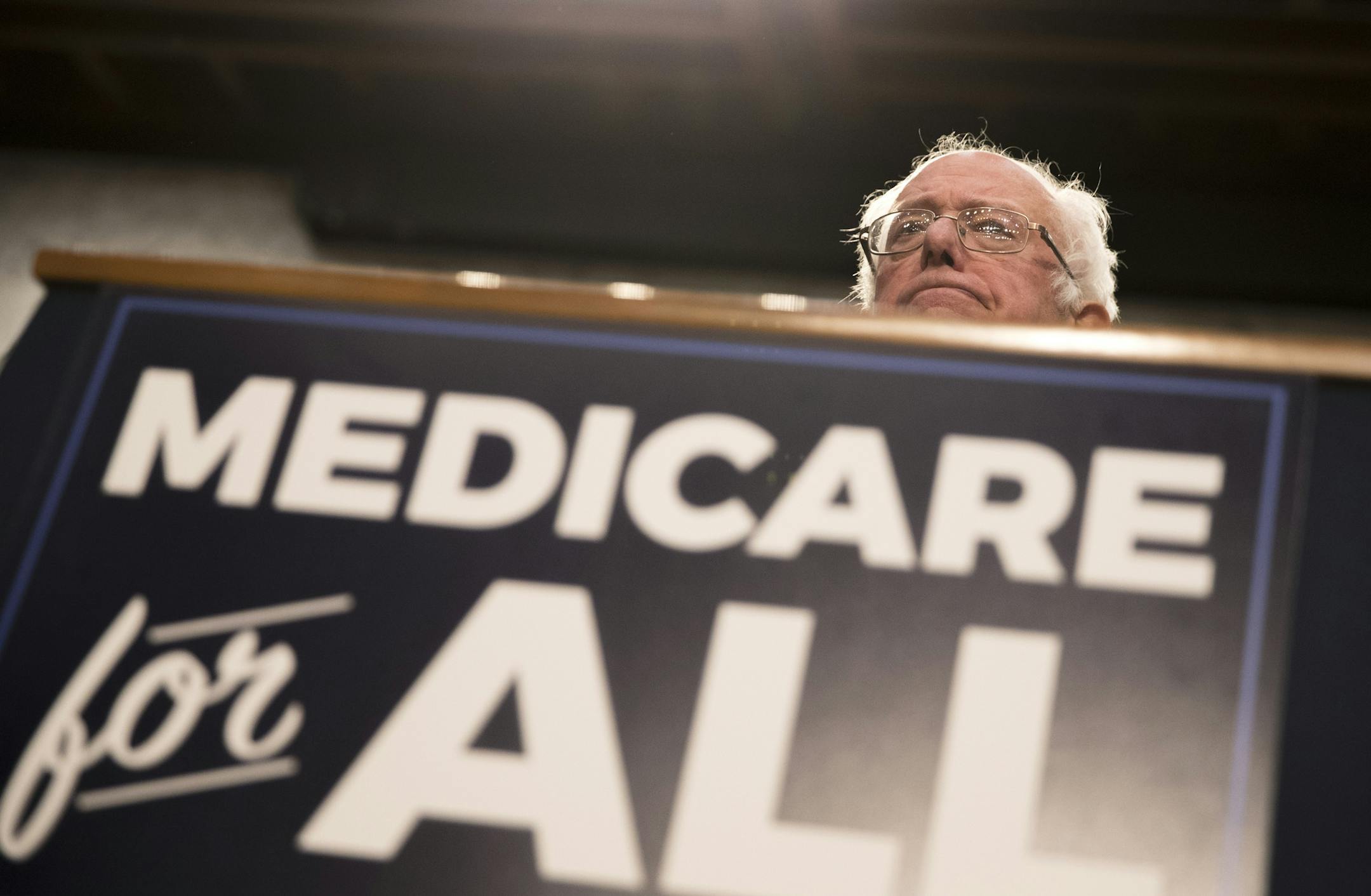
On Wednesday, Sen. Bernie Sanders, I-Vt., and 15 cosponsors, all Democrats, introduced a new "Medicare for All" single-payer, health-care bill. It's a thoughtful, ambitious place to start this critical policy discussion of how to squeeze costly inefficiencies out of our health care system, while ensuring robust, affordable coverage for all.
But hold up. Isn't that what the Affordable Care Act was all about, and haven't recent politics revealed that the ACA appears to be here to stay? Should not our efforts in this space be devoted to shoring up that program, protecting it against Republican sabotage? Isn't this single-payer stuff dangerous politics?
First, a brief description of Sanders' plan. In year one of the plan, Medicare is expanded to cover children 18 and under and adults 55 and up. Over a four-year period, the plan transitions all Americans into a comprehensive package covering most health-care needs, including hospital and primary care, maternity care, and prescription drugs, vision and dental benefits, and reproductive services. The government would be the sole insurer.
The critique that Sanders doesn't say how he'd pay for this huge shift in how we spend over $3 trillion per year on health care, or 17 percent of GDP (about twice that of other countries on a per capita basis), is incorrect. Here's his list of pay-for options, which mostly include progressive taxes, assumptions about savings on health-care spending, and repealing the "employer exclusion," the single largest tax expenditure in the U.S. system, costing about $260 billion this year. The tax expenditure would no longer be necessary as eventually, the federal government would replace employers as the source of their workers' health coverage.
As these options reveal, the plan obviously requires a bigger government footprint in health care and thus higher taxes, which will be one of many sources of attack by opponents. These will include insurers, the pharma lobby, and many health care service providers whose reimbursements would fall under the plan, not to mention higher-income taxpayers dinged by some of the pay-fors. You don't cut per-capita spending by this much without goring somebody's ox.
At the most basic level, Sanders is talking about taking "rents" — excess profits — out of the current system and using that money to provide comprehensive coverage for all. Of course, what he's calling excess profits, somebody else — typically a powerful somebody with scads of politicians on autodial — calls "my family's income."
Regarding costs, supporters will counter, correctly, that the cost to households must be considered net of insurance premiums they currently pay. The pay-for sheet above claims this leaves many middle-income families ahead ("The typical middle class family would save over $4,400 under this plan"), but let's see if this sticks in future scores, which will surely be forthcoming. Sanders' argument is that under his plan, people should be able to swap out some of what they now pay in premiums for what they'll pay in taxes, and get more robust coverage at a better price. No question, there's a ton of disruption and trench warfare with deep-pocketed stakeholders between here and there, but Sanders' basic formulation does describe health systems in most other advanced economies.
Obviously, there is much to be said about the reality of all this. But to say it's not going anywhere in this Congress misses the point.


