

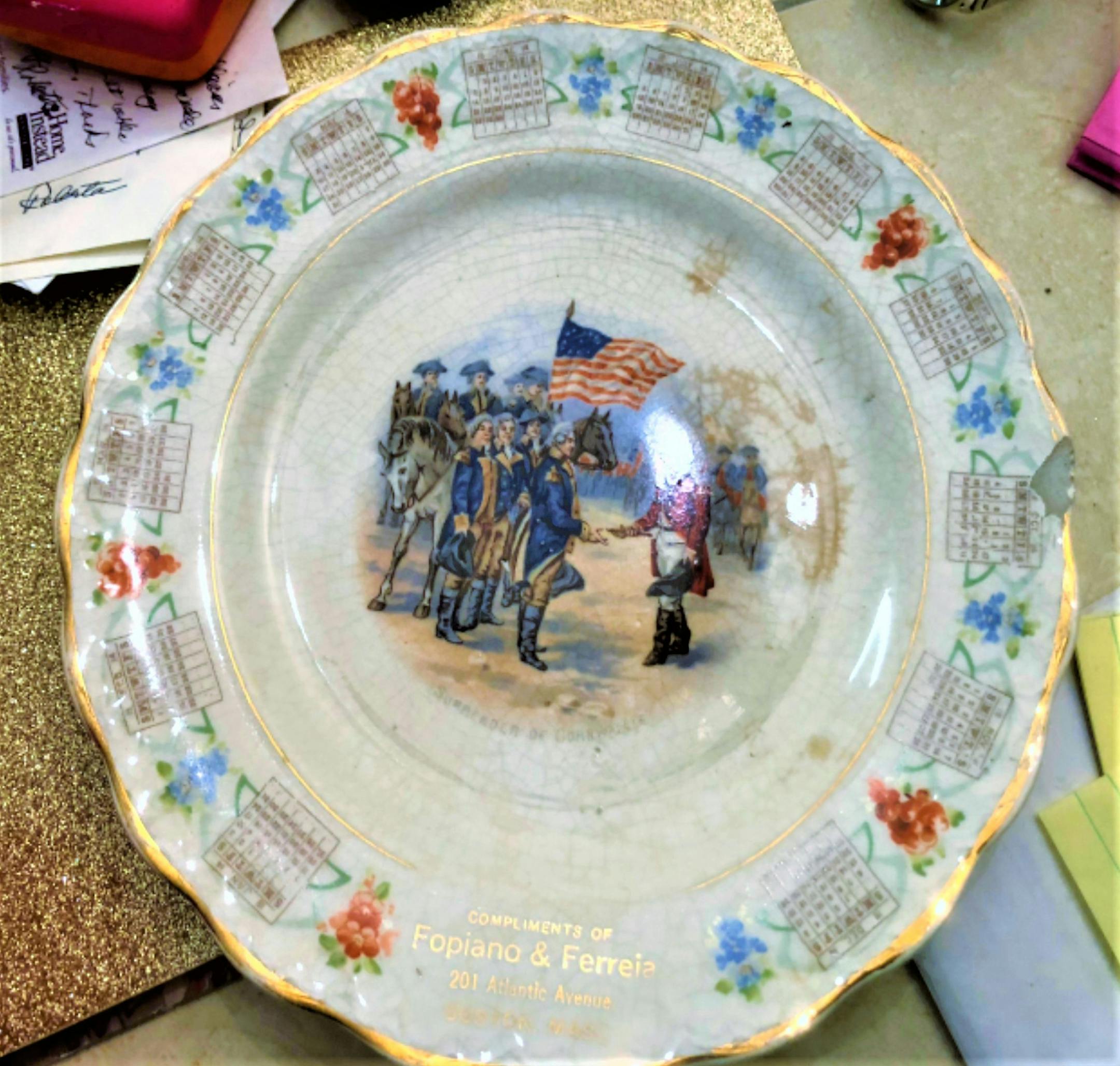
Q: I found this piece in my mom's apartment after she passed away. Looks like it was made by D.E. McNicol Pottery Co. The plate appears to have an image of the surrender of Cornwallis. Any thoughts on its value?
A: There's monetary value, which we talk about a lot, and then there's sentimental value, which I think we underplay. The plate has lost most of its monetary value because of the damage it has sustained over its 104 years of existence.
Many people say to us something like, "It's in good shape for its age!" We recognize this as code meaning the piece under discussion looks like it has been run over by a truck at some point. The piece in today's question has a rather large and unsightly chip out of its rim plus a network of serious crazing (fine cracks running through the glaze) and brown spots where grease has percolated through these cracks and stained the underlying pottery.
These imperfections turn collectors off big-time, and this lowers its monetary value significantly below the $10 mark. But, the piece does have historic value to your family and does tell a story.
These are called "calendar plates." They were made inexpensively and in large numbers by several American manufacturers. They were often given away as premiums by grocery stores, clothing stores, jewelers, hardware stores, liquor stores and such.
They often read "Compliments of" and then the name of the store and its address. Sometimes the type of business was listed. In this case, the store was Fopiano and Ferreria, 201 Atlantic Av., Boston, but we have no idea what kind of merchandise the firm sold.
The address is in an area that has been the site of redevelopment in the recent past, and Fopiano and Ferreria seem to have left no records.
The plate was indeed made by D.E. McNicol Pottery of East Liverpool, Ohio. The company began operation in 1892 and moved to Clarksburg, W.Va., in the 1920s. It stayed in business in the later location until the 1960s.


