

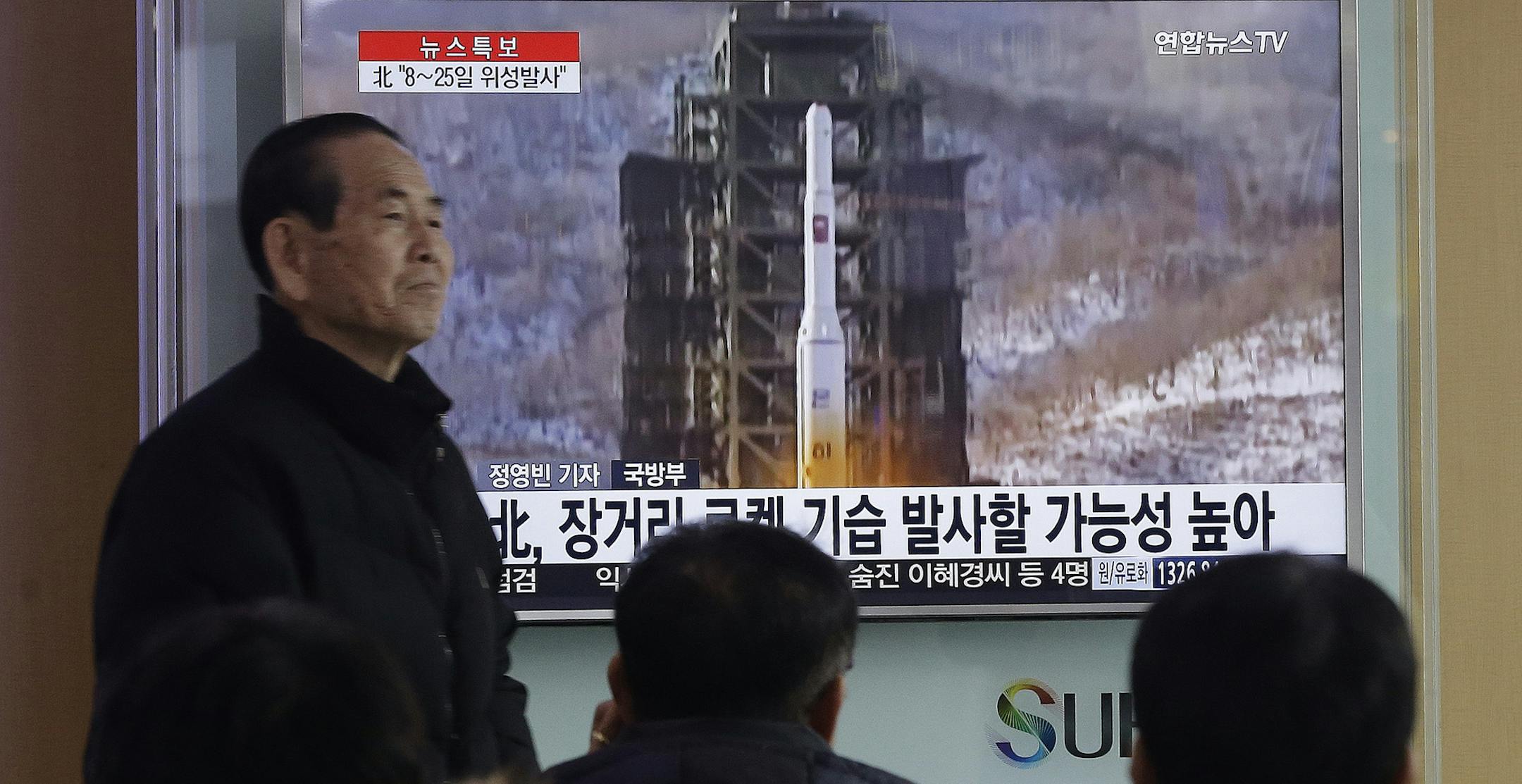
The increasing danger posed by North Korean military provocations necessitates a strong response. Congress has supplied one in the form of sanctions contained in a previously passed House bill and a Senate bill approved on a welcomed bipartisan basis on Wednesday. Once a reconciled bill is sent to President Obama, he should sign it, then accelerate diplomatic efforts to coalesce Asian nations to curb the destabilizing behavior.
That won't be easy, especially with China. Beijing seems to recognize the threat its ally in Pyongyang poses but seems to favor diplomatic outreach over punitive sanctions. And while it's quite clear that Chinese leaders don't want enhanced security ties between the U.S., South Korea and Japan, Beijing needs to realize that its current approach to Pyongyang is not working. China doesn't directly control the unstable Kim Jong Un regime, but it has by far the most influence. If it won't use this influence, imperiled neighboring nations — in alliance with the U.S. — will take more direct measures.
The latest flash point involves two tests by North Korea. On Jan. 6, the country conducted an underground nuclear explosion that it claimed was a hydrogen bomb. While experts cast doubt on that boast, the test, along with Sunday's rocket launch that experts claim was a test of ballistic-missile technology, sparked alarms in world capitals. It would be irresponsible for those threatened not to act.
And Beijing should not be surprised that despite its warming relations with Seoul, South Korean leaders are now considering allowing the deployment of an advanced U.S. missile-defense system, THAAD (Terminal High-Altitude Area Defense). This will worry, if not anger, China, whose state-run news agency said such a deployment could spark a regional arms race.
That may be true. But those threatened by North Korea cannot be complacent. Underscoring the increased intensity of North Korea's weapons development, U.S. National Intelligence Director James Clapper testified to the Senate Armed Services Committee on Tuesday that Pyongyang's program was the world's most dangerous nuclear weapons and proliferation threat. Clapper warned that North Korea was producing more fissile material and developing a submarine-launched ballistic missile and that the country is committed to developing a long-range nuclear missile capable of hitting the U.S.
Campaign rhetoric by his would-be successors notwithstanding, President Obama has taken this threat seriously and is rightly trying to convince allies to step up defenses in conjunction with the U.S. Still, the Senate bill mandates sanctions and does not leave it up to Obama's diplomatic discretion. While every president should have the ability to conduct his or her own foreign policy in consultation with Congress, Obama should nonetheless sign a reconciled bill when it reaches him, as well as continue his efforts to convince Chinese President Xi Jinping that it is in Beijing's best interest to amplify, not reduce, global efforts to defuse the dangerous Kim regime.


