

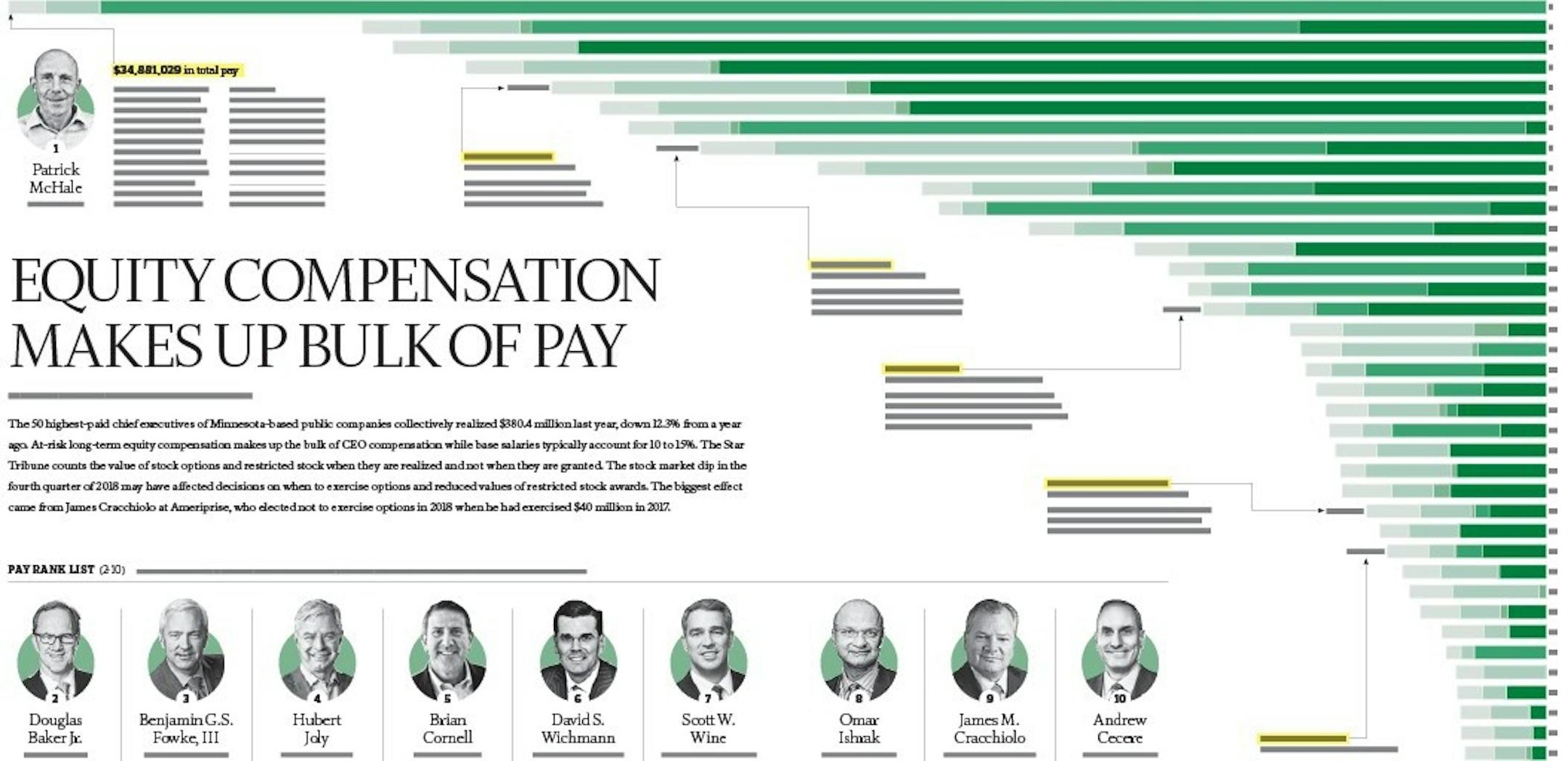
Sunday morning coffee and the Star Tribune go hand in hand in our household. Upon opening to the Business section and its executive compensation report July 21, we were met with yet another example of income disparity between top CEOs and median Minnesota households. A shocking 510 times more than most of us could even imagine earning. That in itself is disheartening, but I saw more.
As owners of a small business, we make a decent living and are proud of our contribution to our community and the service we provide. We pay a lot in taxes and have to buy "individual health care," which I can tell you is ridiculous for what we get in return. But yet that is still not what I was thinking as I looked over all of the information gathered for that report.
When I turned to the center of the section and saw the double-page spread of the top 10 CEOs, what I clearly saw was 10 men, all white — no diversity, no women. I held up the paper to my husband and said, "What is the first thing you see?" His response was immediate and the same.
I've been speaking out for years, starting back in high school athletics — the girls' sports and facilities weren't the same as the boys'. When I worked in advertising and had to conform to the "good old boys club," and was treated differently and asked to do things the men wouldn't do, I was diminished for what I could actually bring to the companies I worked for. Sadly, I really thought that things would change during my lifetime, yet we are still seeing headlines about income inequality, and men are still predominantly at the helm.
As I continued to read through the list of all of the top 50 executives, I noticed very few women, and from what I could decipher from names, very little diversity. I'd be curious if the Star Tribune could clarify not just compensation but gender and diversity in these annual reports, so we can hold these companies accountable. I am still holding out hope to see a change in our business culture before I die, knowing that there are many, many women who could do great things for any of those companies.
Debbie Anthony, Coon Rapids
POPPING PERSONAL BUBBLES
We have not yet confronted the reality of our racist heritage
I appreciate Michael Nesset's conclusion in "The world outside my bubble" (Opinion Exchange, July 21) that our country and state need a new civil-rights movement. An essential element is the need to deepen and broaden the understanding of our national origin — to face the reality that our country was built on racism with free slave labor essential to our economy, not only in the South.
In his autobiography "Born a Crime," Trevor Noah states that we in the U.S., as in his native South Africa, have not confronted the reality of racism. He would affirm Nesset's view that our superficial understanding of racism can lead us to assume that the problem was resolved with the Civil Rights Act of 1964. In order to combat this shallowness, Noah suggests that we look at the way Germany educates its children about the Holocaust and the Nazi era. German children, he says, are taught in depth "the how, the why, and the meaning" of this shameful period in their past, whereas children in the U.S. learn some facts about slavery and racism, but "never the emotional or moral dimensions."
Including these dimensions in our education may lead us to better cope with our racist heritage. Books such as Toni Morrison's "A Mercy" can help in this respect. This novel lays out America's early involvement with the Atlantic slave trade and the barbarous cruelty of the slave system as well as the deplorable treatment of native people.


