

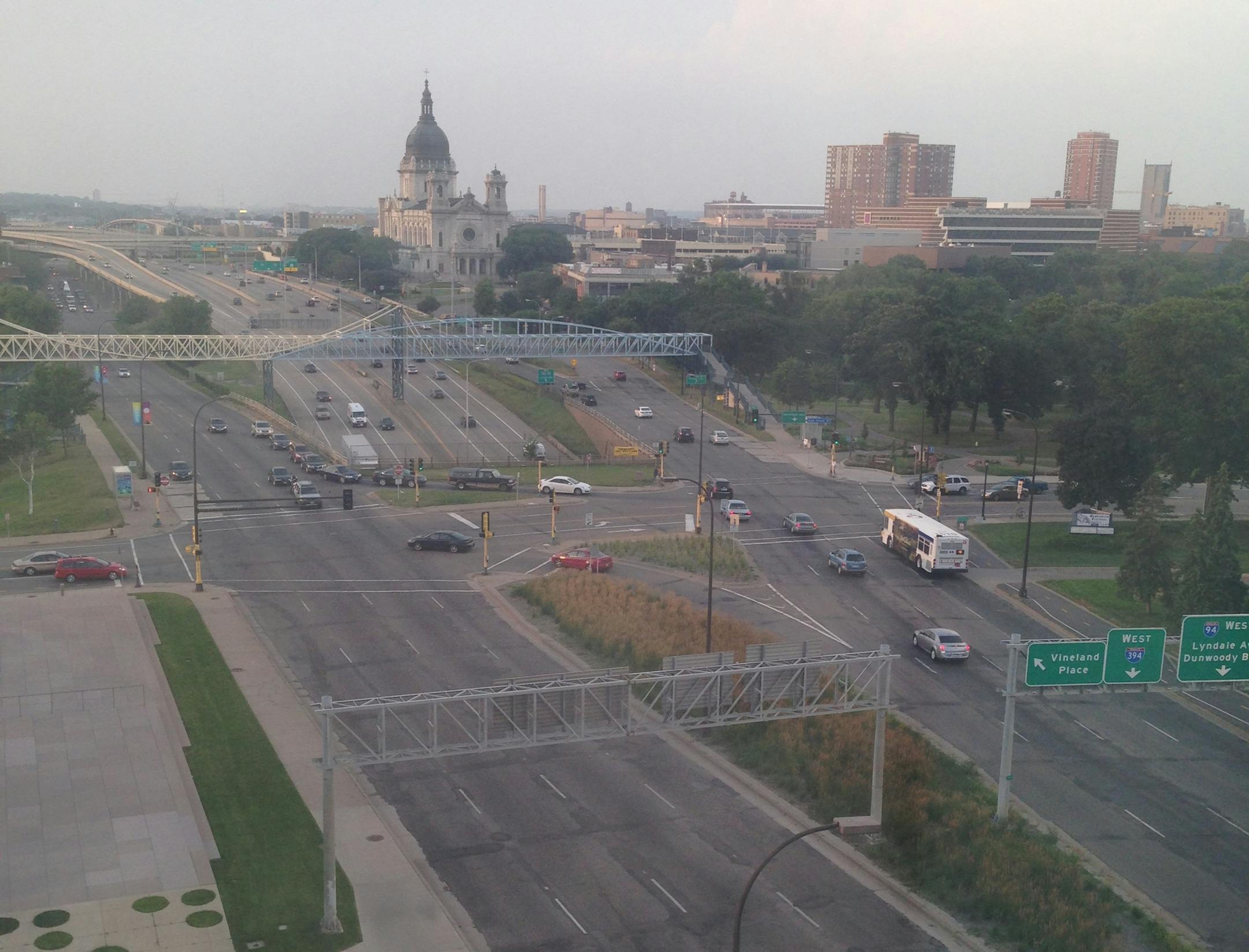
Minneapolis city officials are looking to revamp one of the most troublesome intersections in the city by reducing the number of traffic lanes, creating more space for pedestrians and simplifying traffic flow.
City leaders are mulling two options for a $9 million overhaul of the "bottleneck" joining Hennepin and Lyndale avenues, the confusing confluence of roadways that connects downtown with south Minneapolis. Traffic zips (or crawls) past landmarks like the Walker Art Center, Loring Park and St. Mark's Episcopal Cathedral on pothole-filled streets.
"Anything will be an improvement," said Sherman Ford at a crowded open house about the project at the Walker on Monday night.
Both proposals would improve the experience for pedestrians, who must now brave nine lanes of traffic and sometimes multiple traffic lights to cross the roadway in a densely populated, high-traffic area. Even the sidewalk is seldom a refuge, since bicyclists whiz down a shared path descending Lowry Hill.
The intersection can be just as maddening for more than 50,000 motorists a day who must weave between a complicated series of lanes to reach downtown, Interstate 94, Lyndale and Hennepin avenues. At busy times, the intersection can become a racket of squealing brakes and car horns.
The most controversial component of the project is likely to be the potential decrease in vehicular lanes. Both plans call for eliminating one downtown-bound lane on Hennepin Avenue — alongside two churches — and one would nix parts of a lane heading toward Uptown. They would also eliminate some of the narrow single lanes that carve through medians for drivers wishing to make a turn.
But city officials also envision improvements for drivers by simplifying signage, reconfiguring lanes to reduce the need for abrupt lane changes and keep traffic flow more consistent. The changes, engineers say, would increase travel time through the area during peak hours, but by no more than 30 seconds.
"There's a lot of weaving going on with people trying to get into the lanes they want to get into," project engineer Ole Mersinger said. "What we looked at is, how can we get people lined up through the corridor in a way that prevents that friction?"


