

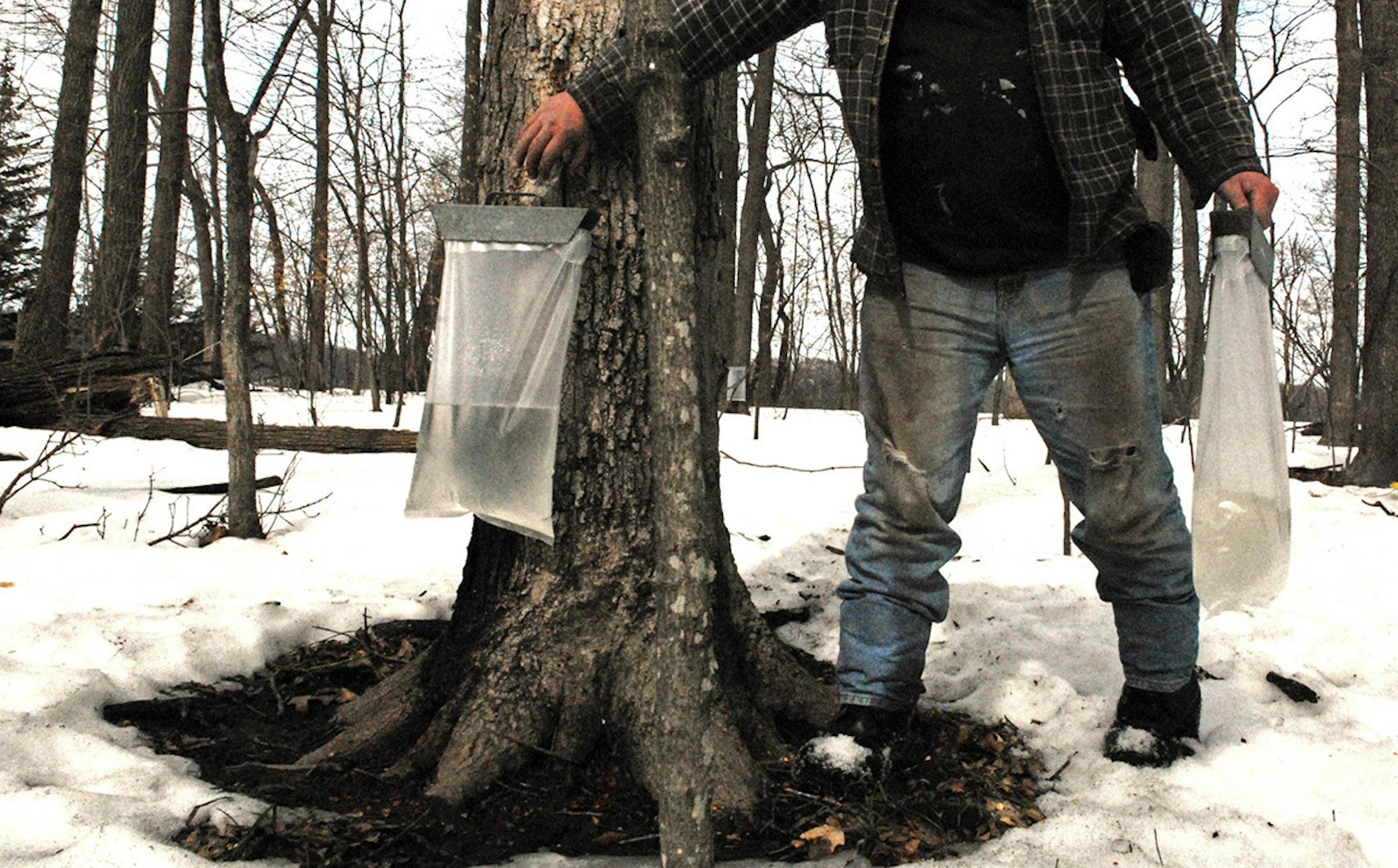
On Tuesday in the woods I had a fire burning with plenty of storm-felled maple and red pine to keep a good flame. Surrounding me were 55 tapped trees that within a week or so will account for close to 400 gallons of sap, the upper limit of our down-home sugarbush operation. Sandhill cranes were aloft high overhead against a cobalt sky, pushing the snow line north, and Canada geese arrowed over the St. Croix River.
You couldn't argue with the weather. The temperature hovered on either side of 50, and I was in shirtsleeves. A friend, Mike Tate, would stop by later to help burn the waste wood, and in the evening another friend would arrive for the day's maple-sap gathering. Otherwise I was alone with the fire and the tapped trees and the cranes and the geese.
Tapping trees the traditional way with sap flowing into buckets or bags suits me. Like anyone who has ever lit a fire beneath an evaporator, I'm aware of efficiencies gained by the application of vast reptilian vacuum systems and their enabling miles of blue plastic tubing. Minnesota's largest syruping operations punch holes in 20,000 trees and deploy monitoring screens and wireless keyboards to suck sap into sugar shacks like oil moving through pipelines. Vintage knucklehead Harleys spellbind me in ways contortion-inducing crotch rockets don't, and for this reason and others I prefer the old, slow way of gathering sap.
In days past when our boys were young they careened through the woods on our four-wheeler gathering sap into a 35-gallon tank. The tank was strapped to the back of the four-wheeler, creating as it filled a sloshing effect that had to be counterweighed by the operator. In a season's early days the forest floor was frozen. But as March gave way to April the ground softened and mud prevailed, creating for the boys the same sporting opportunities celebrated monthly by 4Wheel & Off-Road magazine.
"I'll boil at my house this year, it'll just be easier,'' John Weyrauch said.
John, a Stillwater barrister, is the chief cook and bottle washer of our two-bit operation, also the spiritual leader and confessed impulse buyer of A-to-Z syruping gadgetry.
Shopping sprees to Morley's in Luck, Wis., or another supplier can in a moment's notice yield carts full of funnels, bags, bag hangars, drills, drill bits, filters, hydrometers and, of course, bottles. It's a cult, maple syruping, and the hazings are self-administered, usually by credit card.
In this part of the world the Ojibwe were the original stalwarts of the spring syruping season. During the Moon of the Boiling Sap, or iskigamizige-giizis, they left their winter homes for sugar camps surrounded by maple forests. Modern taps are metal, but the Ojibwe's were carved of wood, and below them swinging from the maples were birch bark sap baskets, or biskitenaagan.
![Sap dripped into a collection bag from a freshly tapped maple tree at the Arboretum. ] ANTHONY SOUFFLE • anthony.souffle@startribune.com A surprisingly warm winter has sprung at the state's maple syrup production into life several weeks early at the Minnesota Landscape Arboretum in Chaska, Minn. The Arboretum recorded the earliest sap tap date yet. They sponsor several educational programs that explain the process of maple syrup making, hold an annual pancake breakfast, and sell their pro](https://arc.stimg.co/startribunemedia/ORTC5PW5O5BBB4EBWWZHES5WFI.jpg?&w=1080)


