

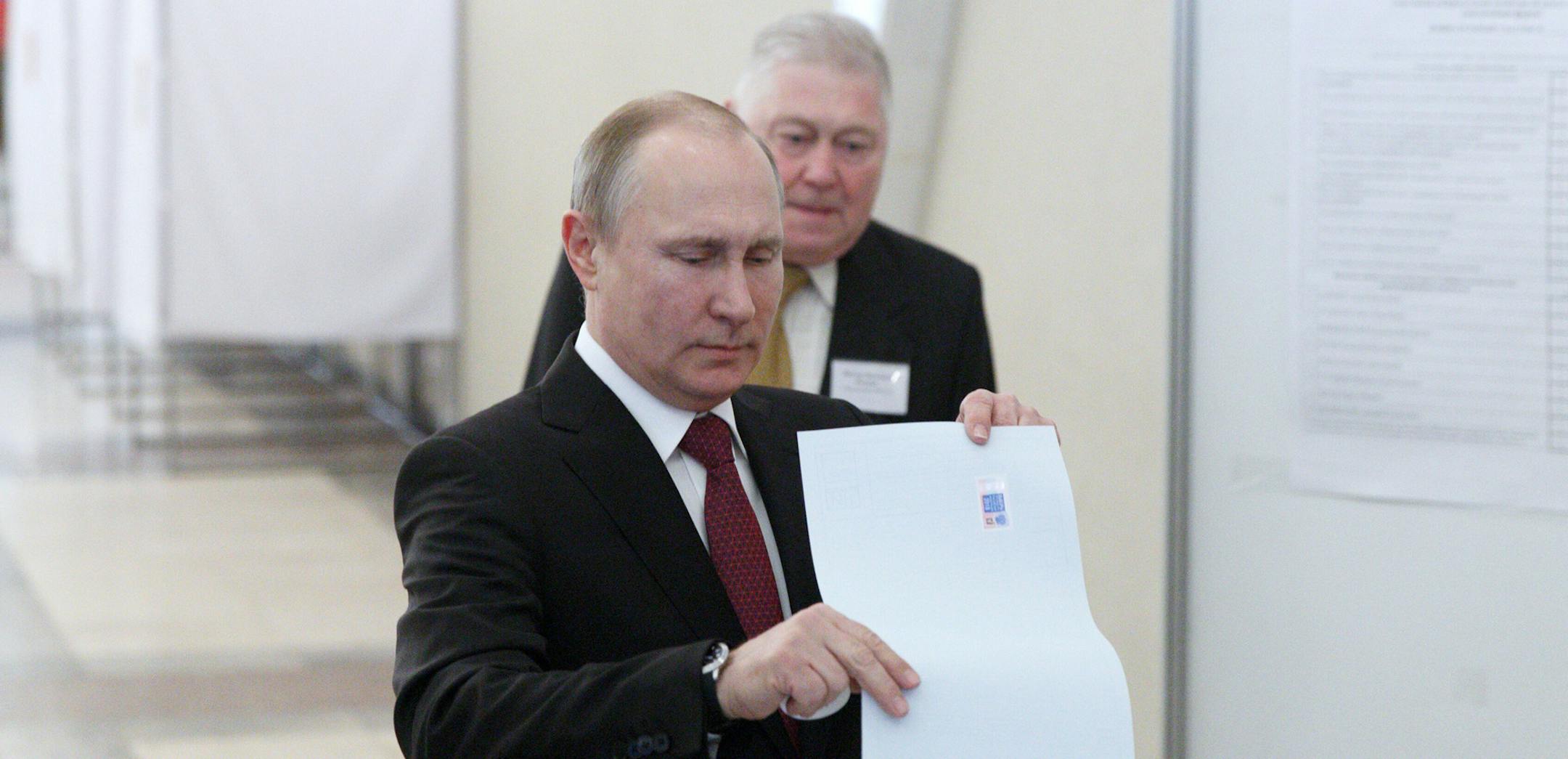
The outcome of Sunday's election in Russia was never in doubt.
The outcome of Russia's ostensible democracy is in flux, however, especially given that the country's constitution states that this should be Russian President Vladimir Putin's last six-year term.
But then again, that document didn't deter the Kremlin from banning the top opposition figure, anti-corruption campaigner Alexei Navalny. Instead, seven obscure opposition candidates gave the presidential plebiscite a respectable veneer without actually providing a legitimate choice.
In fact, the election became a contest to see if Putin would cross the thresholds of vote totals and turnout that could be sold as a mandate. On that account, the vote was a success for Russia's president, who garnered support from more than three-fourths of the 67 percent of Russians who cast ballots.
The election, according to a statement from the Organization for Security and Cooperation in Europe, "took place in an overly controlled legal and political environment marked by continued pressure on critical voices."
Indeed, Putin's popularity is in part due to Kremlin-controlled media that discredits the opposition and pounds Russians with the message that their country is a besieged victim of Western aggression.
Conversely, some of Putin's popularity is due to Russian aggression itself. No doubt voters noticed that the March 18 election came on the four-year anniversary of Russia's annexation of Crimea, a point of pride for Putin that much of the rest of the civilized world considers criminal.
Cleaving Crimea is just one example of Putin's lethal foreign policy. His immoral rescue of the homicidal Assad regime in Syria is another. And just weeks before the election, Putin trumpeted new nuclear weapons that could respark an arms race. On another front, an attack on a former spy in Great Britain created a diplomatic row between London and Moscow.


