Home | Opinion Exchange | Commentary
Hint: It has nothing to do with resignation -- and quite a lot to do with helping leaders stay on the proper path.
The last time I saw my maternal granddaddy alive, he was dragging an old wicker chair down the main street of my hometown, loping behind the back line of the Independence Day parade, carrying a beer.
Granddaddy never stopped drinking that day and, because he was drunk by the time he got home, my grandmother locked the door in anticipation of trouble. She'd long understood something it took me years to realize: However nice a man he was, granddaddy was no leader. Nor was he a good follower. He'd imitate his friends, make them laugh, flatter them -- anything but correct, question or oppose them.
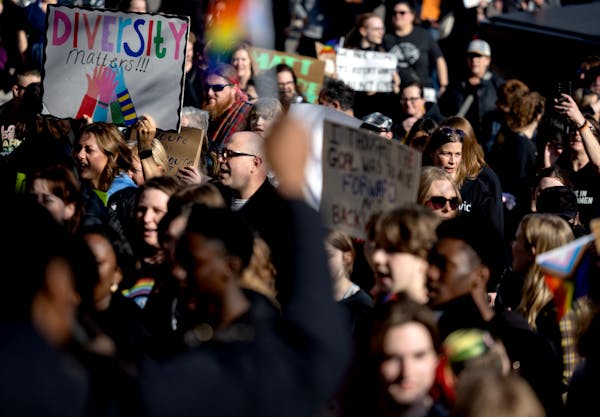
Like most Americans, granddaddy never learned the secret that eludes even Harvard MBAs: that the art of ethical leadership and the art of ethical following are two sides of the same coin. In the public arena, that coin is known as "civic engagement" and is now in sharp decline, thanks in part to the current undue emphasis on leadership theory. Every year, dozens of new books extol the virtues of leadership, while the value of active ethical following recedes into the shadows. Yet, in the most moral and conscientious societies, it is the followers who are responsible for keeping their leaders honest and implementing the real change that must occur if the seeds of progress are to germinate.
The problem is, following isn't considered sexy. After all, who wants to be known as a good follower? Certainly not Americans, who are manifestly excellent at following directions and supporting the status quo. But when it comes to understanding the true art of ethical following -- which involves providing feedback, course corrections and checks and balances on leadership -- Americans are negligent in the extreme. The very word "follower" conjures up a sense of servility and passivity. In the dictionary, among its synonyms are words like "minion" and even "lick spittle."
In the peculiarly competitive environment of the United States, we are fed a steady diet of leadership conceit and told that we live and die on the basis of our leaders. While leadership is certainly important, our historical experience tells us that 90 percent of all participants in social-change movements never become leaders. Turns out, that's a good thing: the real backbreaking work in any organization or movement is done by committed ethical followers, individuals who check their leaders every step of the way and, when necessary, spur them on to new and more creative approaches.
In the American Civil Rights movement, for example, literally thousands of people from all walks of life took courses in nonviolent resistance, which facilitated the rise of Martin Luther King Jr. as a great leader. However, the movement didn't take off until untold numbers of high-school and college students hurled themselves into the teeth of what had become an American form of apartheid, to the initial consternation of King and others.
In our day-to-day experience, we instinctively understand that not every football player can be the quarterback and that basketball teams with dueling point guards seldom become champions. In the team approach to civic engagement, some people naturally will emerge as professional leaders who seek the authority to set the prevailing agenda. But they must never be allowed to do so without accountability. That is what ethical followers do: They refine, complete and even finish leaders, contributing enormously to successful societies and organizations.
Unfortunately, we live in a deeply competitive culture in which we're constantly measuring ourselves against the attributes and achievements of others. Each of us is blindly encouraged to "be the best" in our fields when, in fact, we know that this is impossible: There can only be one who is truly the best. The realistic goal -- what all should strive for -- is to be our best selves in every situation, determined to serve as the captain of our own ship and as navigators for vessels that sail on our behalf.
My granddaddy drank to console his ego, to self-medicate, because he considered himself a failure. This was a tragic perception -- he wasn't a failure, just an extraordinarily sensitive man struggling to raise his family. While sleeping off his drunken binge on the ledge of his brownstone that evening, he fell into the basement stairway, breaking his neck in three places.
A metaphorically similar fate awaits all who fail to learn the art of ethically following our leaders.
Syl Jones, of Minnetonka, is a journalist, playwright and communications consultant.
|
|
Win tickets to The 2008 Twin Cities Promoter's Ball at the historic Zuhrah Shrine Center & Mansion.Vita.mn presents The 2008 Twin Cities Promoter's Ball on Nov. 8 at the historic Zuhrah Shrine Center & Mansion. |
Comment on this story | Read all 0 comments | Hide reader comments