

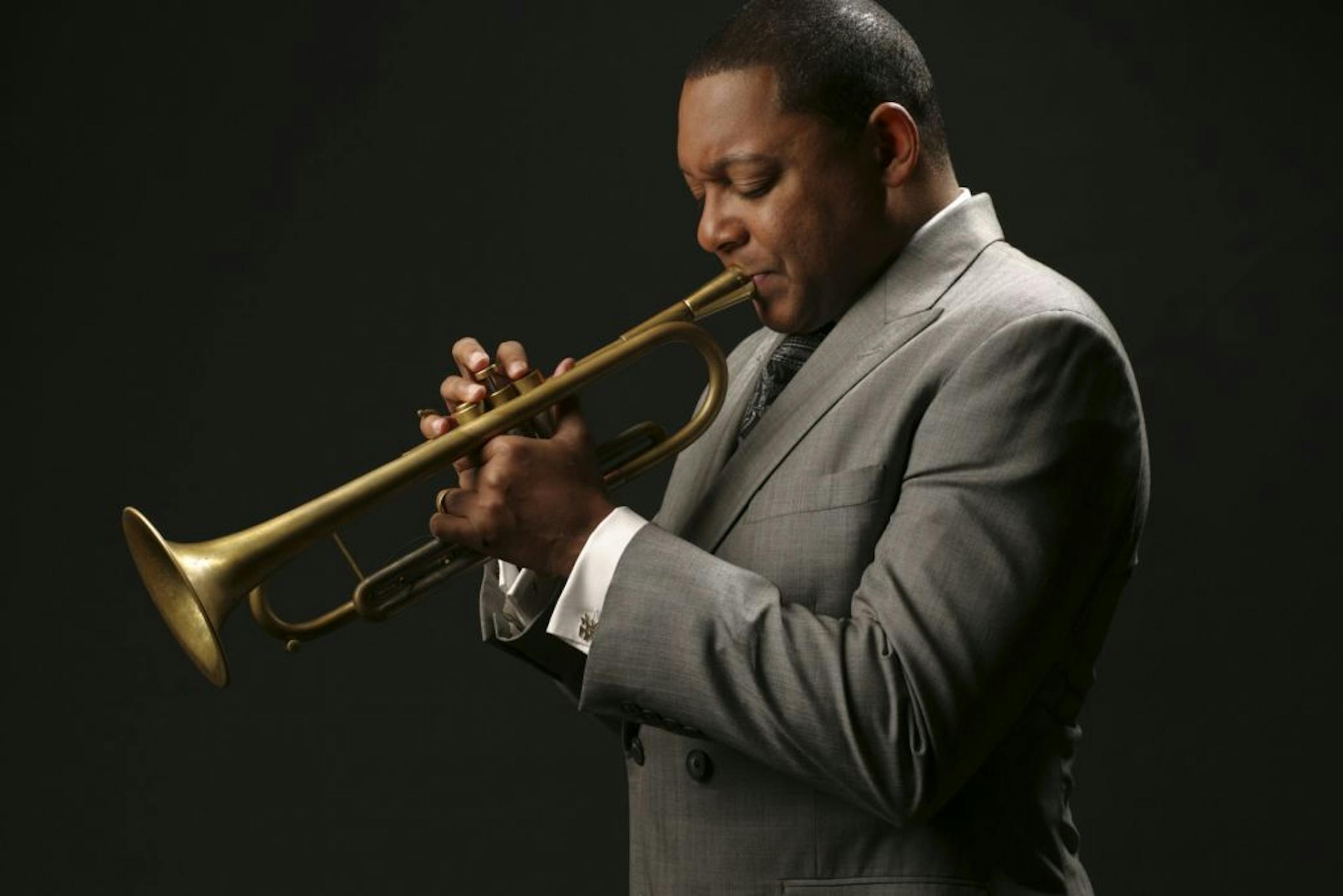
At age 50, Julius Caesar crossed the Rubicon, FDR became president and Irving Berlin wrote "God Bless America." Not quite 50 -- his birthday is Oct. 18 -- trumpeter Wynton Marsalis can look back on a life of accomplishment.
He has won a Pulitzer Prize and nine Grammys, released more than 40 jazz and classical recordings, written many compositions (including symphonies and ballet scores) and five books (most recently "Moving to Higher Ground: How Jazz Can Change Your Life"), and led the creation of Jazz at Lincoln Center, the world's largest not-for-profit arts organization devoted to jazz, with a posh home in New York and a year-round program of more than 450 events.
Artistic director of Jazz at Lincoln Center since 1987, Marsalis is arguably the most famous living jazz musician, sometimes controversial and still baby-faced.
In a phone interview earlier this month, he was invited to reflect on his life and his legacy. But he's all about forward motion. Just back from his first trip to South Africa, he'd been up since 4:30 that morning. He was thinking about a lecture he would soon deliver at Harvard on social dance. He was tweaking his latest compositions, "Blues Symphony" and "Swing Symphony," and getting ready to tour with his Jazz at Lincoln Center Orchestra (JLCO), which comes to Orchestra Hall on Sunday in what's billed as a "50th birthday celebration."
"This is a golden period for the band," Marsalis said. "The concert will be heavily weighted toward music I've written. We'll play a lot of my music, and music by guys in the band [plus] an eclectic mix of stuff I like -- Blue Note, Monk, Ellington."
Marsalis leads the orchestra but plays fourth trumpet, sitting in the back row with the rest of the trumpet section. He tried conducting but other members talked him out of it.
Asked to choose a few of his own recordings that are especially meaningful, he demurred at first. "It's not possible to do that. Like people say about their kids." But he settled on two: "All Rise" (2002) and "The Majesty of the Blues" (1988).
Recorded Sept. 13, 2001, two days after the terrorist attacks, "All Rise" was the "most difficult," he said. "There were no planes, no transportation, no reason not to cancel." Composed for chorus, symphony orchestra and jazz big band, it's a 106-minute monster in 12 movements, a nod to the 12-bar blues.


