

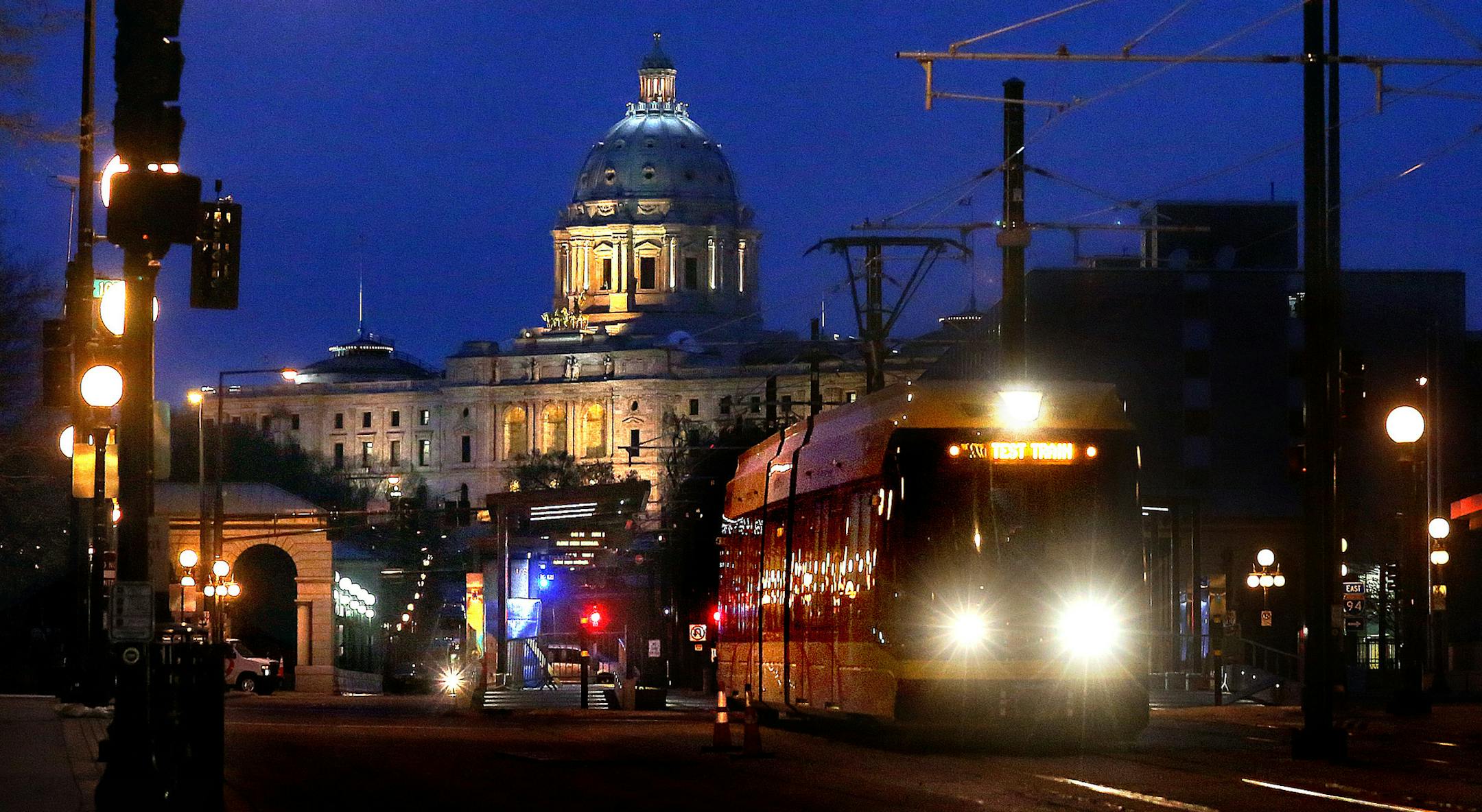
After decades of planning, three years of construction, months of anticipation and some fine-tuning down the final stretch, the largest public works project in state history is just about ready to roll.
Come June 14, when public officials and dignitaries gather at St. Paul's Union Depot to cut the ribbon, the Twin Cities' newest light-rail transit route — the Green Line — will start up for real, connecting the downtowns of St. Paul and Minneapolis in a way that they've not been linked since the days of their old streetcar systems.
"This is about re-Twinning the Twin Cities," said Hennepin County Commissioner Peter McLaughlin, a longtime mass transit advocate. "We are trying to create a transportation system that is going to keep us economically competitive in this century. Connecting these cities is critically important to that."
Even as construction crews and transportation officials juggle last-minute tasks and test runs, the nearly $1 billion development, the most substantial transportation link between the downtowns since the building of I-94, is already making an impact: Officials are crediting the project with spurring $2.5 billion in commercial and housing development along its 11-mile route, with dozens of projects to come.
The Green Line also is expected to create $252 million in payroll by the time it is complete. But its influence extends well beyond buildings or jobs — some say it will transform the way we commute and the character of neighborhoods along the line for generations to come. Officials project that by 2030, annual ridership on the Green Line, which runs primarily along University Avenue, will surpass 10 million, matching the 2013 ridership total on the Blue Line, which runs from the Mall of America in Bloomington to downtown Minneapolis.
"Essentially, the light-rail system is changing the geography of the city. Some places are effectively becoming closer together," said David Lanegran, a geography professor at Macalester College. "And that's a big deal."
Opening Day parties
As opening day nears, construction crews, cops, train operators and transportation officials are busy with final preparations, ironing out the kinks and smoothing surfaces in time for the big rollout.
Despite some unexpected construction issues and downtown-to-downtown test runs of trains that have run slower — 20 minutes longer or more — than projected, transit officials are optimistic.
![A train traveled west along University Avenue along the new Green Line. ] JIM GEHRZ • jgehrz@startribune.com / Minneapolis, MN / May 13 , 2014 / 8:30 PM / BACKGROUND INFORMATION: The newly constructed Metro Transit Green Line is the largest public works project in state history. The line, which begins operation for the public on June 14, connects downtown St. Paul and downtown Minneapolis along an 8-mile light rail line.](https://arc.stimg.co/startribunemedia/KYQIHXVR5QQSPUAYCRJR5LMTFI.jpg?&w=1080)
![A test train returned to St. Paul along Cedar Street after making a trip to Minneapolis along the new Green Line. ] JIM GEHRZ • jgehrz@startribune.com / Minneapolis, MN / May 13 , 2014 / 8:30 PM / BACKGROUND INFORMATION: The newly constructed Metro Transit Green Line is the largest public works project in state history. The line, which begins operation for the public on June 14, connects downtown St. Paul and downtown Minneapolis along an 8-mile light rail line.](https://arc.stimg.co/startribunemedia/SV37XFPKGZQYS6FXEDKDXRFBKE.jpg?&w=1080)
 djoles@startribune Celebrate the opening of Target Field Station -- a bustling urban park, transit station and neighborhood gathering space. This one-of-a-kind destination will connect approximately 500 trains arriving and departing daily via the METRO Blue Line (Hiawath](https://arc.stimg.co/startribunemedia/EB46TG77Y6RUS7XNC5G5KABS4Y.jpg?&w=1080)


