

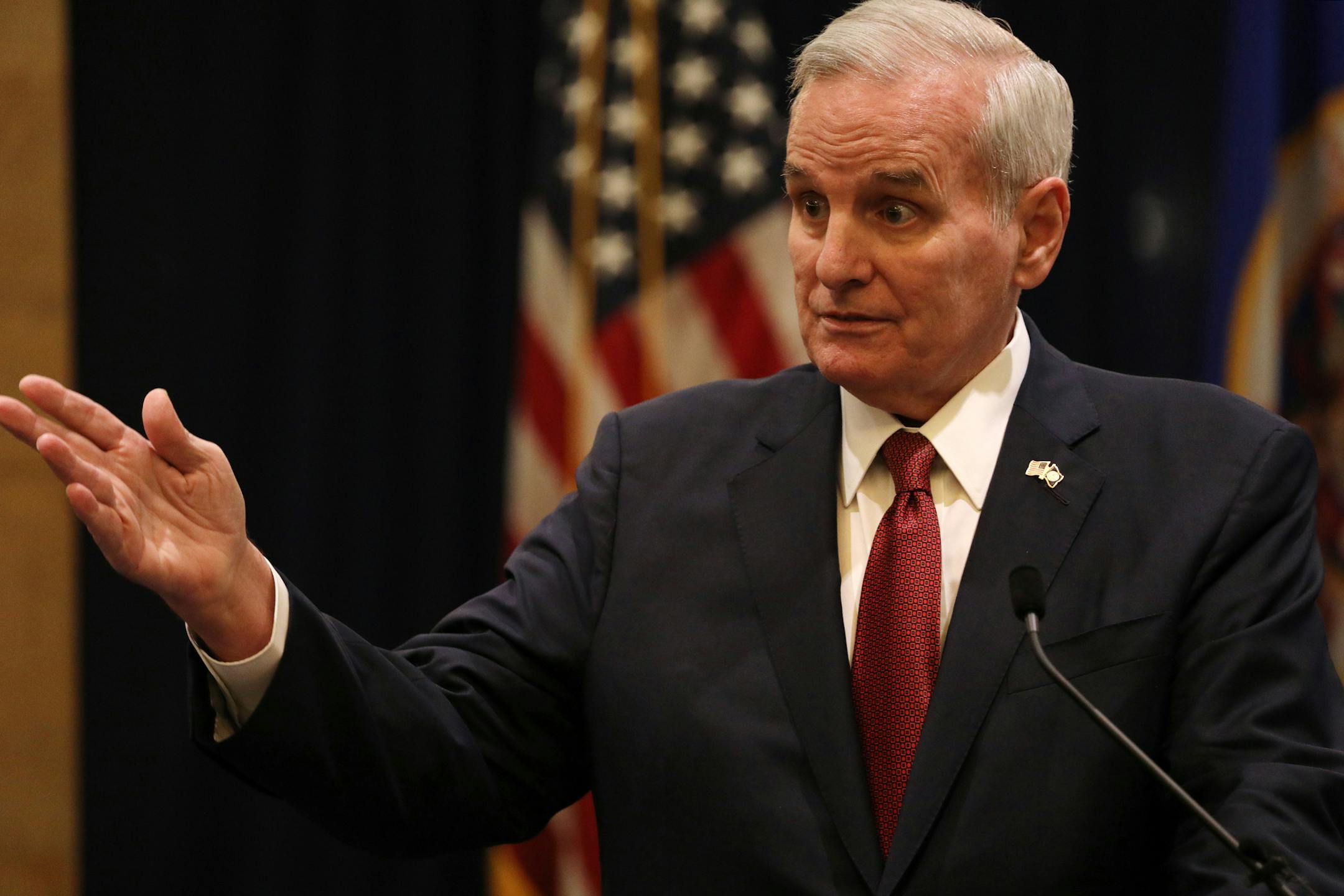
Mark Dayton probably will never land on the cover of Time magazine, in contrast to previous noteworthy Minnesota governors, such as the athletically charismatic Wendell Anderson (in 1973) and the outrageously flamboyant Jesse Ventura (in 1998).
Yet Dayton has been as impactful as either, and for a longer time. He's been near center stage in Minnesota politics and policymaking for almost 40 years. When he finishes his second gubernatorial term next January, he will have served in three statewide offices for a combined 18 years (eight as governor, six in the U.S. Senate, four as state auditor).
But somehow it's a little hard to imagine a statue of Dayton joining those of Hubert H. Humphrey and Floyd B. Olson and other greats on the State Capitol lawn.
Some obvious limitations affect perceptions of Dayton's legacy. His chronic health problems, introversion and awkwardness in public settings, mushmouth speaking style, perennially dysfunctional relations with Republican and sometimes DFL legislative leaders, and a few too many snafus in state government are not the stuff that inspires adulation and sky-high approval ratings. (Dayton currently ranks squarely in the middle, 24th, among America's 50 governors on public approval of his job performance.)
Often dour and brutally hard on himself when he and his administration have fallen short, Dayton strikes many outsiders as a downright oddball. When he first ran for governor in 2010, an otherwise mostly positive profile in the liberal New Republic magazine was headlined: "Eeyore for Governor."
But here's the most important truth about our slightly gloomy chief executive — and the reason the state ought to raise a statue to him someday. No Minnesota political leader in modern times has had more impact advancing the cause of racial and economic equity, and improving our natural environment. Dayton's credo of "A Better Minnesota" has meant reducing overall economic inequality and otherwise improving the lives and potential of people of color, women, the variously disabled and middle- and lower-income folks. And he has used his office persistently to accelerate renewable energy conversion and begin improving air and water quality, in a state actually named for sky and water quality (Minnesota is Dakota for sky-tinted water).
A thunderous ovation from hundreds, mostly Minnesotans of color, greeted Dayton before he spoke on Jan. 15 at a Martin Luther King Day celebration in St. Paul. True to form, Gov. Eeyore rained on his own parade at one point: "There's so much left undone, and, in fact, too much is getting worse, not better," he said.
But there was much head-nodding and many shouts of affirmation as Dayton recited a litany of his efforts to attack disparities and discrimination.


