
States crack down on welfare fraud

Private contractors are making tougher and more frequent eligibility checks.

May 27, 2017 at 9:25PM
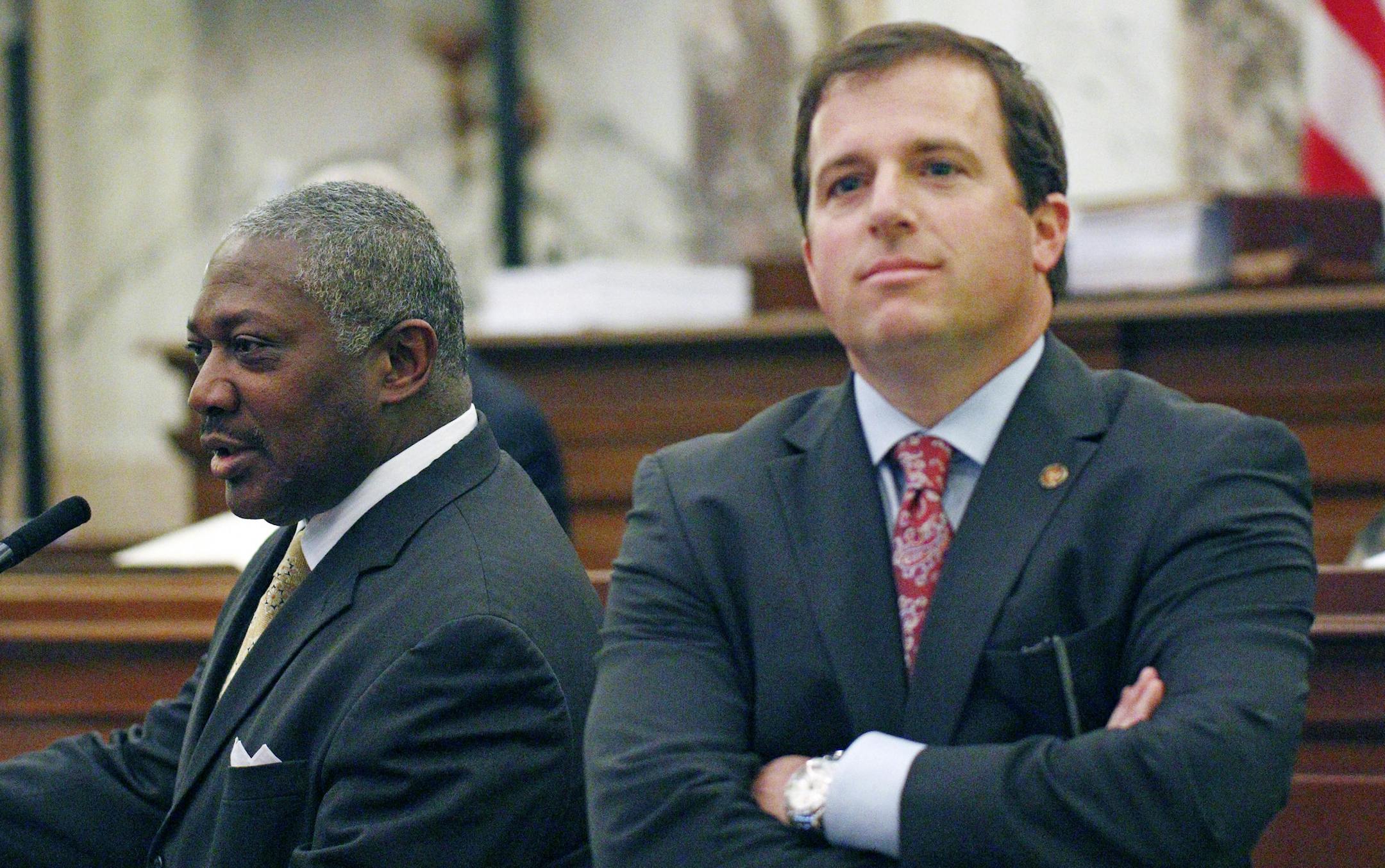
Sen. Josh Harkins, R-Flowood, right, reacts as Sen. John Horhn, D-Jackson, left, purposes amendments that would affect Harkins' proposed legislation that would shift control of the Jackson-Medgar Wiley Evers International Airport to state officials and surrounding counties, Thursday, March 3, 2016 in Senate chambers at the Capitol in Jackson, Miss. The bill, which was approved on a 29-18 vote, would replace the five-member Jackson Municipal Airport Authority with a nine-member Jackson Metropolit
Mississippi Sen. Josh Harkins, right, was the sponsor of a new state law cracking down on welfare recipients in the state. (The Minnesota Star Tribune)

WASHINGTON – By the time Illinois decided to crack down on Medicaid fraud in 2012, state officials knew that many people enrolled in the program probably weren't eligible. For years, caseworkers hadn't had the time or resources to check.

To catch up, the state hired a private contractor to identify people who might not be eligible for the low-income health program and to make recommendations for whose benefits should be canceled. Within about a year, Illinois had canceled benefits for nearly 150,000 people whose eligibility could not be verified — and saved about $70 million.

Now, faced with growing Medicaid enrollment and tight budgets, Republican lawmakers in several other states are taking similar steps to ensure that people receiving welfare benefits are eligible for them. Under their proposals, which are modeled on legislation drafted by a national conservative group, recipients would face tougher and more frequent eligibility checks. And the checks could be conducted by private contractors who are motivated to justify their hiring by knocking as many people as possible off the rolls.

Mississippi enacted a law in April that will require the state to hire a private contractor to create a new computer system to review and more frequently check the eligibility of people participating in Medicaid and the federal food stamps program, formally called the Supplemental Nutrition Assistance Program. Similar bills are being considered in Oklahoma and Ohio, and Missouri and Wyoming enacted similar laws last year.

Supporters say the measures will root out fraud in the welfare system. Fraud, overpayments and underpayments in all assistance programs cost federal and state governments about $136.7 billion in 2015, out of about $2.8 trillion spent in assistance overall.

In Mississippi, people "are intentionally scamming the system," said state Sen. Josh Harkins, a Republican who supported the new law there. "This is to make sure we aren't just carelessly spending state tax dollars."

But Democratic policy analysts and advocates for people on welfare say that while it's important to try to reduce fraud, the proposals go about it the wrong way. Roy Mitchell, executive director of the Mississippi Health Advocacy Program, says the bills are meant to sweep even eligible families off the system. "You basically put a bounty on Medicaid recipients," Mitchell said.

The most concerning part of the new Mississippi law and the other proposals, Mitchell and others say, is that they give people who receive benefits as little as 10 days to respond when they're asked for more information to prove their eligibility. If they don't reply or can't provide the information, their benefits are canceled.

Welfare recipients move often, and many will miss the request, Mitchell said. People will be forced off the system, he said, just to re-enroll shortly after — a phenomenon referred to as "churn."

Illinois saw savings when it first stepped up eligibility checks. But about 20 percent of those who were kicked off the rolls soon re-enrolled, according to state data. Most simply fail at first to respond to the request for information.

The recent proposals follow model legislation drafted by the Foundation for Government Accountability, a Florida-based nonprofit that favors free market principles. The point, said Jonathan Ingram, the foundation's vice president of research, is to preserve finite government resources.

Many states, such as Oregon, are facing a backlog in verifying the eligibility of people enrolled in welfare programs. In a survey last year, officials from six states told the Kaiser Family Foundation that they were facing delays in confirming eligibility for Medicaid recipients, due mostly to challenges with their computer systems or staff capacity.

Federal law generally requires eligibility checks once a year for Medicaid recipients and every six months for SNAP recipients, although that varies based on age, disability status and other factors. Generally, recipients must prove they make under a certain amount of money, are U.S. citizens and are residents of the state.

Mitchell said the bills wrongly target the needy when they should target health care providers who commit fraud.

about the writer

about the writer

Jen Fifield, Stateline.org

More from No Section

See More
FILE -- A rent deposit slot at an apartment complex in Tucker, Ga., on July 21, 2020. As an eviction crisis has seemed increasingly likely this summer, everyone in the housing market has made the same plea to Washington: Send money — lots of it — that would keep renters in their homes and landlords afloat. (Melissa Golden/The New York Times) ORG XMIT: XNYT58
Melissa Golden/The New York Times

It’s too soon to tell how much the immigration crackdown is to blame.