

Ryder Cup demand and prices push back 2016 marathon weekend

November 14, 2015 at 4:44AM
Chad Millner of Eden Prairie received encouragement from a race official just shy of the finish line Sunday morning.
Chad Millner of Eden Prairie received encouragement from a race official just shy of the finish line Sunday morning. (Star Tribune/The Minnesota Star Tribune)

It is an annual ritual for thousands of runners from Minnesota and beyond: Train hard. Double-knot those shoes. Show up on the first Sunday in October ready to run 10 or even 26.2 miles. But not next Oct. 2.

Next year, that weekend will be occupied by the 2016 Ryder Cup, which is being held at Hazeltine National Golf Club in Chaska. To make way for the crush of golf fans, the nine running races that make up Twin Cities Marathon weekend are bumping back a week to Oct. 8 and 9.

The decision will save race participants — almost 26,000 this year on race Sunday alone — money and time trying to find already-scarce hotel rooms during the Ryder Cup, said Virginia Brophy Achman, executive director of Twin Cities in Motion, which oversees the race weekend events.

She said she's heard of Ryder-boosted hotel rates as high as $400 a night at Intercontinental St. Paul Riverfront, which has served as race headquarters in recent years. The authorized Ryder tour operator bought up most rooms months ago at the Intercontinental and other St. Paul hotels, according to Kimberly Osterhout, the hotel's sales director.

"We can't expect our runners to pay that much," Achman said.

But the switch also puts the marathon in direct conflict with the Chicago Marathon, a popular destination race for many Minnesota runners. That race attracts several hundred more Minnesota runners than the Twin Cities race attracts from Illinois.

Achman said the Twin Cities-Chicago conflict happens about once every seven years when the calendar puts the two races on the same date. Chicago usually is at least a week later, but it has varied between Sept. 24 and Oct. 31, a date when runners have endured snow.

The tradition of an October marathon in the Twin Cities dates to predecessor races as far back as 1963. There have been only four exceptions to that rule: Twice the race happened on Sept. 30 and twice, years ago, the runners lined up in May.
In 2002, the marathon moved the races ahead to Sept. 30 because of a large law enforcement conference. Marathon officials changed the date to ensure they had enough law enforcement personnel on the course.

Meanwhile, the U.S.-European golf tournament expects attendance of more than 250,000 for the six days of practice and competition rounds, according to Jeff Hintz, Ryder Cup director for the Professional Golfers Association of America, which runs the event.

Seventy-five percent of those seeking tickets are from outside the state, Hintz said, which means huge demand for the area's 39,000 hotel rooms.

The Ryder Cup is later than normal next year because of the addition of golf to the Olympics.

Achman said the decision to delay a week was made last summer when the hotel situation became evident. The marathon began publicizing its 2016 date in September and included it in this year's race materials.

The delay does have one silver lining for runners — an added week of cool weather, ideal for training.

Steve Brandt • 612-673-4438

Twitter: @brandtstrib

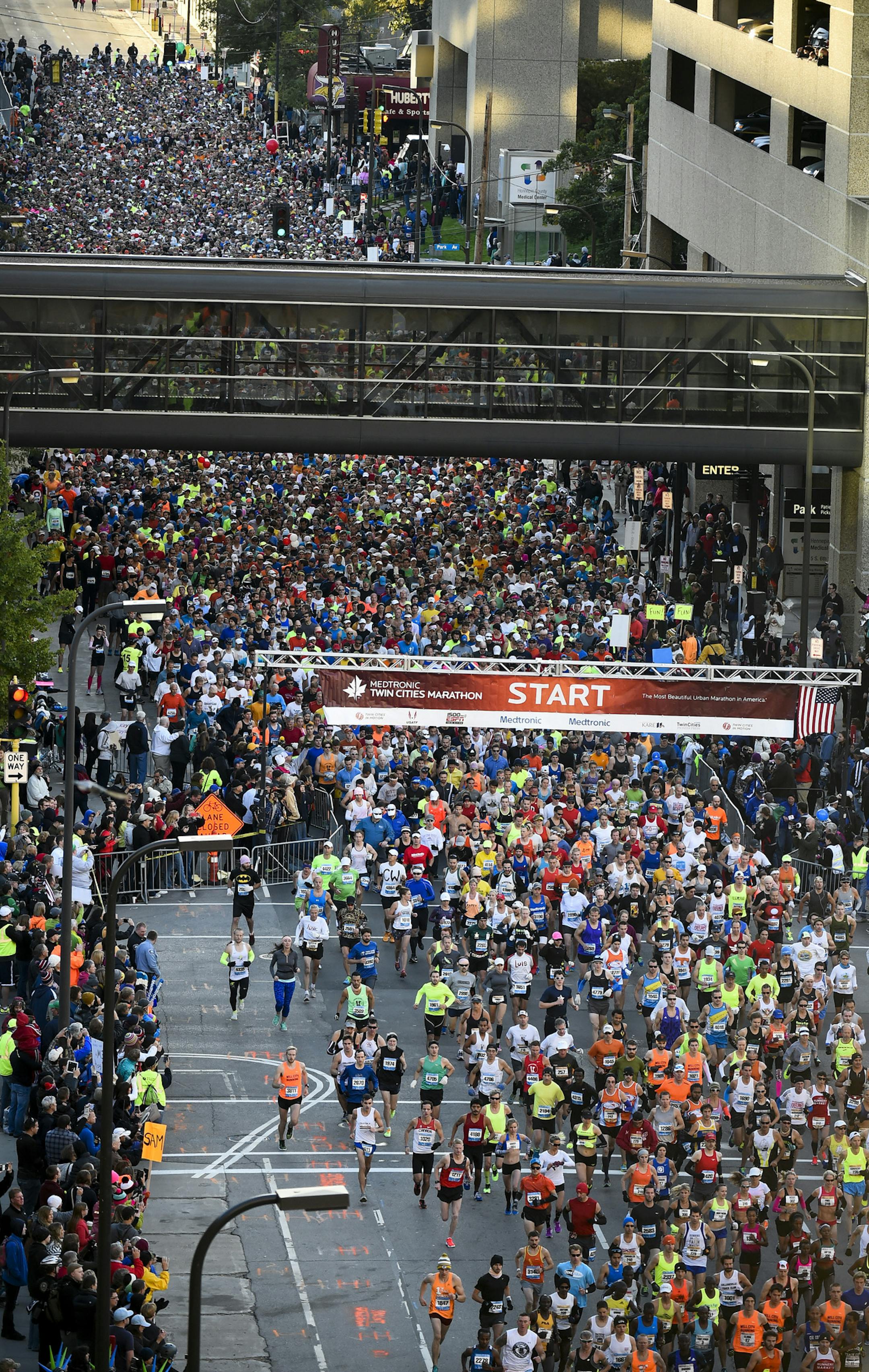
Runners head out at the start of the Twin Cities Marathon, Sunday, Oct. 4, 2015, in Minneapolis. (AP Photo/Craig Lassig)
Runners head out at the start of the Twin Cities Marathon, Sunday, Oct. 4, 2015, in Minneapolis. (AP Photo/Craig Lassig) (The Minnesota Star Tribune)
Runners, including Andrea Arrell of Minneapolis, wearing bib 1289, approached the finish line Sunday morning. ] JEFF WHEELER • jeff.wheeler@startribune.com More than 11,000 runners started the Twin Cities Marathon Sunday morning, October 4, 2015 in Minneapolis.
With golf’s Ryder Cup in town next year, Twin Cities Marathon weekend will bump to Oct. 8-9. (The Minnesota Star Tribune)
about the writer

about the writer

Steve Brandt, Star Tribune

More from No Section

See More
FILE -- A rent deposit slot at an apartment complex in Tucker, Ga., on July 21, 2020. As an eviction crisis has seemed increasingly likely this summer, everyone in the housing market has made the same plea to Washington: Send money — lots of it — that would keep renters in their homes and landlords afloat. (Melissa Golden/The New York Times) ORG XMIT: XNYT58
Melissa Golden/The New York Times

It’s too soon to tell how much the immigration crackdown is to blame.