

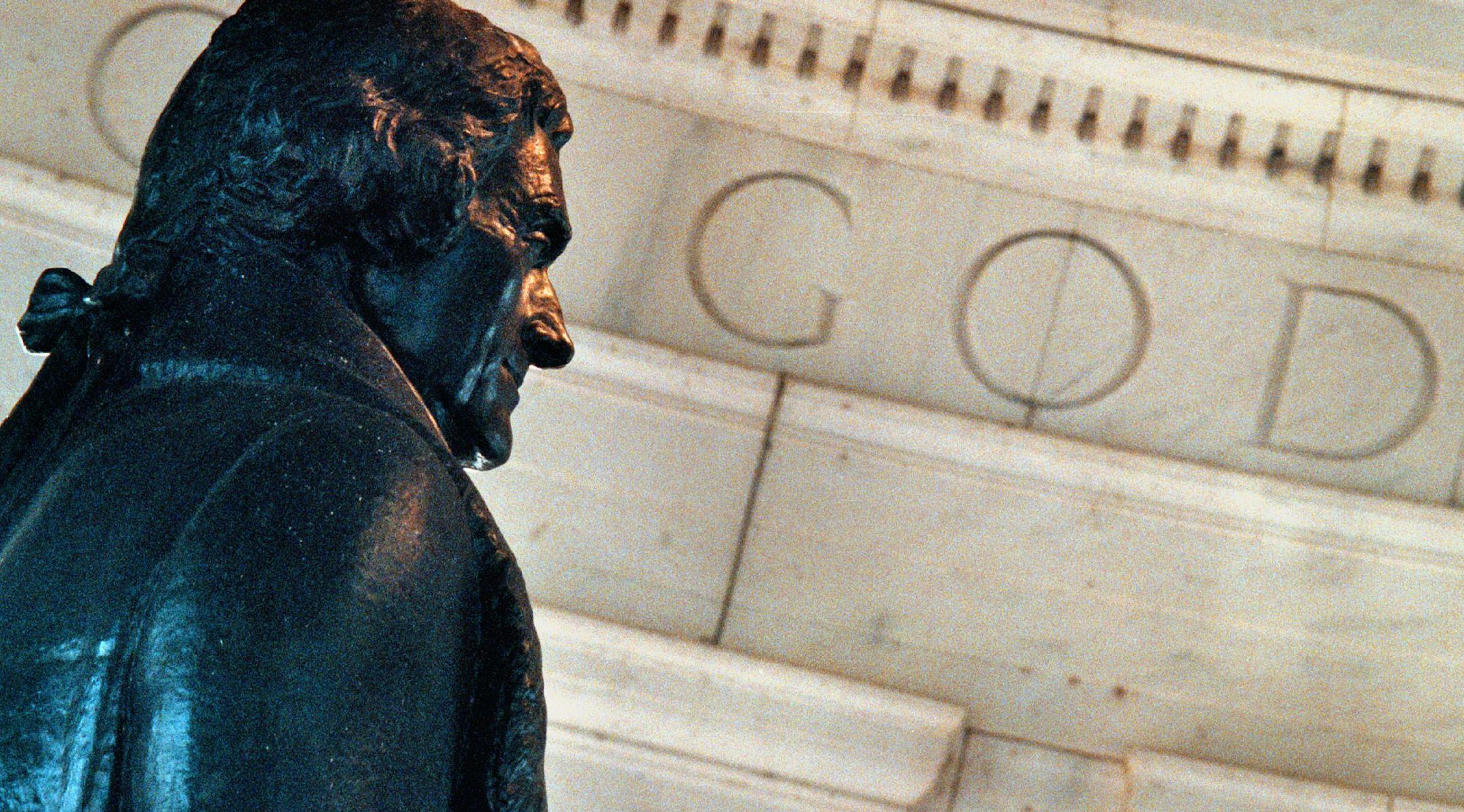
Thomas Jefferson's 1814 response to a sea captain and convert to Christianity, who wrote to him urging for his conversion, too ("Thomas Jefferson makes case for reason, morality," July 4), calls my attention to contemporary issues confronting our interreligious life together in modern times.
Jefferson rightly reminds his pious minister, and us today, that religious differences must be held with charity toward those whose visions of human destiny radically differ. In his day, difference was primarily between the Christian denominations; in ours it is much more complex — Buddhists, Hindus, secularists, Christians, Muslims, Jews. Jefferson wisely counsels the minister and us to act "honestly towards all, benevolently to those who fall within our way, respecting sacredly their rights bodily and mental, and cherishing especially their freedom of conscience, as we value our own."
But Jefferson's reason for this is itself a religious view based on a forgivable but irrational conclusion. "Let us not be uneasy," he says, because in heaven "by these different paths we shall all meet in the end."
It is historically forgivable because Jefferson, being the prodigious mind that he was, could not have asserted this if he were aware of the radical differences between world religious visions, which only began to be known in the Euro-American setting after 1850 but are on full display before us now.
It is nonetheless irrational in view of today's more fulsome knowledge of religious pluralism. The religions have contrasting and even conflicting visions of what is the true and ultimate destiny of humankind. To state we shall "all meet in the end" unifies all religious aims and unintentionally functions to coerce the believers of the individual religions to attain an end they may not believe or teach by a means they do not practice or accept.
James F. Lewis, Roseville
MEDICARE FOR ALL
Free care won't cure our bad habits
Rapidly becoming the topic of the day, Medicare for All is seen by many as the bromide to cure the nation's health care ills. Proponents believe that if we all have access to medical care, treatments, drugs and therapies, everyone will be healthier and costs will be significantly lower. Medicare for All will not, however, bring an end to many root causes of where we are with health care today.
It's no secret that a significant number of us are choosing a sedentary lifestyle staring at our phones, bingeing on Netflix and reality shows, scarfing down jumbo cheeseburgers and fries, large supreme pizzas, washing it all down with sugar-laden colas and beer. These are, after all, some of the primary causes of obesity, heart disease, diabetes, high blood pressure, lung cancer, bone and muscle deterioration and more. It's also said that physicians complain about patients who don't follow orders, fail to take medicines they need while insisting they need drugs they have seen advertised on television. When we have a medical problem, we run to our doctors to get an immediate cure. That's why most health care insurance companies provide program services to promote a healthier lifestyle. Fortunately, there is a trend toward a healthier diet and regular exercise, but the incidence of poor choices and noncompliance remains too high. Stemming the tide of these factors is what will bring costs down.
We already have the best health care technology in the world, an abundance of medical devices and diagnostic tools, more cutting-edge medical providers than anyone else and excellent medical education and research institutions. That patients, physicians and researchers from the world over come to the Mayo Clinic, Johns Hopkins, Stanford University, Harvard and Yale, Cedars-Sinai, New York Presbyterian, MD Anderson Cancer Center, Memorial Sloan Kettering Hospital and others for medical treatment and education gives testimony to health care excellence in America. Rather than improve these resources, Medicare for All just may lead to the opposite.


