

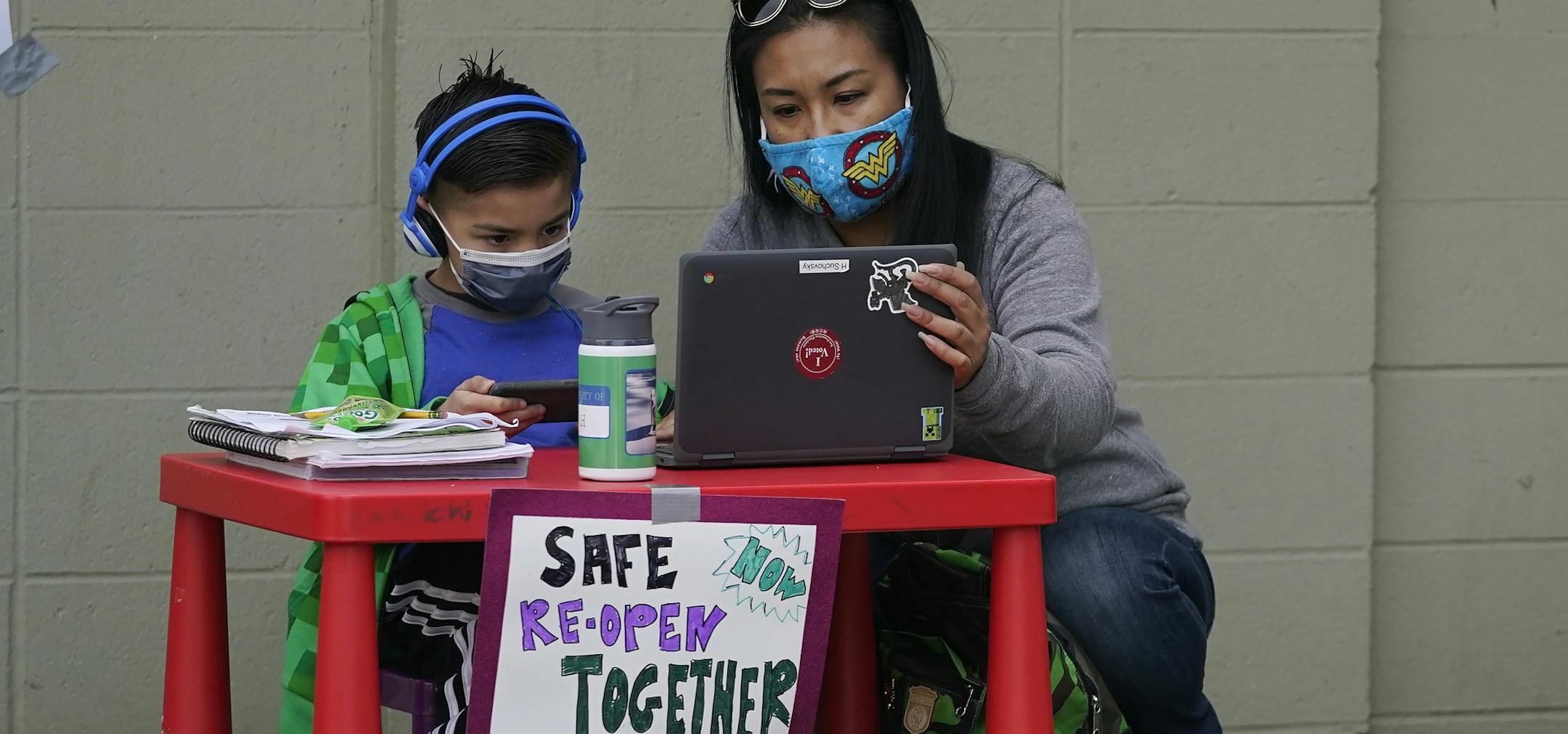
Last week's article about making online learning a more substantial part of post-pandemic schooling raises some familiar questions about what education is ("Online learning may outlast pandemic," front page, Feb. 17). Is there a significant difference between online social interaction and face-to-face interaction? As long as the student learns to do quadratic equations and write an essay on Sojourner Truth, does it matter how she has learned these things? If her SAT/ACT scores are high, hasn't she received a good education? Or is there more?
As technology edges toward the center of our lives, the question has gained a new relevance. Most would agree that there is a vital social dimension of education. One important thing we begin to learn in school is how imperfect and needy we humans can be. Good teachers help us learn to address our own needs and those of others. Many fortunate children have the opportunity to encounter human differences in their classroom — differences in religion, cultural background, skin tone and economic status. It is hard to believe that the understandings gained in such a classroom could be achieved in an online unit on diversity.
As we move into an increasingly mediated way of living, we might argue that the time kids spend with electronic devices is the critical education they need for survival and flourishing. If success in adult life means sitting at a console pressing keys to manipulate information on a screen, then the more online schooling the better, I suppose. Maybe in this new world the human differences encountered in classrooms will fade into the distance and disappear. (I doubt it and I shudder to think what this might mean.)
I believe that cautious monitoring of where we are and where technology is taking us is critical and can only be done by people, including children, who have their feet firmly grounded in the unmediated world.
Stephen Parker, Minneapolis
• • •
In a time when many have been promoting the necessity of in-person learning for all school students, I am surprised that Sen. John Jasinski, R-Faribault, would be proposing that the state approve online driver education courses that can be taken "at any time, day or night, without an instructor present," quoting the article. ("Bill would allow online driver's ed," Feb. 16.) If distance learning has truly been failing our students, why would he suggest that an effective, in-person, teacher-lead driver-training curriculum be replaced with virtual teleconferences?
Engaging students in a classroom setting can be challenging. This proposal would allow students to log on to a virtual presentation, potentially without accountability for participating or even remaining in front of the screen. Just because technology makes it possible to do this doesn't mean it's a good idea.
Mickey Bluedorn, Fridley
The writer is a driver's education instructor.
AMERICAN SOCIETY
Churchgoing is no automatic fix
In response to Keith C. Burris' article in Opinion Exchange ("What America needs is a moral awakening," Feb. 22), I would like to say first and foremost that I agree that with most of what he said and in particular his desire to find political middle ground. There is only one thing I take issue with, which is the statement that Americans need to go back to church to rediscover their morality. As someone who was raised in a Christian household but no longer considers themselves religious, this is a sentiment that I have experienced firsthand. Morality does not necessarily stem from religion, as so many seem to assume. Rather, I believe it comes from the most humanistic aspects of our nature.


