

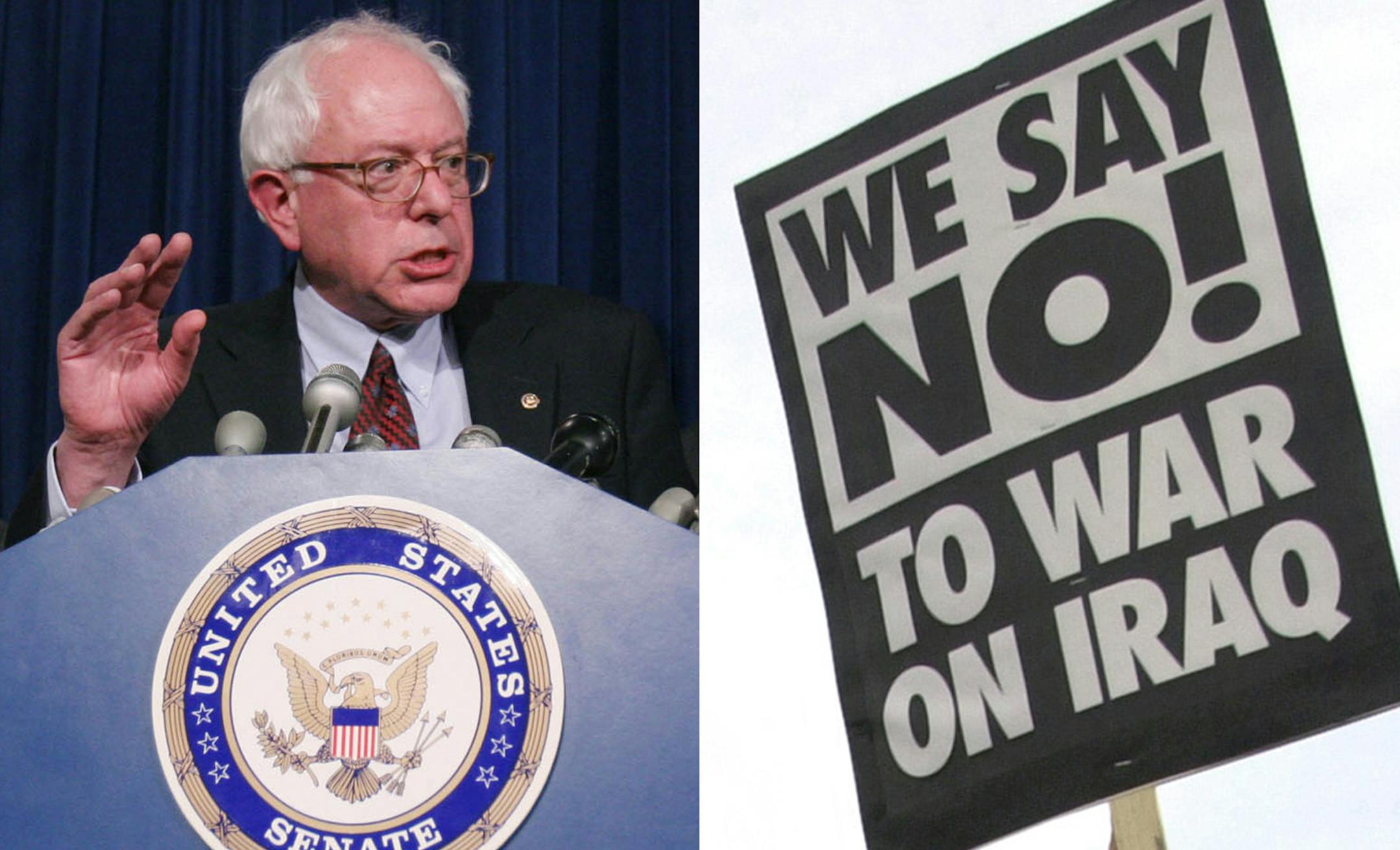
As an American, I posted a "No War With Iraq" sign in my yard and attended rallies and vigils against the Iraq war. As a woman, I am well aware of gender bias in the U.S. workplace and women being held to different standards than men. Not surprisingly, I am having mixed reactions to Bernie Sanders' statement that Hillary Clinton is not qualified to be president because of her vote for the Iraq war. Joe Biden voted for the war. He is a heartbeat away from the presidency, and yet I have not heard Sanders object to his holding this position. John Edwards also voted for the war, and I certainly don't remember Sanders arguing that this vote should have disqualified him when Edwards ran for president. Current Secretary of State John Kerry also voted for the war. Again, I don't think Sanders raised this concern during Kerry's presidential race. Surely, if Sanders believes a vote for the Iraq war means an individual is not competent to be president, it should mean an individual is not competent to be secretary of state. Mr. Sanders, if you are going to apply this metric to a woman, apply it to your male colleagues as well.
Julie Risser, Edina
VETERANS
Female roles are growing, and appropriate support is needed
The female veteran population is expected to increase in the next 10 years, with many types of combat positions opening that were not previously offered to females in the military. Female vets are the quickest-growing homeless population, and many times they become homeless with their children (Women Veterans Health Care, 2012). Female veterans are also more likely to receive food support for their family than are their male counterparts (National Center for Veteran Analysis and Statistics, 2015). Female veterans are at a higher risk for attempting or completing suicide, and they have different risk factors than their male colleagues. Some of these risk factors include difficulty with deployment, specifically due to leaving children during developmental stages and milestones (Burkhart, L., Hogan, N., 2014).
The Department of Veterans Affairs has been under scrutiny for its health care lately, and a federal bill proposes to evaluate the effectiveness of suicide-prevention programs (HR 2915), specifically for female veterans. U.S. code 1709B states that mental-health programs need to be evaluated by a third-party evaluator each fiscal year. If we are able to evaluate the effectiveness of programming and satisfaction of the recipients, we may be able to reduce the 22 veteran lives per day that are lost to suicide and recognize that programming may not be effective for every veteran.
Krystle Englund, Minneapolis
'TOO BIG TO FAIL'
Federal Reserve's Kashkari admirably takes on excess
Neel Kashkari, chairman of the Federal Reserve Bank of Minneapolis, has the knowledge and courage to confront the issue that our banks are "too big to fail" ("Mpls. forum takes aim at too-big-to-fail," April 5). As an American, I am encouraged that an official at this level is willing to grapple with this elusive "elephant in the nation." I also fear that these efforts will be undermined by the self-serving banks that are larger now than during the 2008-09 meltdown. Former Minnesota Gov. Tim Pawlenty, now head of Financial Services Roundtable (FSR), an advocacy organization for the financial-services industry, carries the banks' self-preservation message ("Big banks light into any talk of breakup," April 6). I hope Americans will support Chairman Kashkari in his attempt to reduce the risk of future bank collapse.
Hilary M. Beste, Minneapolis
TERMINOLOGY
To dismiss the phrase 'illegal aliens' offends me. Here's why.
Regarding the April 4 article "Library of Congress excises the term 'illegal aliens' ": My family, together with thousands of World War II refugees from Europe, immigrated legally to America in the 1950s, after spending four years in Displaced Persons camps where we were thoroughly screened for any connections to communism or national socialism. We also had to have a sponsor, usually a farmer. After five years in the U.S. as legal aliens, most of us obtained U.S. citizenship according to established U.S. rules. Some chose not to obtain U.S. citizenship and remained as aliens but received most benefits, such as education, employment, health care and Social Security, and some served in the Armed Forces.
The dictionary-opposite of "legal" is "illegal." An alien who is not legal is an "illegal alien." We should not allow illegal aliens to determine our American vocabulary. If a person is offended by being called an illegal alien, that person should take steps to become legal.
I was once an alien. I am offended by the term "noncitizen" in lieu of the shorter and accepted term "alien."
Girts Jatnieks, Minneapolis
THE 2016 CAMPAIGN
Cruz offers a clear and honest agenda — if we'll have it
Ted Cruz has two big hurdles to overcome in his quest for the Republican nomination. First, he wants to follow the Constitution as it is written and as the words were understood at the time. Similar to the late Supreme Court justice Antonin Scalia's inclination. Second, he fulfills his promises to the voters — he does what he says he will do. These are two things that voters are not accustomed to seeing in their politicians.


