

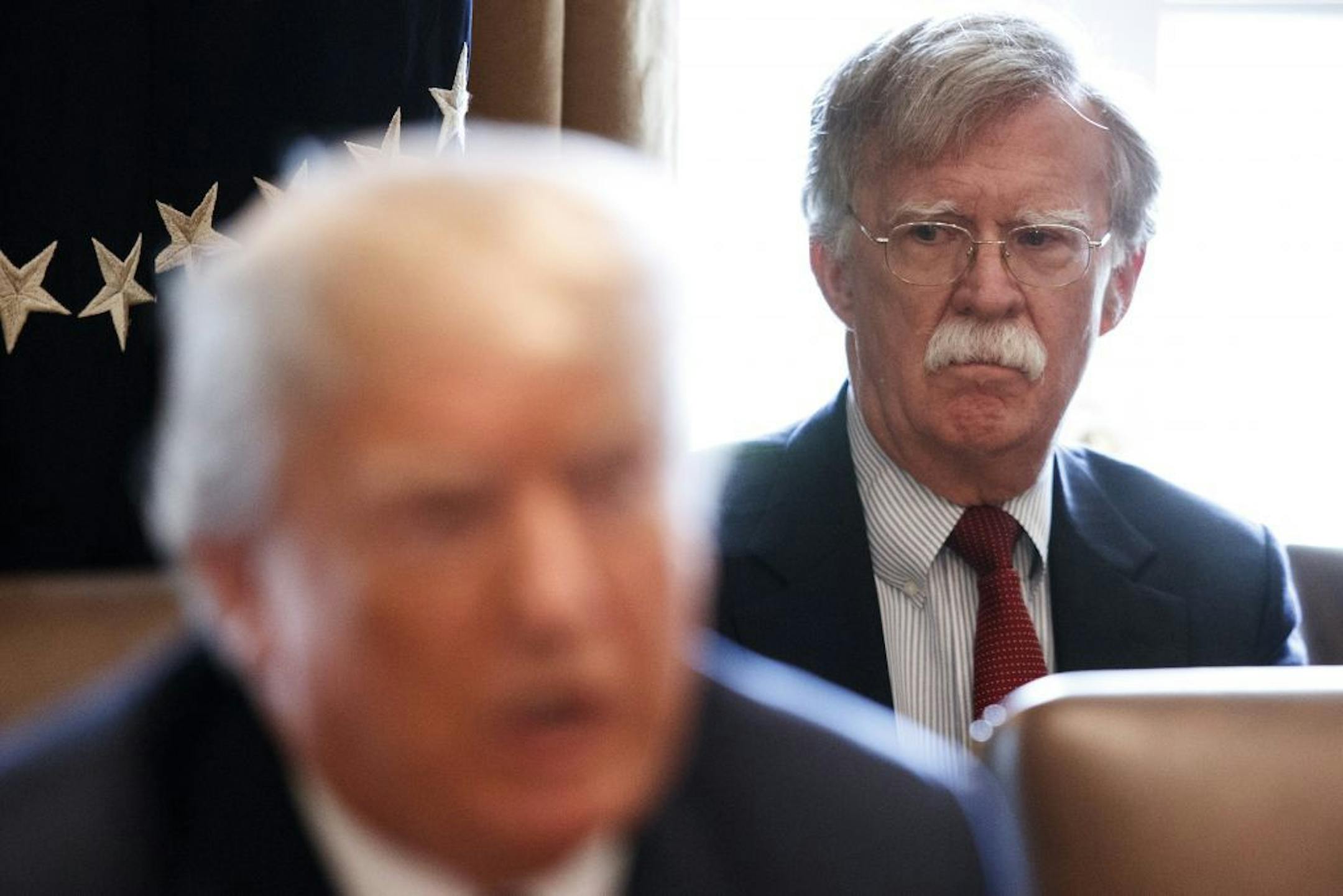
John Bolton is not well-liked in Washington. A warmonger and bully, the national-security adviser is disdainful of the bipartisan foreign-policy world and the governing institutions its members cycle in and out of. That he oversees one of them is typical of the plate-smashing Trump administration.
Few doubt, however, that Bolton is a wily operator. As President Donald Trump's third national-security adviser — and the first with previous experience of civilian bureaucracy — he already has demonstrated his mastery of the inter-agency policy process. His role in derailing, at least temporarily, Trump's planned meeting with Korean dictator Kim Jong Un in Singapore therefore demands scrutiny.
Bolton suggested that the "Libya model" was what America wanted from North Korea. That was not illogical: Trump had demanded that Kim take the same step as Libyan dictator Muammar Qaddafi in 2003, carrying out denuclearization in return for sanctions relief.
Nonetheless, the fact that Qaddafi later was bombed from power by a NATO intervention, dragged from his hiding place by insurgents, sodomized with a bayonet and shot dead, made Bolton's choice of precedent complicated. The Libya model is what Kim fears most. It is prime evidence for the theory that has underpinned his regime's nuclear program, to the North Korean people's cost, for five decades: Possession of nuclear weapons equals regime survival, so disarmament equals regime endangerment.
The North Korean smackdown to Bolton ("We do not hide our feelings of repugnance toward him") was predictable. Then, however, Trump blundered in. Wrongly assuming that Bolton had referred to the American-led bombing of Libya, not to the disarmament that preceded it, he said it didn't sound like what he had in mind for Kim. But then he added that, yes, now you come to mention it, if the North Korean despot wouldn't make a deal in Singapore, his regime would "most likely" have to be "decimated." When Vice President Mike Pence parroted that threat, the North Koreans called him "ignorant and stupid" and threatened a nuclear war.
Bolton went to see Trump about that. The president called off the summit soon after. Bolton, who doubts it is worth negotiating with Kim and long has advocated toppling his regime, may not be displeased with that outcome.
At the least, he clearly intended to add a harder edge to Trump's newfound enthusiasm for the "honorable" Kim. In the absence of many other moderating influences on Trump, whose confidence in his ability to direct global affairs appears to be growing by the day, this suggests that Bolton could play a more positive role than his many critics have countenanced.
They fear he may lead Trump into a catastrophic conflict, which is a valid concern. Yet it seems likelier that Bolton's skepticism about diplomacy, his apparent good standing with the president and his willingness to speak truth to power could mitigate a more pressing risk: that the president will expend a rare moment of American leverage with Kim on a hasty, ill-considered deal that could leave eastern Asia even more insecure than it is now.


