

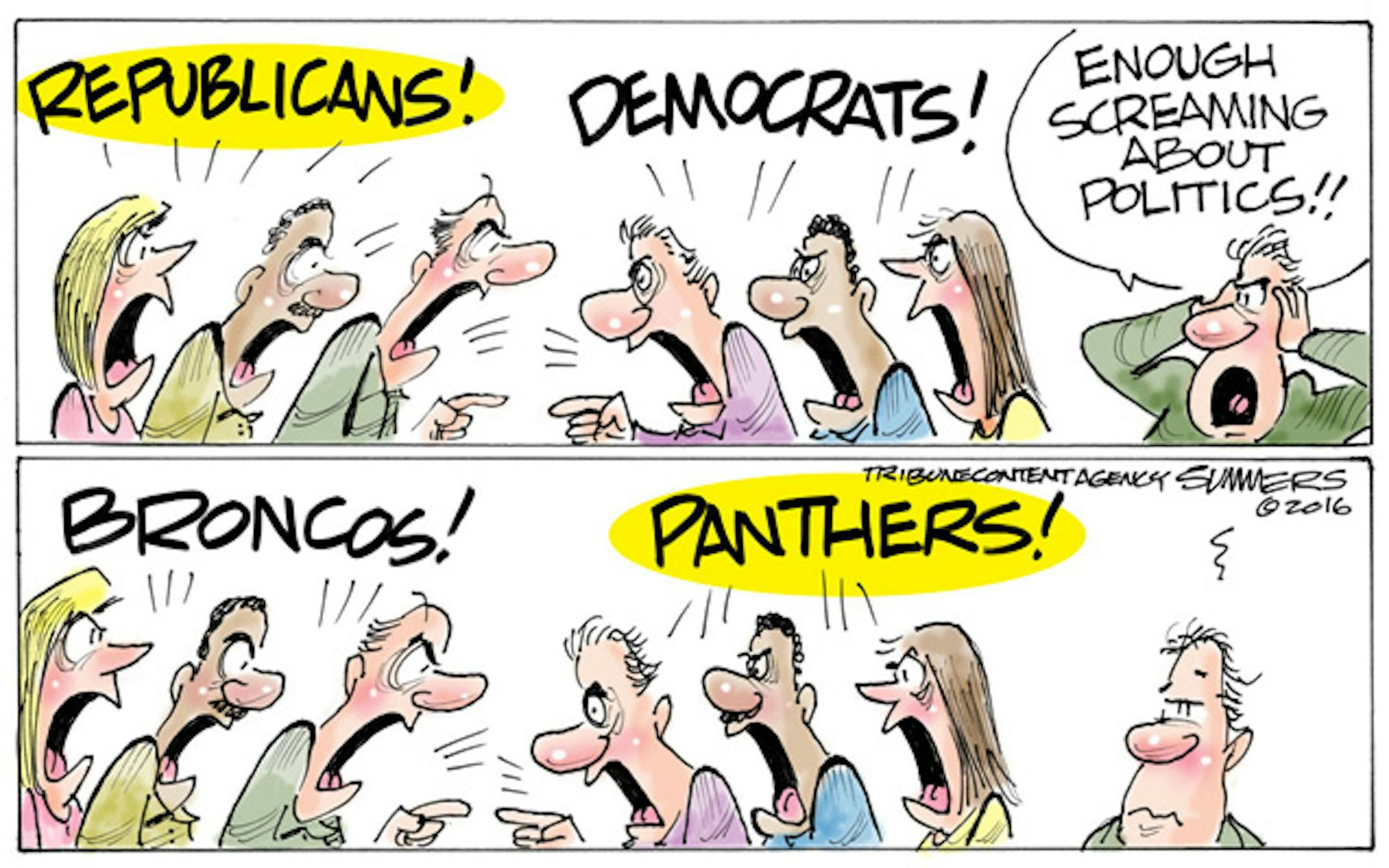
Early February will be remembered for a high-stakes contest that had endless analysis, faltering favorites, blown calls, controversial commercials, coin flips and even trash talking.
Oh yeah, the Super Bowl is on Sunday, too.
Like the big game, the Iowa caucuses — the kickoff to 2016's political gamesmanship — have become an outsized event backed by big money, despite more modest beginnings.
The caucuses didn't really seize the interest of the public or the political world until 1976, when a then-unknown southern governor flew under the radar to finish second ("Undecided" bested Jimmy Carter that year). Conversely, nothing went undetected this year, as saturation coverage carried the story worldwide, including the coin flips that determined Democratic delegates in some tied precincts.
New Hampshire, the site of Tuesday's first presidential primary, has also grown exponentially in meaning — and media. The iconic optics used to be rugged Granite Staters voting at midnight in tiny Dixville Notch, not nationally televised rallies by Donald Trump. The Super Bowl also had humbler origins. So Spartan, in fact, that it wasn't until this year that film was found of the first NFL-AFL Championship 50 years ago. And even then radio audio had to overlay the grainy video.
The recent rebroadcast of that game was on the NFL's own network. Politics has its own permanent presence, too, on CSPAN, CNN, MSNBC and Fox News.
The NFL's leap from lost footage to 24/7 coverage is a result of societal shifts, technological transformations, media industry economics and many other factors. But more than anything, it's about the popularity of football — America's true national pastime. (Sorry, baseball purists, but TV ratings reflect this fact, as does a new Syracuse University poll stating that twice as many Americans choose the gridiron over the diamond for their favorite sport.)
Political polls, conversely, suggest that disliking the government is about the only uniquely unifying political viewpoint. Only 19 percent "trust the government always or most of the time," while 74 percent believe that "most elected officials put their own interests ahead of the country," according to a Pew Research Center poll in November.


