

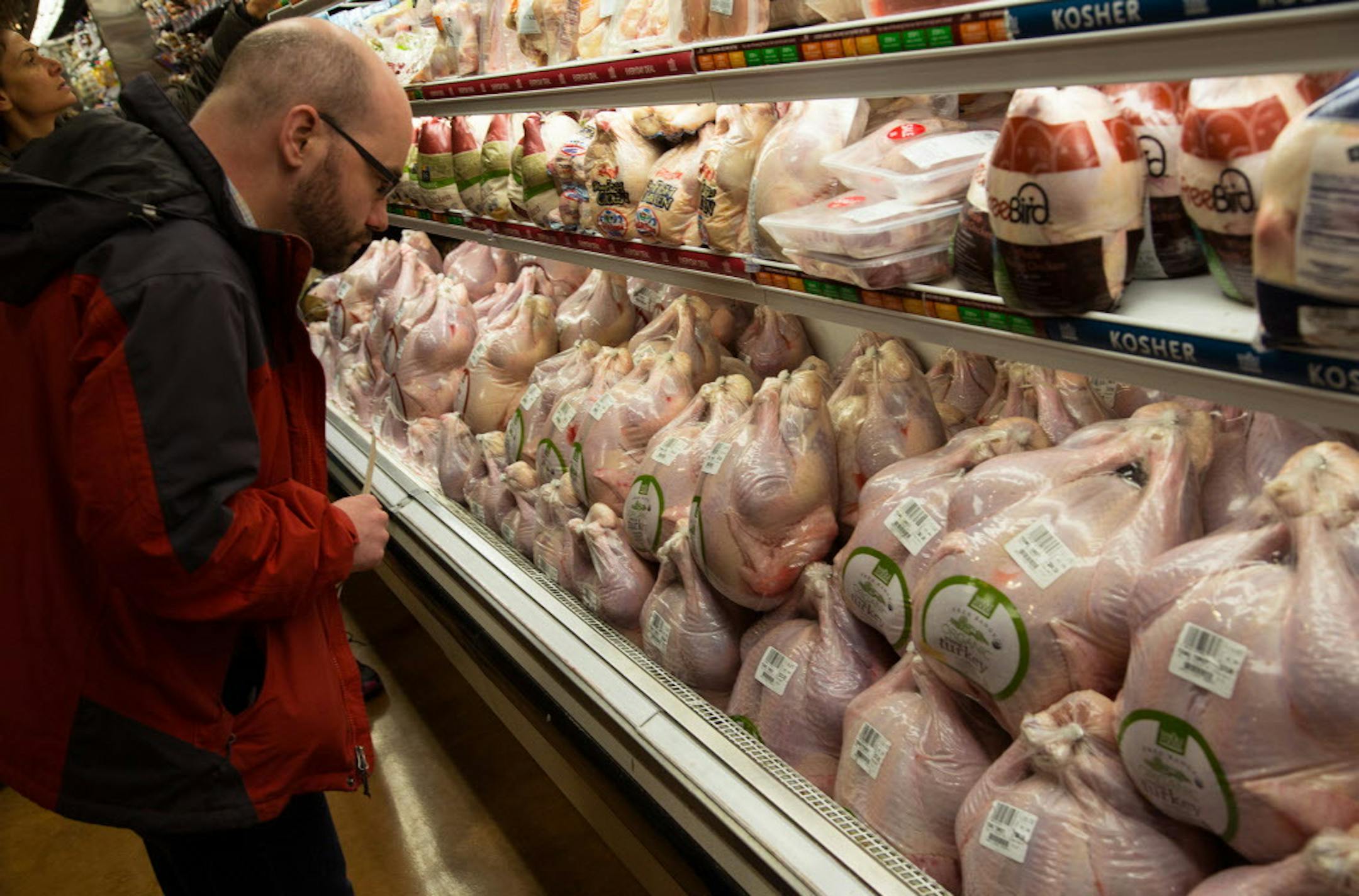
The Henningsen Cold Storage Co. warehouse in Stilwell, Okla., was so jammed with frozen turkeys from the likes of Butterball and Cargill Inc. this year that manager Scott Mayberry turned down requests to store about 1 million more birds, or double his inventory.
"We didn't have any room," said Mayberry, who manages 3.5 million cubic feet of space that is the size of two Home Depot Inc. stores and usually holds as much as 20 million pounds of frozen turkeys before the Thanksgiving holiday in November, the peak for U.S. demand.
Rising output last year and slowing sales left domestic stockpiles tracked by the government at four-year highs in August and September. That signals deeper seasonal discounts on retail prices that are the highest on record going back to 1980, because about 85 percent of the 46 million birds Americans eat at Thanksgiving meals are frozen rather than fresh, according to the National Turkey Federation.
"We overproduced a bit in 2012, and we had quite a few excess birds left over in freezers," said Tom Elam, the president of food-industry consultant FarmEcon in Carmel, Ind.
U.S. warehouses held 325.34 million pounds of frozen whole turkeys in September and 335.55 million pounds in August, the highest for each month since 2009, U.S. Department of Agriculture data show. Stockpiles typically peak at that time of year in preparation for Thanksgiving, said David Harvey, a USDA economist.
Farmers will sell turkeys on average for $1.01 to $1.05 a pound in the last three months of 2013, as much as 4.8 percent less than a year earlier, the USDA estimates.
The decline comes as prices fall for many commodities. The Standard & Poor's GSCI Spot Index of 24 raw materials is down 3.7 percent this year, heading for the first annual drop since the recession in 2008, led by a 39 percent plunge in corn. The Bloomberg U.S. Treasury Bond Index lost 2.3 percent since the end of December, while the MSCI All-Country World Index of equities rose 18 percent.
While retail meat prices tracked by the government rallied to records this year, after a 2012 surge in feed costs forced poultry and beef producers to cut output, consumers probably will be paying less for Thanksgiving birds than in 2012, said Corinne Alexander, an agricultural economist at Purdue University in West Lafayette, Ind.



