

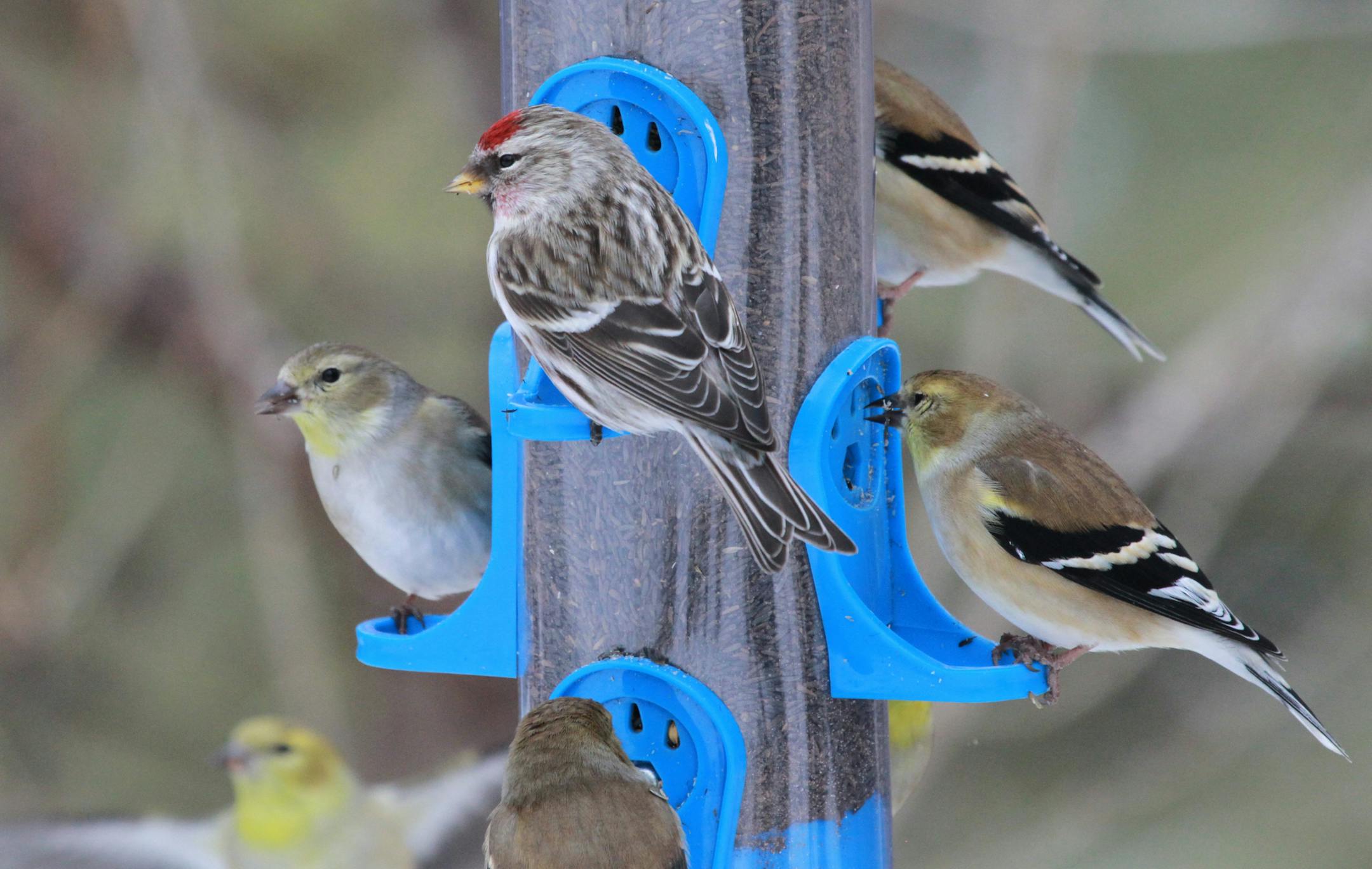
Q: My dad says we shouldn't feed the birds because this makes them lose their ability to find food on their own. Is this true?
A: People have been debating this question for a long time, but to me it's pretty clear that we don't foster dependency in birds by offering them seed in our feeders. In fact, a study of chickadees found the little birds able to adapt quickly to a change in food availability. The chickadees under study lived in a woodland where someone had maintained feeders for 25 years. When the feeders were suddenly removed, the 'dees switched to foraging on their own and their survival rate was similar to that of wild birds without access to feeders. To me, this shows that the act of offering seed does not cause them to lose the ability to seek wild sources of food.
Almost weightless
Q: How much do small birds, like goldfinches and downy woodpeckers, weigh?
A: If you have some pennies around the house, you can feel how much birds weigh. Goldfinches are truly tiny birds, weighing about .5 of an ounce. about the same as five pennies. The downy, our smallest woodpecker, weighs the same as seven to 10 pennies. As you can see, birds are surprisingly lightweight.
A gathering of crows
Q: One recent evening there were hundreds of crows swarming our neighborhood before settling in the trees on the street. They left early the next morning, and we're wondering where they went and what they were doing.
A: It sounds like your neighborhood was nominated by the local crows to be their night-roosting spot. Crows gather to sleep together in the winter because they've found that there's safety in numbers. Their big fear is of great horned owls, a predator that attacks at night. That racket they were making before dark is typical of crows at a roost: Some researchers feel they're communicating about their success in finding food that day. In the morning, hungry crows may follow the good food-finders to see if this helps them find a meal. According to crow expert Kevin McGowan at the Cornell Lab of Ornithology, such gatherings pose no danger to human health.
Searching for bugs?
Q: We have woodpeckers visiting the black oil sunflower seed feeder in winter. I'm wondering whether they're eating the seeds, or sifting through them looking for insects.
A: That's an excellent question, and relates to the fact that woodpeckers are known to spend much of each day searching for insects to eat. About 75 percent of their diet is made up of insects, often in larval form, and the rest comprises nuts, seeds and fruit. In winter, especially, woodpeckers visit feeders to consume high-energy seeds and suet to augment any insects they can find. They're also known to perch on sunflower heads to pick out the seeds and to snack on any berries still on trees and shrubs.


