

Dazzling b-roll footage on Georgia.org's video "Korean investment in Georgia" features women backbending to thump samgomu drums and Ssireum wrestlers sparring in a cloud of sand. We see Koreans laughing over Korean BBQ and Koreans shopping in Korean supermarkets, plus picturesque mountains, beaches, and the verdant undulations of a golf course (because Koreans love golf). The three-minute reel, narrated entirely in Korean, intends to capture a Hanguk haven smack dab in the American South and concludes with an invitation: "Let us show you the harmony and success you will find here in Georgia, USA."
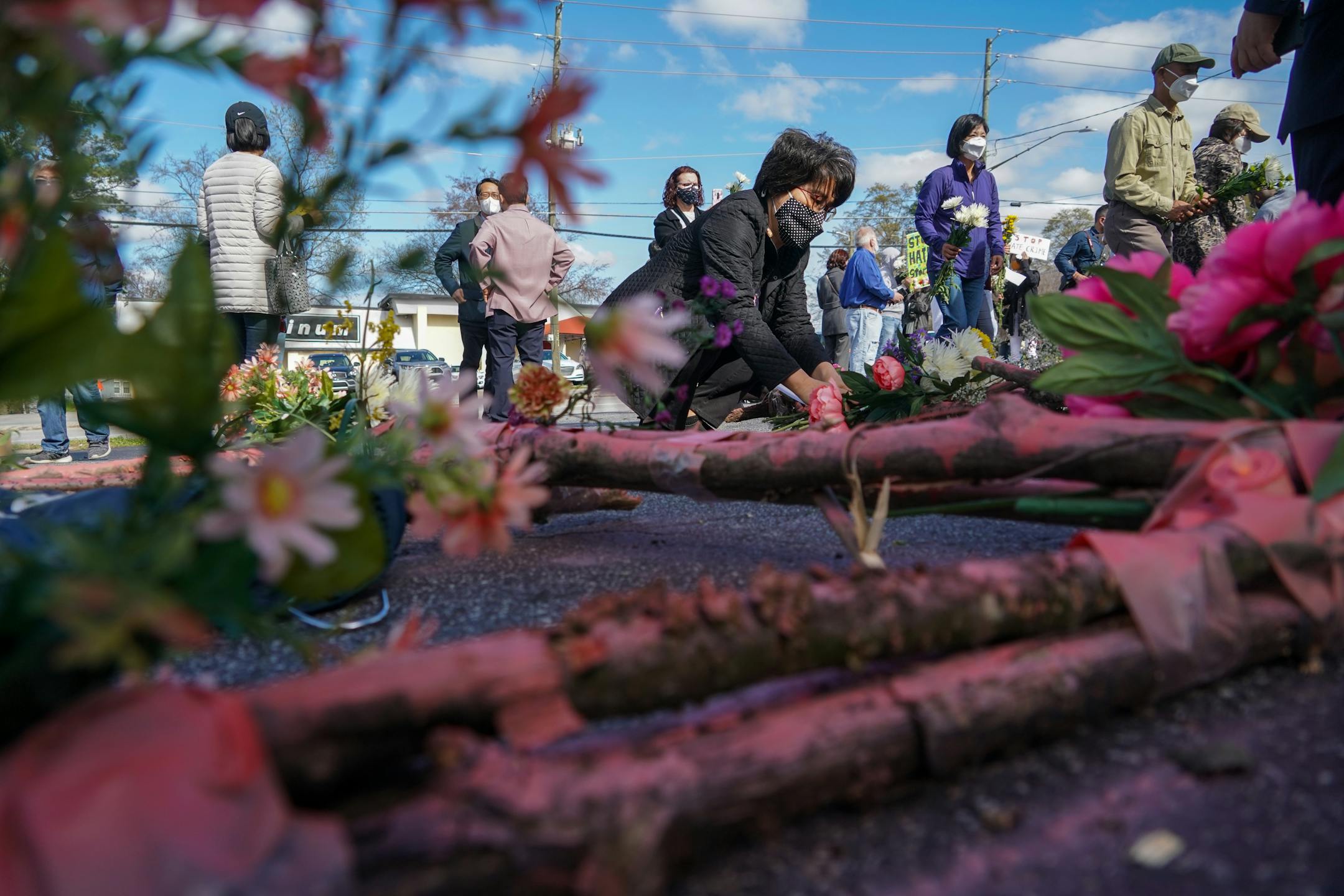
I imagine no Korean woman watched this video and pictured herself working at a strip mall massage business in Atlanta's "red light district." Four of the six Asian women murdered on March 16 were Korean: Soon C. Park, Hyun Jung Grant, Suncha Kim, and Yong A. Yue. We may never know their interior worlds, their unspoken dreams, who and what they loved.
Georgia's Asian oasis advertises a narrative familiar to countless immigrants: the promise of retaining one's own cultural identity while seamlessly pursuing the American dream. The Atlanta shootings reveal a different narrative: how class complications are often left out of the bootstrap-lifting immigrant success story.
My mother started her American life changing bed pans at a nursing home. She learned English and, after stints in convenience stores and swap meets, she became an open-heart surgery nurse, eventually ascending income brackets. When we talked after the shootings, she seemed unrattled, which surprised me (I'd been on the brink of tears all morning). Stoicism is part of her generation's ethos; South Korean boomers grew up in the wake of the Korean War and came of age during a period of rapid, transformative industrialization. Carving out new lives in America through painstaking work has rendered them unflappable. But I thought my mother and I would react the same way over the horrific events in Atlanta. Why didn't we?
I moved to Georgia in 2017 for book research. I wanted to see firsthand how Koreans fit into the Southern landscape — a place discussed mostly within a white/Black binary. Growing up in California, I hadn't been aware of the Korean presence in Georgia, but immigrant families like mine have been quietly inhabiting the Peach State for decades.
In the early 1980s, an increase of construction jobs diversified the predominantly white, outer suburban Atlanta area; Mexican and Central American migrant workers soon set roots alongside Asian immigrants. In 1985, when Georgia's Department of Economic Development opened its first office in Seoul, the Korean community had only just begun to develop off Buford Highway — a miles-long corridor connecting metropolitan Atlanta to the southernmost edge of Gwinnett County (later dubbed by its own tourism bureau "Seoul of the South").
Those looking to relocate from Tri-State and D.C. Korean neighborhoods could travel a straight shot south and west along Interstate 85 to opt for an up-and-coming hamlet boasting warmer weather and cheaper rent. From 1990 to 2000, Georgia's Korean community grew by a staggering 88.2%, faster than anywhere else in the country. Now, approximately 80 Korean companies — including Hyundai, Kia Motors, and LG — have established American headquarters across Georgia.
As with K-towns elsewhere, I'd noticed Korean immigrants in the Atlanta area seemed to rarely socialize beyond their ethnic circles. And they didn't have to: there are Korean churches, Korean local newspapers, radio and television stations, and whole plazas chock-full of Korean travel agencies, hair salons, and bakeries, so that halmonis can go entire weeks without ever speaking English.


