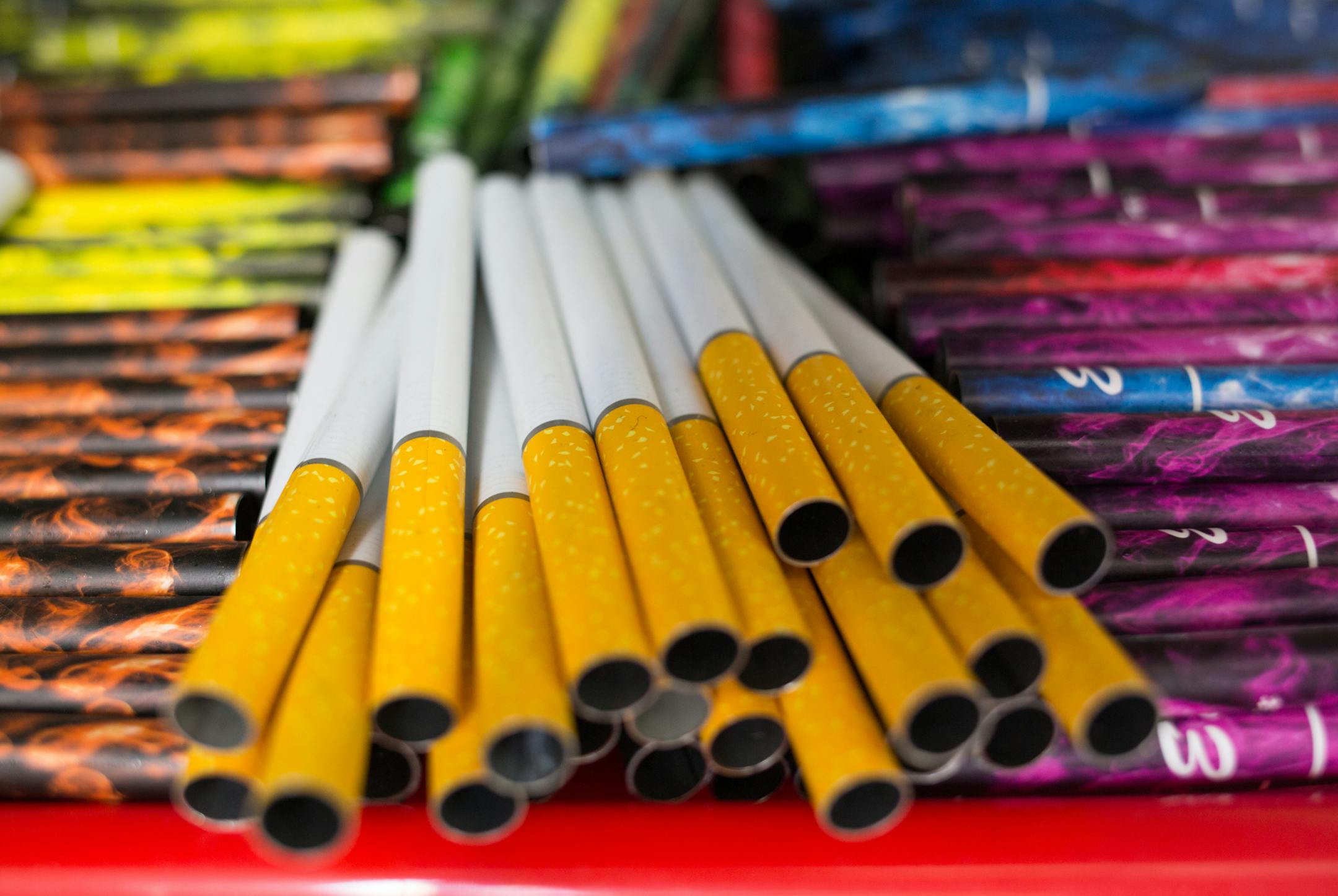
SHENZHEN, China – In a grimy workshop, among boiling vats of chemicals, factory workers are busy turning stainless steel rods into slender tube casings, a crucial component of electronic cigarettes. Not long ago, Skorite Electronics was a tiny firm struggling to produce pen parts. Today, it is part of an enormous — and virtually unregulated — supply chain centered here that produces about 90 percent of the world's e-cigarettes.
This year, Chinese manufacturers are expected to ship more than 300 million e-cigarettes to the United States and Europe, where they will reach shelves of Wal-Marts, gas station outlets and vaping shops.
The devices have become increasingly popular, and yet hundreds of e-cigarette manufacturers in China operate with little oversight. Experts say flawed or sloppy manufacturing could account for some of the heavy metals, carcinogens and other dangerous compounds, such as lead, tin and zinc, that have been detected in some e-cigarettes.
One study found e-cigarette vapor that contained hazardous nickel and chromium at four times the level they appear in traditional cigarette smoke; another found that half the e-cigs malfunctioned and some released vapor tainted with silicon fibers.
There have also been reports in the United States of e-cigarettes that exploded after a lithium ion battery or electric charger overheated.
"We need to understand what e-cigarettes are made of," said Avrum Spira, a lung specialist at the Boston University School of Medicine, "and the manufacturing process is a critical part of that understanding."
A review of manufacturing operations in Shenzhen found that many factories were legitimate and made efforts at quality control, but some were lower-end operations that either had no safety testing equipment or specialized in counterfeiting.
Little quality control
The e-cigarette industry in China has developed differently from other industries, like toys, apparel and smartphones, where global brands outsource their manufacturing here but monitor and enforce quality control standards. Chinese companies were the first to develop e-cigarettes, and that happened in a regulatory void. In the United States, the Food and Drug Administration has just begun to move toward regulating e-cigarettes, working on rules that would force global producers, in China and elsewhere, to provide the agency with a list of ingredients and details about the manufacturing process.