

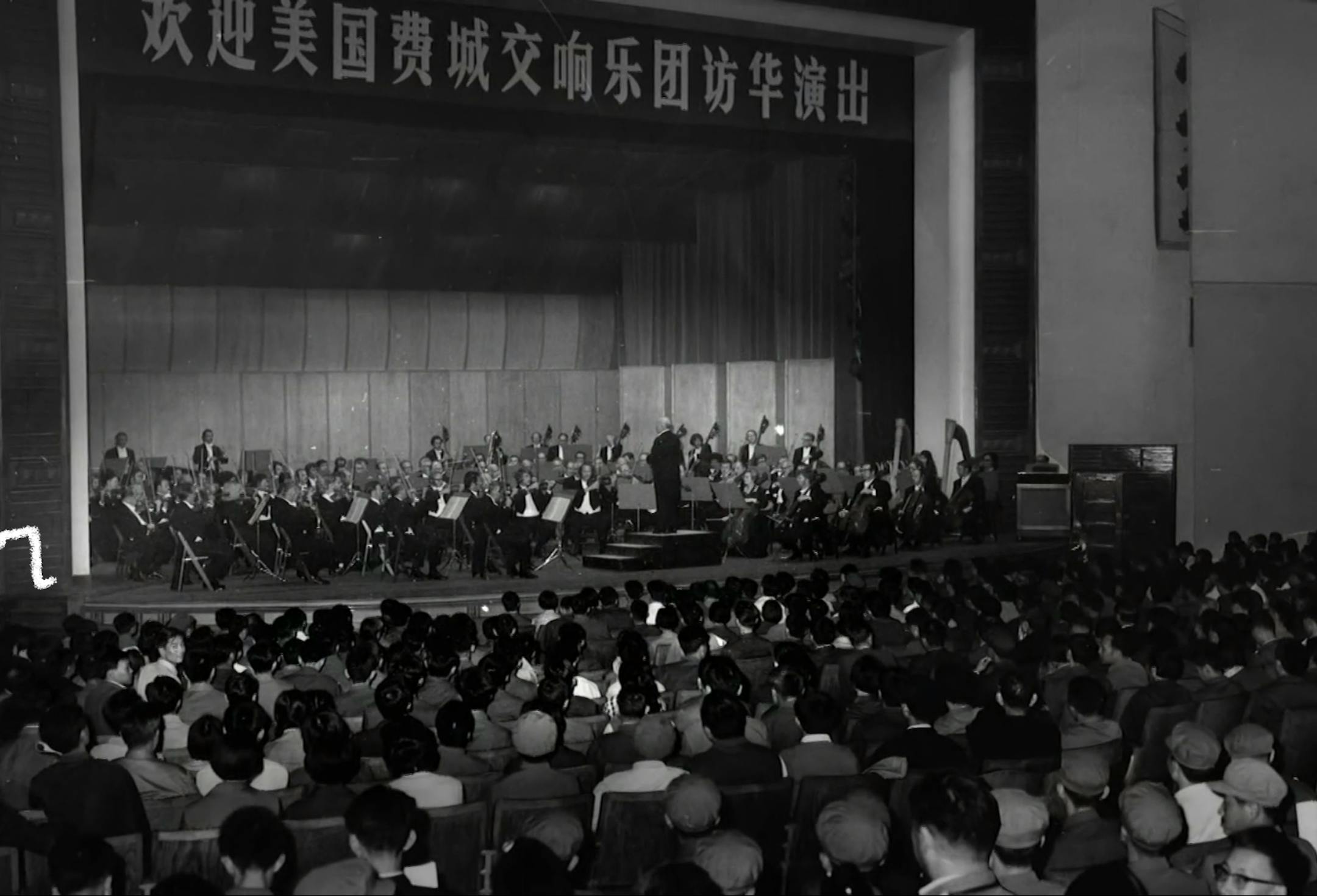
If you want to understand why we're not embarked on a "new Cold War" with Beijing, I suggest you watch a PBS documentary this week called "Beethoven in Beijing" — about the Philadelphia Orchestra's unique relationship with China.
I suggest this not because of a vain hope that music can offset political strife. We are indeed headed into rocky, and risky, disputes with Beijing over Taiwan, the South China Sea, Hong Kong, Xinjiang and global leadership in cutting-edge technologies.
But a film about China's passion for the German master — and for Philadelphia's orchestral treasure — is a reminder that the U.S.-China relationship is far more complex than your father's Cold War with Moscow. The U.S. and Soviet Union operated in two separate orbits. Americans had virtually no trade with the Soviets and very little human contact with Soviet Russians, except for arms control talks.
The relationship between America and China, on the other hand, is broad and deep with multiple layers, from massive trade links to decades of people-to-people exchanges, including many thousands of academics and scientists, sports teams, tourists and millions of students, along with many, many cultural organizations.
So the idea that the world's two most powerful countries can simply "decouple" as their strategic competition grows fiercer — a concept promoted by China hawks — doesn't match reality. In the case of classical music, as "Beethoven in Beijing" illustrates, the ties that bind our two countries are historically driven and deeply emotional. They will be tested, but hopefully, they will survive.
The documentary revolves around the Philadelphia Orchestra's historic 1973 visit to China, the first by a U.S. orchestra. It followed President Richard Nixon's groundbreaking trip to Beijing that established diplomatic ties with the country. Classical music had been banned as "decadent" during Mao Zedong's Cultural Revolution, but the orchestra's visit, with Eugene Ormandy conducting Beethoven's "Symphony No. 6," became a milestone in U.S.-Chinese relations.
"I was a teenager during the Cultural Revolution, when anything foreign was forbidden," recalls Jindong Cai, a producer of the film and now director of the U.S.-China Music Institute at Bard College. He had heard Beethoven recordings secretly on a gramophone hidden at a friend's house, but now the Ormandy performance was blaring on loudspeakers. Cai was inspired to study music at the New England Conservatory, and now promotes exchanges and collaborations between Chinese and U.S. musicians.
Today, the Philadelphia Orchestra is still an icon in China, having made many concert tours of the country and worked with Chinese students, universities, and the Shanghai Philharmonic. It also works with emerging Chinese orchestras that want advice on how to market their concerts in cities that are building new concert halls across the country. Other U.S. orchestras also tour China regularly and have built relationships with Chinese musical institutions.


