

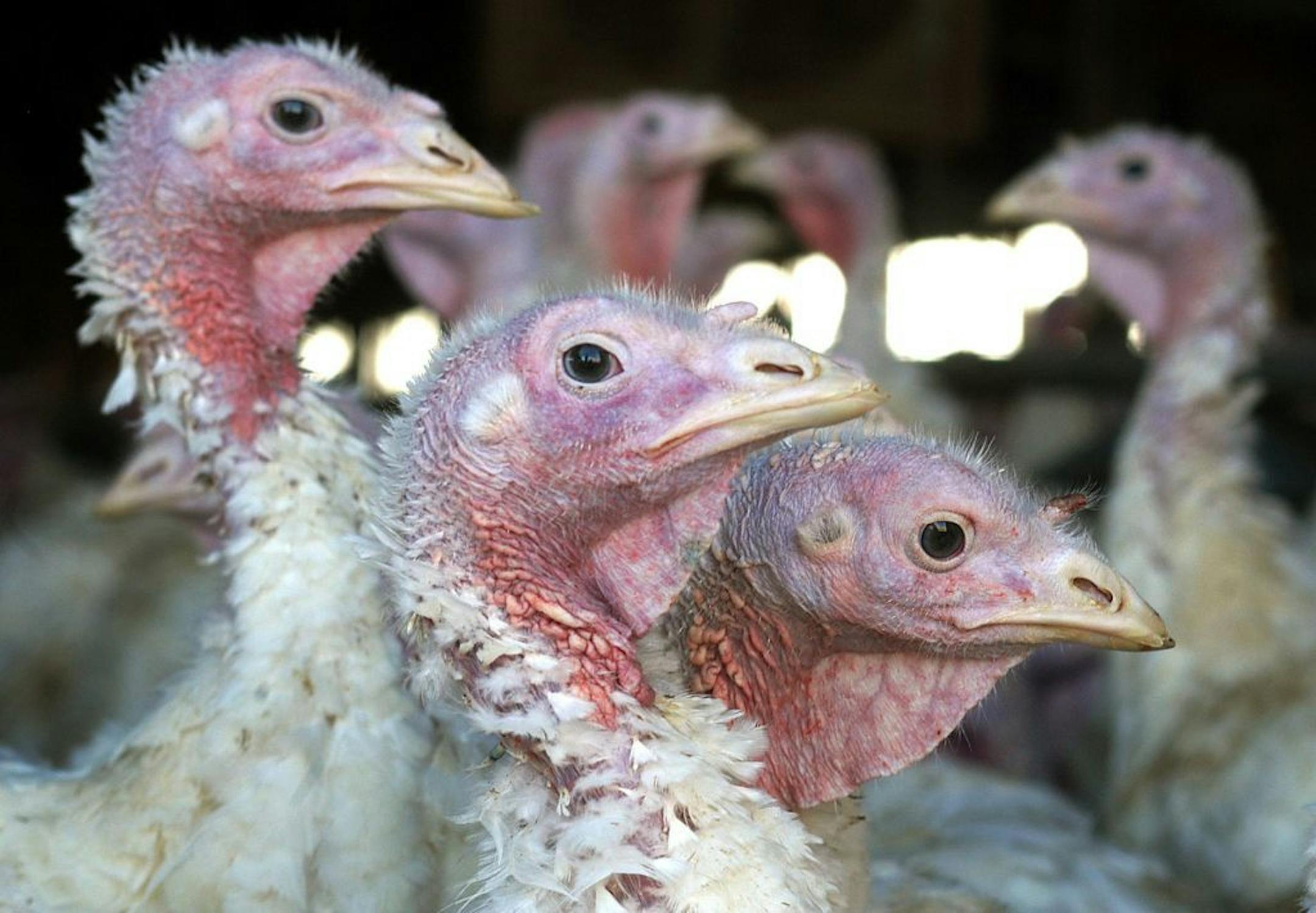
The commercial turkey industry in Minnesota, the nation's largest, has been struck again by bird flu, and animal health experts are stumped as to exactly how the virus invades a farm.
The U.S. Department of Agriculture confirmed the detection of the disease in a second Stearns County flock of 71,000 turkeys, the fifth in a commercial operation. A Nobles County turkey farm became the fourth such case in the state in recent weeks.
The bird flu has led dozens of countries to stop buying turkey meat from Minnesota and other states. About 12 percent of Minnesota's turkey production — mostly dark meat — is exported.
The Nobles County facility had 21,000 birds — 7,000 in each of three barns — at the time of the infection, the Minnesota Board of Animal Health said. The farmer noted an increase in deaths in one of three barns and reported it to the board. Birds in the other two barns were expected to be killed Thursday as a precaution.
The H5N2 strain of highly pathogenic bird flu first surfaced a month ago in Minnesota at a turkey breeding farm in Pope County. Since then, the same virus appeared in commercial turkey farms in Lac qui Parle and Stearns counties and now at a farm near the Iowa border.
The bird flu also has been reported recently in eastern South Dakota, Arkansas and Missouri, and earlier this year in several western states. Turkey farms have been noticeably hit by the virus, though chicken flocks are also susceptible.
The lethal flu is believed to be spread by migratory wild birds that carry the virus but don't appear to get sick themselves. The question vexing animal scientists: How is the flu virus making its way into enclosed turkey barns?
"So far our investigations haven't found an answer to that," said Bill Hartmann, state veterinarian for the Minnesota Board of Animal Health. "But what we do know is there is no connection between these [four] farms."


