

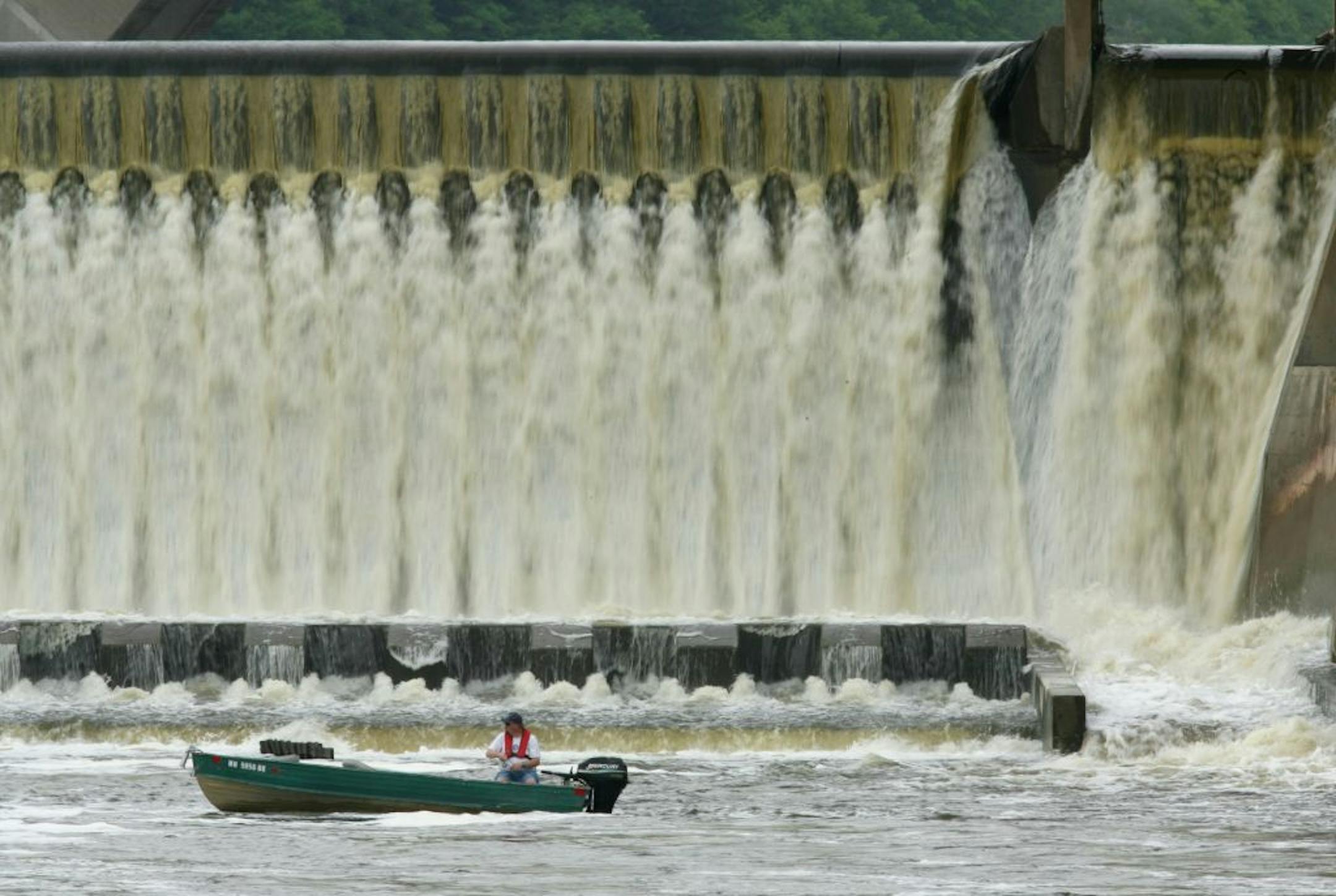
News last week that the Department of Natural Resources wants to build a bubble and sound barrier on the Mississippi at Lock and Dam 1 in the Twin Cities to prevent Asian carp from swimming farther upstream arrived simultaneous with news the agency believed an electric barrier at the same site would be impractical.
The DNR's original plan, or idea, was to install an electric barrier at Lock and Dam 1 (also known as the Ford Dam) similar to the electric barriers placed in the Chicago ship canal to prevent Asian carp from entering Lake Michigan.
But the agency's contract engineering firm determined an electric barrier in the Twin Cities could be dangerous to boaters while also threatening to corrode the lock.
Thus the bubbler and sound idea, and the DNR says as much as $19 million will be needed to build it, in addition to $1 million to design it, not counting money already spent developing the proposal.
Whatever threat any of this ultimately presents to Asian carp, the state's taxpayers should feel threatened, if not cheated.
That's because the far better, easier, cheaper and more effective alternative to dissuade invading carp from infesting northern Minnesota waters would be to close the lock at Upper St. Anthony Falls, if not also the one at the Ford Dam.
Even absent that, a still better idea than building a sound and bubble barrier at Lock and Dam 1 would be to place a similar structure near Keokuk, Iowa, at Lock and Dam 19.
That way, protection the DNR hopes to afford the Upper Mississippi River also could be afforded the Minnesota and St. Croix rivers and their tributaries, as well as the Chippewa and other rivers that spill into the Mississippi from Wisconsin south of the Twin Cities.


