

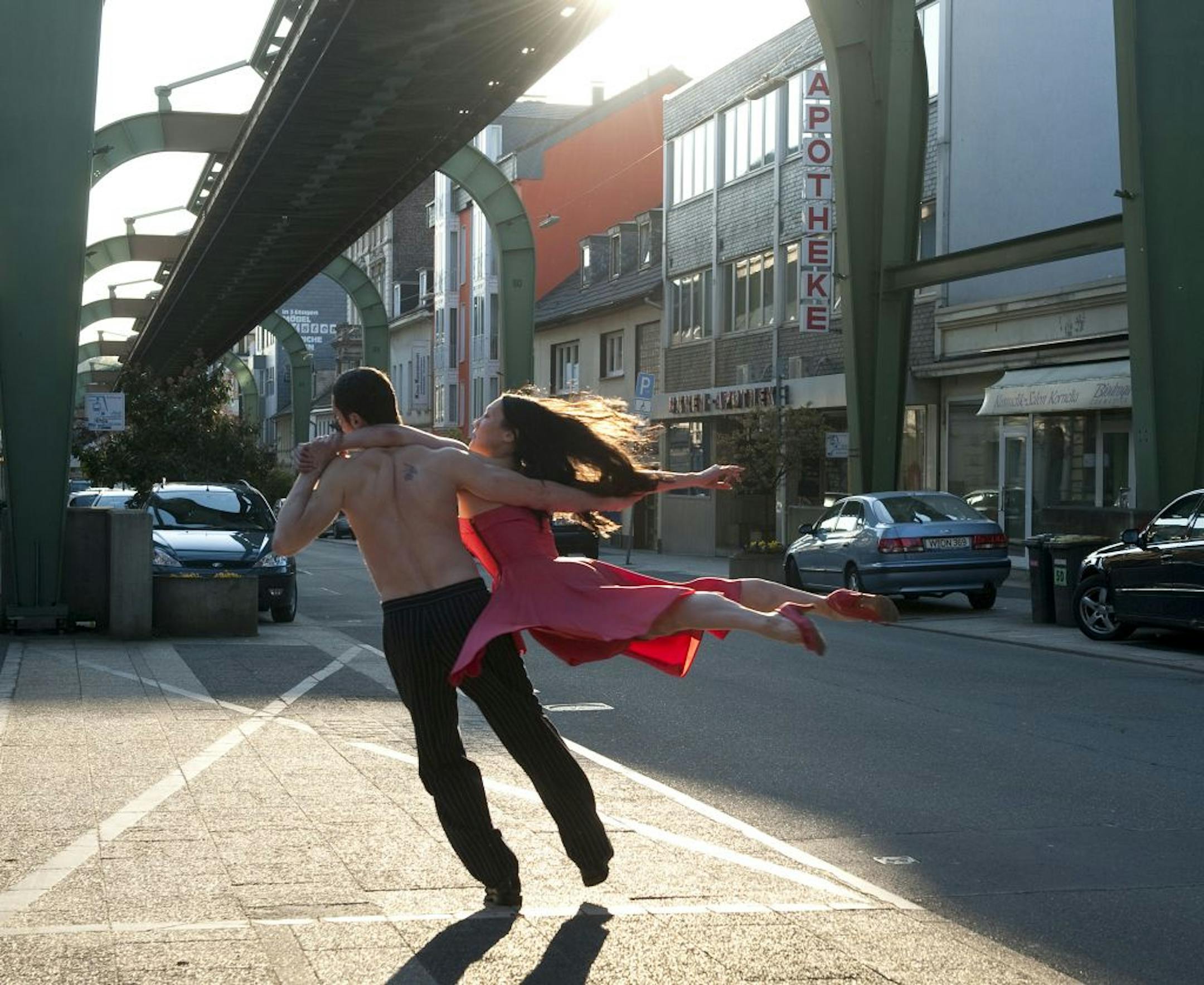
"Dance, dance ... otherwise we are lost." For German choreographer Pina Bausch these words summed up a life's mission, one cut short by her death at age 68 in 2009. Those fortunate enough to see her Tanztheater Wuppertal in performance knew Bausch as a visionary among contemporary dancemakers. But how best to keep her legacy alive, especially when dance is so notoriously difficult to capture on film?
Thankfully, writer/director Wim Wenders followed Bausch's work for several years, and his Academy Award-nominated "Pina" (2011) is a remarkable -- and likely enduring -- tribute to an artist committed to creating dance theater drawn from humanity's deepest physical and emotional reserves.
Wenders ("Paris, Texas," "Wings of Desire," "Buena Vista Social Club") uses 3-D to shape some of Bausch's signature efforts. He innovates with this technique, placing the viewer on the same plane as the performer. But don't expect a showy "Avatar"-like experience. The 3-D primarily adds depth so the dancers can fully inhabit the onscreen world. In turn we become displaced -- no longer simply observers, we are embedded in Bausch's imagination. This holds true even as Wenders places the dance in different settings -- Wuppertal's monorail, a rocky cliff, an idyllic park. The movement transforms every locale -- and vice versa.
Although the most visceral moments derive from the dance itself (especially excerpts from Bausch's brutal take on "The Rite of Spring") Wenders also wants us to know the artist -- a difficult task because she was so enigmatic. We catch ghostly glimpses of the austere Bausch in performance and rehearsal. We study her dancers' faces in close-up and hear their words in voice-over. Poignant anecdotes reveal a mentor who rarely gave feedback and yet transformed so many lives.
How fortunate we are that "Pina" exists. The film not only celebrates dance with a fresh cinematic perspective but also elevates the audacious act of creativity itself, on the part of both choreographer and the auteur alike.


