

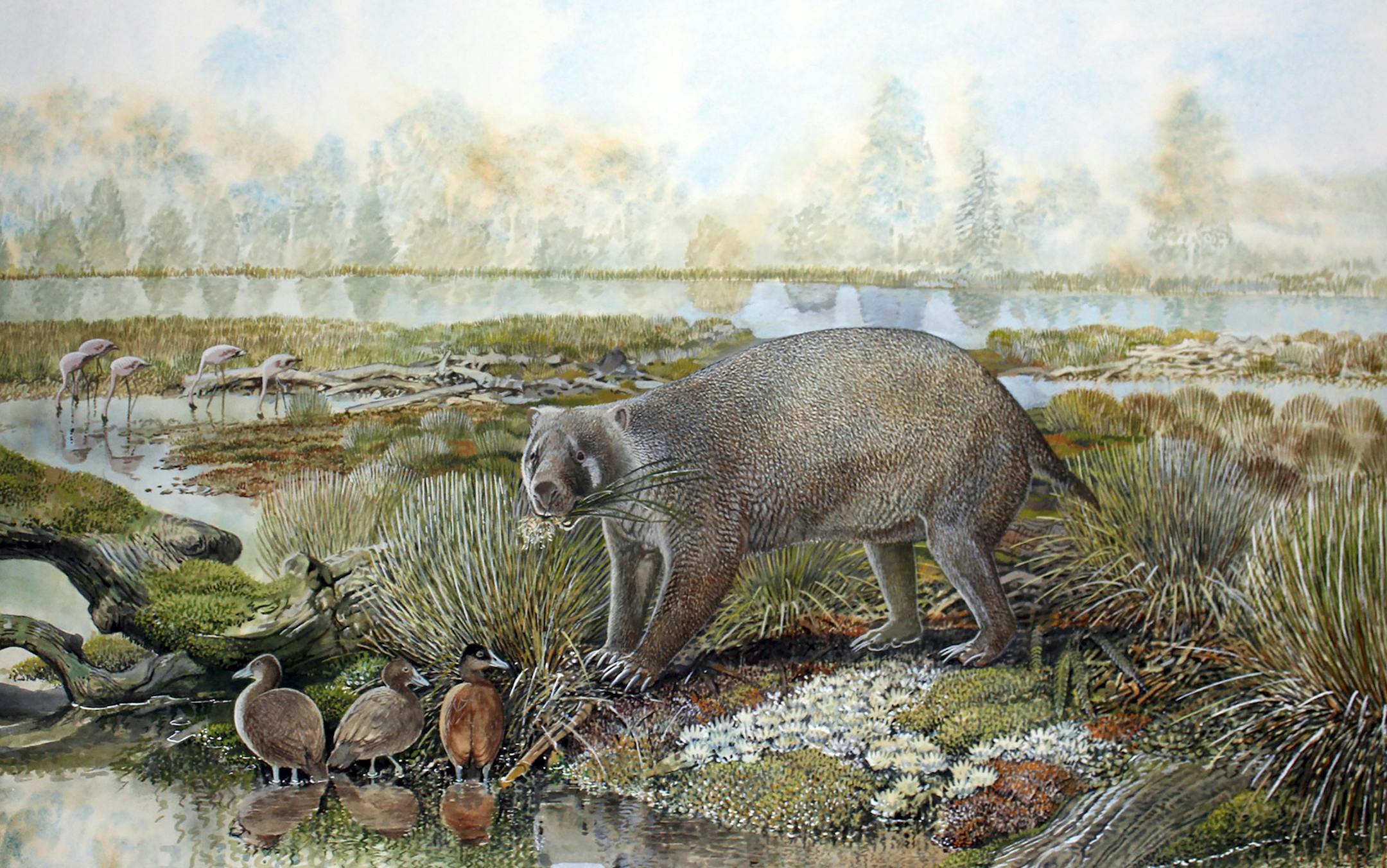
Wombats stand out as bizarre animals even in a continent famed for bizarre animals.
The creatures poop in cubes — yes, cubes — that they leave out and even stack to mark their territory. As for the animal, picture a burrowing ball of fuzz and fat powered by stub-legs.
Now multiply that five times. That's the size of a long-lost member of the same animal group, Mukupirna nambensis, a mega-wombat that tipped the scales at more than 300 pounds. Scientists believe it scrounged around in the rainforest soil of Australia some 25 million years ago.
"I would compare it to a black bear," said Robin Beck, a paleontologist at the University of Salford in England.
The hefty species is the newest member of a supersized menagerie. For millions of years up to the present day, big marsupials flourished on Australia and New Guinea, isolated from the rest of the world. Koalas and wombats are the only surviving remnants of an otherwise extinct group called the vombatiforms, "wombat-like" animals that were more diverse than any other type of marsupials.
Clues in ancient caves offer answers
Experts and cave divers in Mexico's Yucatán Peninsula have found ocher mines that are some of the oldest on the continent.
Since skeletal remains like "Naia," a woman who died 13,000 years ago, were found over the past 15 years, archaeologists have wondered how they wound up in caves whose passages can be barely big enough to squeeze through. About 8,000 years ago, rising sea levels flooded the caves, known as cenotes, around Tulum. Had these early inhabitants fallen in, or did they go down intentionally seeking shelter, food or water?
Recent revelations suggest they may have had a more powerful attraction. The discovery of remains of mining debris, stone tools, navigational aids and digging sites suggest humans went into the caves around 10,000 to 12,000 years ago, seeking iron-rich red ocher used in cave paintings, rock art and burials. The early miners apparently brought torches or wood to light their work, and broke off stalagmites to pound out the ocher. "Now, for the first time we know why the people of this time would undertake the enormous risk and effort to explore these treacherous caves," said CINDAQ founder Sam Meacham.


