
What the rest of the world should do about Venezuela

There are options to save the nation from corrupt leaders behind sweeping hunger and violence.

July 31, 2017 at 8:29PM
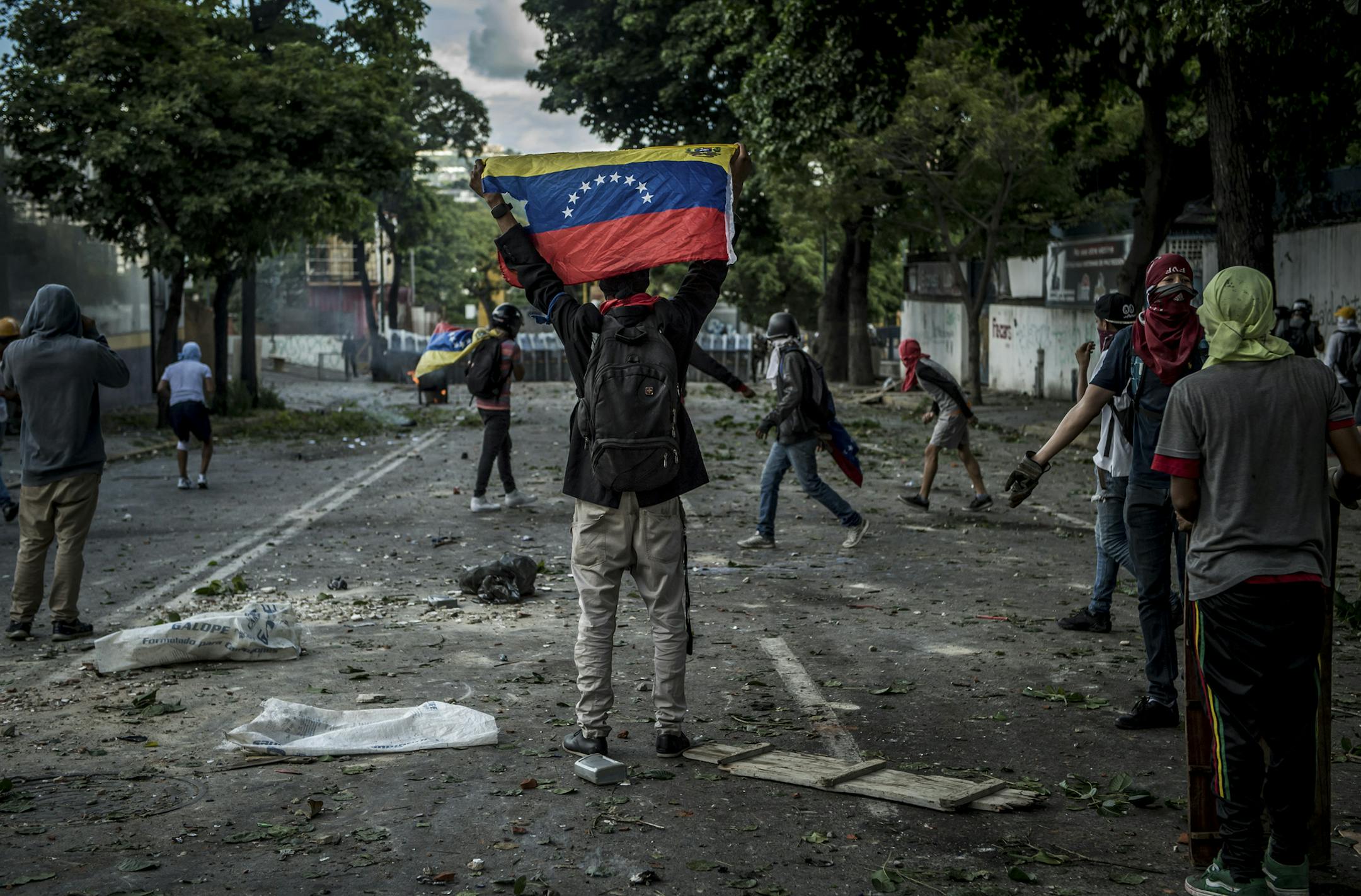
A protester holds up the Venezuelan flag during clashes with soldiers at an anti-government demonstration to demand that the National Constituent Assembly election be cancelled, in Caracas, Venezuela, July 26, 2017. President Nicolás Maduro’s plan to create a new assembly is expected to give leftists virtually unlimited authority. (Meridith Kohut/The New York Times)
A protester held the Venezuelan flag during clashes with soldiers at an anti-government demonstration in Caracas, Venezuela. (The Minnesota Star Tribune)

Venezuela claims to have more oil than Saudi Arabia, yet its citizens are hungry. An astonishing 93 percent of them say they cannot afford the food they need, and three-quarters have lost weight in the past year.

The regime that caused this preventable tragedy professes great love for the poor. Yet its officials have embezzled billions, making Venezuela the most corrupt country in Latin America.

It is a textbook example of why democracy matters: people with bad governments should be able to throw the bums out. That is perhaps why President Nicolás Maduro is so eager to smother what little is left of democracy in Venezuela.

On Sunday, Maduro presided over a rigged election to rubber-stamp the creation of a hand-picked constituent assembly whose aim is to perpetuate his unpopular state-socialist regime. The government claimed 8 million people voted, but the scant lines at polling places suggested the actual figure was much lower.

Many people stayed away from the polls. "Venezuela has screamed with its silence," Julio Borges, president of the opposition-controlled assembly, said, according to the Associated Press.

Nikki Haley, U.S. ambassador to the United Nations, called it a "sham election." Argentina, Brazil, Chile, Colombia, Costa Rica, Mexico, Panama, Peru and Spain also rejected it. On Monday, the Trump administration slapped financial sanctions on Maduro. The sanctions freeze any assets Maduro may have in U.S. jurisdictions and bar Americans from doing business with him.

Opponents say the new assembly will install Cuban-style communism. At the very least, its creation will provoke more violence in a country where the streets are already choked with tear gas and littered with buckshot from police shotguns. In almost four months of protests, more than 100 people have died; hundreds more have been locked up for political reasons. All this infuriates Venezuelans.

By the end of this year, Venezuela's economic collapse since 2012 will be the steepest in modern Latin American history. Income per person is now back where it was in the 1950s.
The main cause of this calamity is ideological. Following the lead of his late mentor, Hugo Chávez, Maduro spends public money lavishly, especially on his supporters. Weak oil prices and inept management mean he cannot pay his bills. So he prints money and blames speculators for the resulting inflation, which is expected to exceed 1,000 percent this year.

The black-market price for U.S. dollars is now about 900 times the official rate. Price controls and the expropriation of private firms have led to shortages of food and medicine. With hospitals bare of supplies, the maternal mortality rate jumped by 66 percent last year. Officials flagrantly profiteer from their access to hard currency and basic goods. Venezuela has become a favored route for drug-trafficking and is awash with arms.

The best solution would be a negotiated transition. Maduro would finish his term but would respect the constitution and parliament, free political prisoners and guarantee that overdue regional elections, and the presidential contest next year, take place fairly. However, there is no sign that Maduro and his cronies will voluntarily surrender power.

Those who want to save Venezuela have limited influence, but they are not helpless. The opposition, a variegated alliance long on personal ambition and short of cohesion, needs to do far more to become a credible alternative government.

Some in the opposition think all that is needed to trigger the regime's collapse is to ramp up protests. But Maduro can still count on the army, with which he co-governs. In Venezuela's command economy he controls such money as there is, and has the advice of Cuba's security officials, who are experts in selective repression.

Despite the sanctions leveled by the U.S. government, Maduro will find new buyers for his oil within months. In the meantime, ordinary people would suffer more than the regime's loyalists. And even broader sanctions might strengthen the regime.

More promisingly, the Trump administration last week announced individual sanctions on a further 13 Venezuelan officials involved in the constituent assembly, or suspected of corruption or abusing human rights. This effort could be intensified by pressing banks to disclose information about officials who have stashed stolen public funds abroad. The E.U. and Latin America should join this effort.

It will not, in itself, force the regime to change. But the stick of individual sanctions should be combined with the offer of negotiations, brokered by foreign governments.

The alternative could be a slide into generalized violence. Already there are signs of anarchy, with radicals on both sides slipping loose from their leaders' control. Rather than a second Cuba or a tropical China, chavista Venezuela, with its corruption, gangs and ineptitude, risks becoming something much worse.


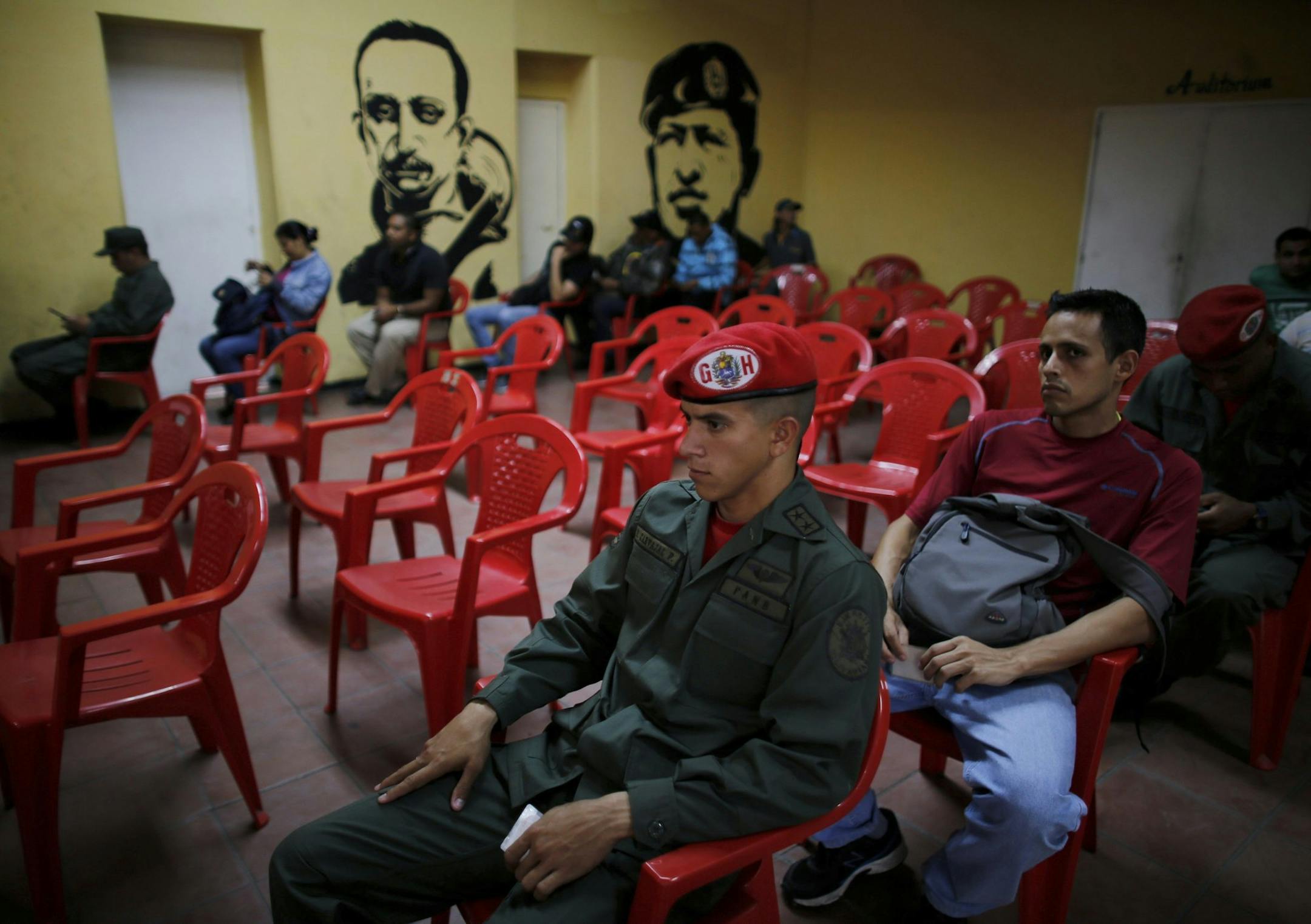
Voters wait to cast their ballots next murals of Venezuelan Independence hero Ezequiel Zamora, left, and the late Venezuelan President Hugo Chavez at a polling station in Caracas, Venezuela, Sunday, July 30, 2017. President Nicolas Maduro asked for global acceptance on Sunday as he cast an unusual pre-dawn vote for an all-powerful constitutional assembly that his opponents fear he'll use to replace Venezuelan democracy with a single-party authoritarian system. (AP Photo/Ariana Cubillos)
on the brink: Voters waited to cast ballots Sunday in what was widely rejected as a “sham election.” Protesters have taken to the streets while others have been locked up. (The Minnesota Star Tribune)
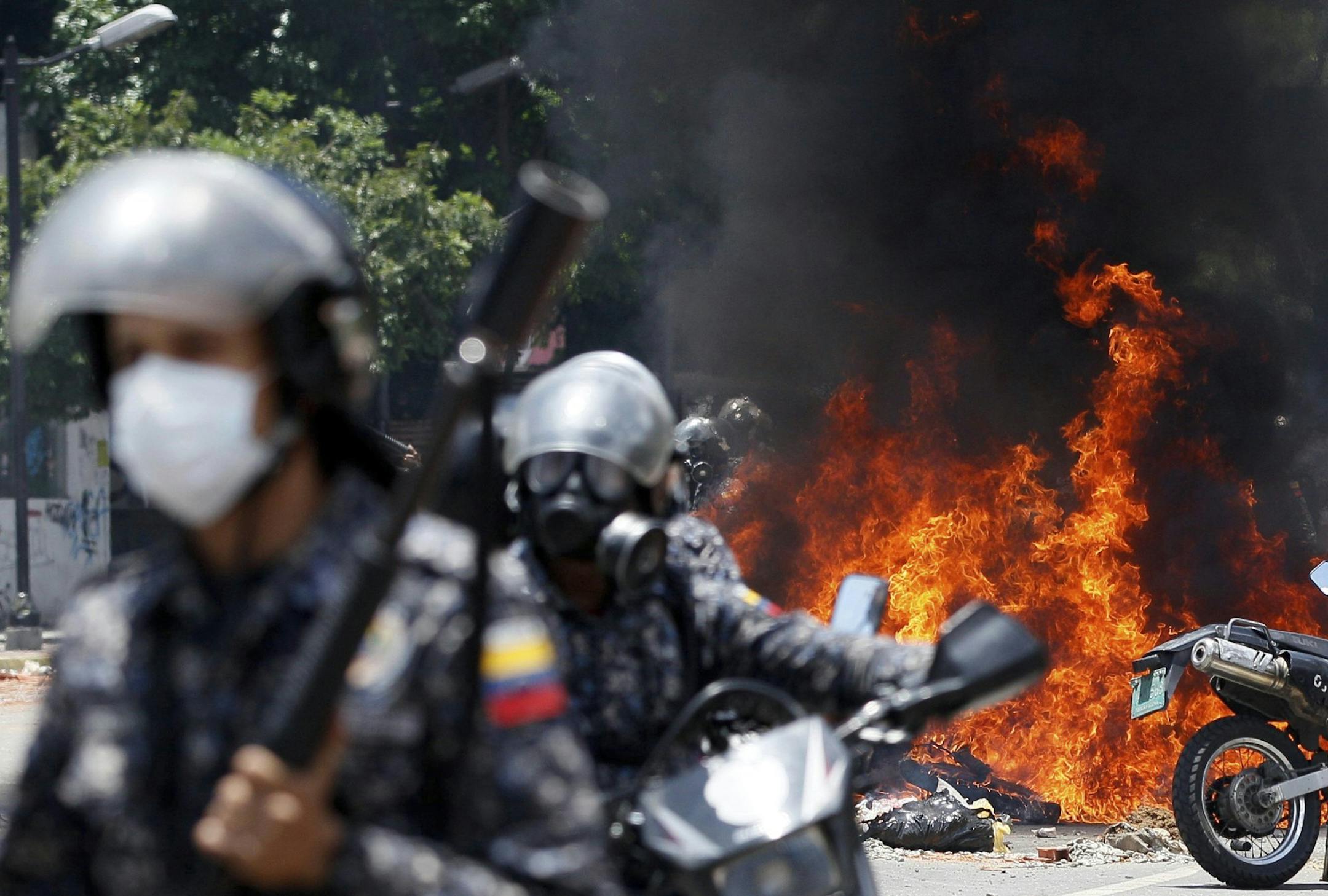
Venezuelan Bolivarian National police move away from the flames after an explosion at Altamira square during clashes against anti-government demonstrators in Caracas, Venezuela, Sunday, July 30, 2017. The explosion injured several officers and damaged several of their motorcycles. The officers were then seen throwing several privately owned motorcycles into the remaining fire in reprisal. (AP Photo/Ariana Cubillos)
Venezuelan Bolivarian National police move away from the flames after an explosion at Altamira square during clashes against anti-government demonstrators in Caracas, Venezuela, Sunday, July 30, 2017. The explosion injured several officers and damaged several of their motorcycles. The officers were then seen throwing several privately owned motorcycles into the remaining fire in reprisal. (AP Photo/Ariana Cubillos) (The Minnesota Star Tribune)
about the writer

about the writer

Economist

More from Business

See More
card image
Fairview Health Services

The school is changing an elective course while still working with the Eden Prairie-based health care giant after students raised concerns.

This transmission electron microscope image shows SARS-CoV-2, the virus that causes COVID-19, isolated from a patient in the U.S., emerging from the surface of cells cultured in the lab. (NIAID/TNS) ORG XMIT: 1659810
card image