

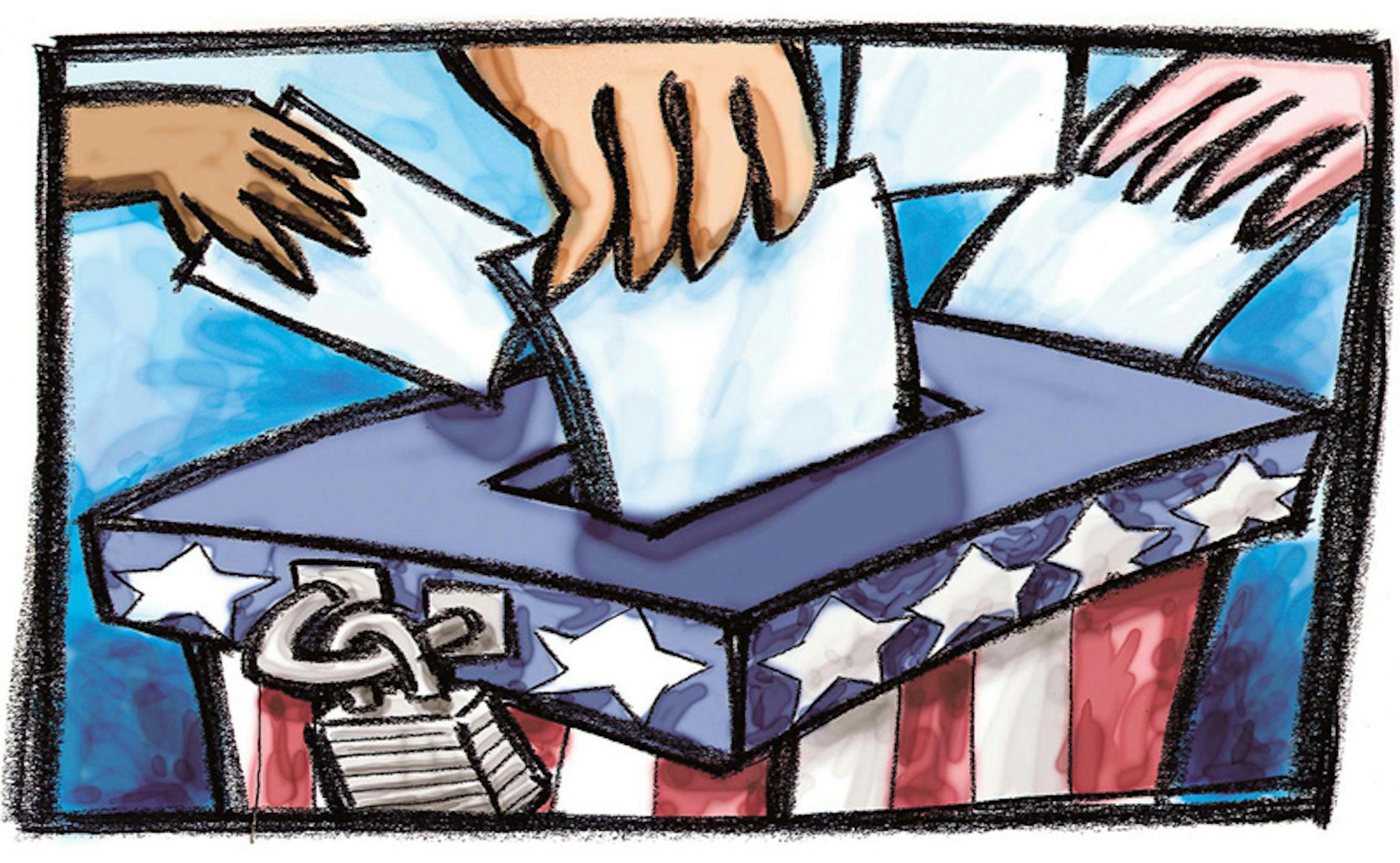
Recent polling indicates that the voter ID amendment may pass. This suggests that most Democrats and most young people don't really understand what's at stake. It's not about voter fraud. Minnesota has had no cases of voter impersonation, which is the only kind of fraud that a government-issued photo ID would prevent. It's about turning Minnesota into a "red state" for the foreseeable future. Here's how.
Half of voters ages 18 to 34 use election-day registration. Two-thirds of them vote Democrat. Passing the photo ID amendment will discourage many of those younger voters from voting, likely costing Democrats 3 to 5 statewide percentage points in presidential years and about 2 statewide points in off-years, well beyond the margins many races are decided by. And that's the plan.
The voter ID amendment will do this by eliminating election-day registration as we know it. Two thirds of election-day registrants are under age 35 -- about 350,000 voters. If the amendment passes, instead of registering on the spot and voting, they will only be able to cast a "provisional ballot."
They will then have to bring registration documents to the county auditor. This will turn the current single-step process into a two-step process with a large hassle factor. Many will conclude it's simply not worth it. In Indiana, a state with a photo ID requirement, 80 percent of the ID-related provisional ballots were not counted in the 2008 general election.
As an example of what this could do, consider that the under-30 demographic was the only one that Al Franken won. Had we had the photo ID amendment in 2008, Franken would not be senator today. This is also the age group that gave the state handily to Obama in 2008, and the math suggests that their staying home in 2010 is what nearly cost Mark Dayton his race for governor.
Young people make up nearly one in four voters in presidential years and about 15 percent on average in off-years. They turned out in 2008 and swept the whole Democratic ticket into power. In 2010, they stayed home, and many Democrats couldn't find the margins to win.
Consider how this played out for U.S. Rep. Tim Walz. In 2006, Walz won with 52 percent. In 2008, with a youth surge in the vote, he won with 62.5 percent. In 2010, when the 18-to-34 demographic stayed home, Walz received only 49 percent. His area, the First Congressional District, has colleges in Mankato, Winona and Rochester.
Something similar happened with state house races in 2008, where the youths in districts with colleges like St. Cloud and Moorhead voted for Obama by a two-to-one ratio and gave Democrats wins all the way down the ballot. But when youths stayed home in 2010, many of those same Democrats lost, and the statehouse turned red.


