

 4:04
4:04MEADOWLANDS, MINN. – To the casual observer, the Sax-Zim Bog is not particularly scenic in winter.
It's a vast stretch of flat, snow-covered, frozen ground punctuated by trees, sometimes in clumps, sometimes standing alone. Every so often, there are the remnants of a rotting, collapsed barn, a vestige of the misplaced optimism of a farmer who had hoped to tame the soggy ground only to discover that the bog usually wins such jurisdictional disputes.
Of course, the bog doesn't get many casual observers. It's tucked into a remote corner of the Iron Range that few Minnesotans visit. Bird-watchers, on the other hand, travel from all over the country to get there.
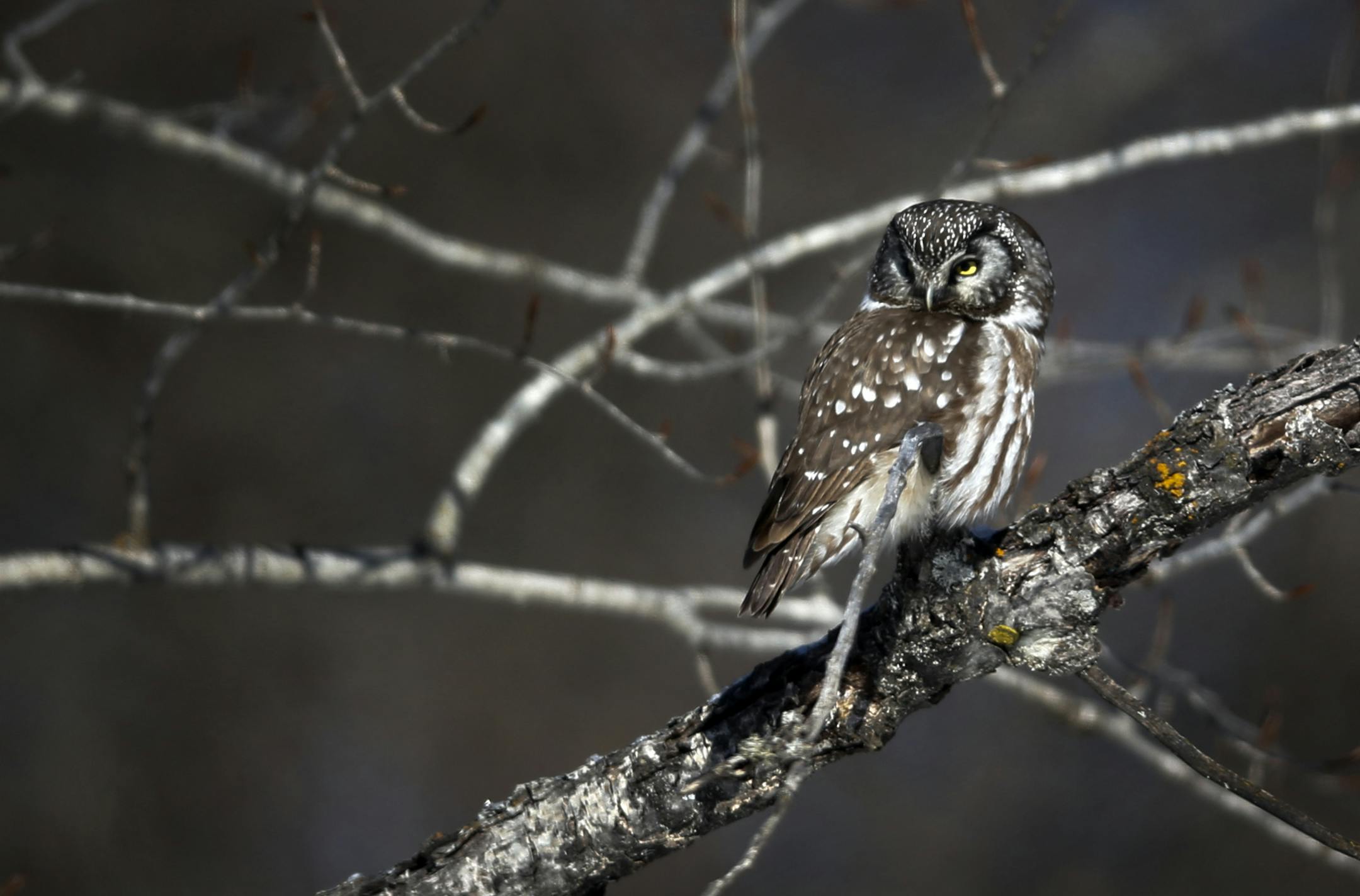
Every February, the immense bog — more than four times the size of Minneapolis — offers extreme birders the prospect of spotting birds that have migrated from northern Canada, species seen nowhere else in the lower 48 states. To these devotees, seeing birds that others haven't seen is what it's all about.
"It's like a big, lifelong Easter egg hunt," said Mike Hendrickson, founder of the bog's annual Winter Birding Festival. "Every state has different eggs, and everyone wants to see them all. Northern Minnesota has its share of very special eggs, and people will go bonkers over that."
This year's festival attracted people from such far-flung — and warm — locales as Southern California, Texas and the bay area of Florida. They bundled up in sweaters, coats and layers of sweatpants to withstand the bog's near-zero temperatures. In their heavy work boots, they tromped across northern Minnesota's tundra, striking the pose of big-game hunters, shooting with cameras outfitted with 2-foot-long lenses.
Their window of opportunity is limited. It was mid-month and, if normal migration patterns held, the birds would be heading back north within a week or two.
"They sort of eat their way down here, moving farther south as they run out of food," explained Frank Nicoletti, a researcher at the Hawk Ridge Bird Observatory in Duluth. As soon as the weather begins to warm up, the birds start eating their way north again, usually leaving the bog by the first of March.
![Sidney Crawford of Ozona, FL, aims his digital camera at a rarely seen boreal owl perching on the limb of a dead tree, off of a rural road during the Sax-Zim Winter Birding Festival Saturday, Feb. 16, 2013, at the Sax-Zim Bog in Meadowlands, MN. It was Crawford's fourth trip to the bog, requiring him to fly in on a commercial jet and then rent a car. "I've only been doing it for 60 years," Crawford responded to the question of whether birding was worth it.] (DAVID JOLES/STARTRIBUNE) djoles@start](https://arc.stimg.co/startribunemedia/7VQUNATDE6XFGLBC4EQ4XWIBLY.jpg?&w=1080)
![Retired Episcopal priest Ed Newbury, 74, of Kimball, NE, kept a log of birds seen in the Sax-Zim Bog during the Sax-Zim Winter Birding Festival Saturday, Feb. 16, 2013, in Meadowlands, MN.] (DAVID JOLES/STARTRIBUNE) djoles@startribune.com Every mid-February, bird watchers from around the country -- and even a few from overseas -- gather before dawn in a frozen bog in northern Minnesota for the Sax-Zim Winter Birding Festival. Bundled in every piece of warm clothing they own and facing frigid tem](https://arc.stimg.co/startribunemedia/AE7PVTBXQFMR7XLVSOVWRHC2BY.jpg?&w=1080)
![A lone grey jay perched in a barren tree in the brown, drab winter landscape of Sax-Zim Bog during the Sax-Zim Winter Birding Festival Saturday, Feb. 16, 2013, in Meadowlands, MN.] (DAVID JOLES/STARTRIBUNE) djoles@startribune.com Every mid-February, bird watchers from around the country -- and even a few from overseas -- gather before dawn in a frozen bog in northern Minnesota for the Sax-Zim Winter Birding Festival. Bundled in every piece of warm clothing they own and facing frigid temperatures](https://arc.stimg.co/startribunemedia/NH3WJXPG6ZKX3QXFOEEWHALYNU.jpg?&w=1080)
![During a dusk search trip for Great Gray Owls as part of the Sax-Zim Winter Birding Festival, birders try to clear frost from the school bus windows Friday, Feb. 15, 2013, in Meadowlands, MN.] (DAVID JOLES/STARTRIBUNE) djoles@startribune.com Every mid-February, bird watchers from around the country -- and even a few from overseas -- gather before dawn in a frozen bog in northern Minnesota for the Sax-Zim Winter Birding Festival. Bundled in every piece of warm clothing they own and facing frigid](https://arc.stimg.co/startribunemedia/MIEUOHUGEFHW25CTCW3WOIKALQ.jpg?&w=1080)
![Susan Elliott of Mendota Heights, front, and Sidney Crawford of Ozona, FL, left, join other birders with binoculars getting a glimpse at birds at a feeding station Saturday, Feb. 16, 2013, at the Sax-Zim Bog in Meadowlands, MN.] (DAVID JOLES/STARTRIBUNE) djoles@startribune.com Every mid-February, bird watchers from around the country -- and even a few from overseas -- gather before dawn in a frozen bog in northern Minnesota for the Sax-Zim Winter Birding Festival. Bundled in every piece of warm](https://arc.stimg.co/startribunemedia/2HSA4NZNWJQY6LIQMYN54IAF4Y.jpg?&w=1080)
![Birders from the Midwest and across the U.S. gathered in the wee hours of the morning at the Meadowlands Community Center to board buses and go out into the Sax-Zim Bog to search for rare bird species during the Sax-Zim Winter Birding Festival Saturday, Feb. 16, 2013, in Meadowlands, MN.] (DAVID JOLES/STARTRIBUNE) djoles@startribune.com Every mid-February, bird watchers from around the country -- and even a few from overseas -- gather before dawn in a frozen bog in northern Minnesota for the Sax](https://arc.stimg.co/startribunemedia/HXZD2OE5CUPHW3IGMZFHDIEKLA.jpg?&w=1080)
![Birders peered through binoculars near a bird feeding station in Sax-Zim Bog to get a good look at an group of bright red pine grosbeaks during the Sax-Zim Winter Birding Festival Saturday, Feb. 16, 2013, at the Sax-Zim Bog in Meadowlands, MN.] (DAVID JOLES/STARTRIBUNE) djoles@startribune.com Every mid-February, bird watchers from around the country -- and even a few from overseas -- gather before dawn in a frozen bog in northern Minnesota for the Sax-Zim Winter Birding Festival. Bundled in ever](https://arc.stimg.co/startribunemedia/BRRMULRX373JUFR3MBFNWO7K4E.jpg?&w=1080)
![A pair of bright red male pine grosbeaks are seen at a bird feeding station in Sax-Zim Bog during the Sax-Zim Winter Birding Festival Saturday, Feb. 16, 2013, at the Sax-Zim Bog in Meadowlands, MN.] (DAVID JOLES/STARTRIBUNE) djoles@startribune.com Every mid-February, bird watchers from around the country -- and even a few from overseas -- gather before dawn in a frozen bog in northern Minnesota for the Sax-Zim Winter Birding Festival. Bundled in every piece of warm clothing they own and facing f](https://arc.stimg.co/startribunemedia/72TQNSEKL7Z4Y4EL4XLUS3PB6A.jpg?&w=1080)
 djoles@startribune.com Every mid-February, bird watchers from around the country -- and even a few from overseas -- gather before dawn in a frozen bog in northern Minnesota for the Sax-Zim Winter Birding Festival. Bundled in every pie](https://arc.stimg.co/startribunemedia/JCQFIQFAFOAIKQFLW6EAJZ2AZM.jpg?&w=1080)


