

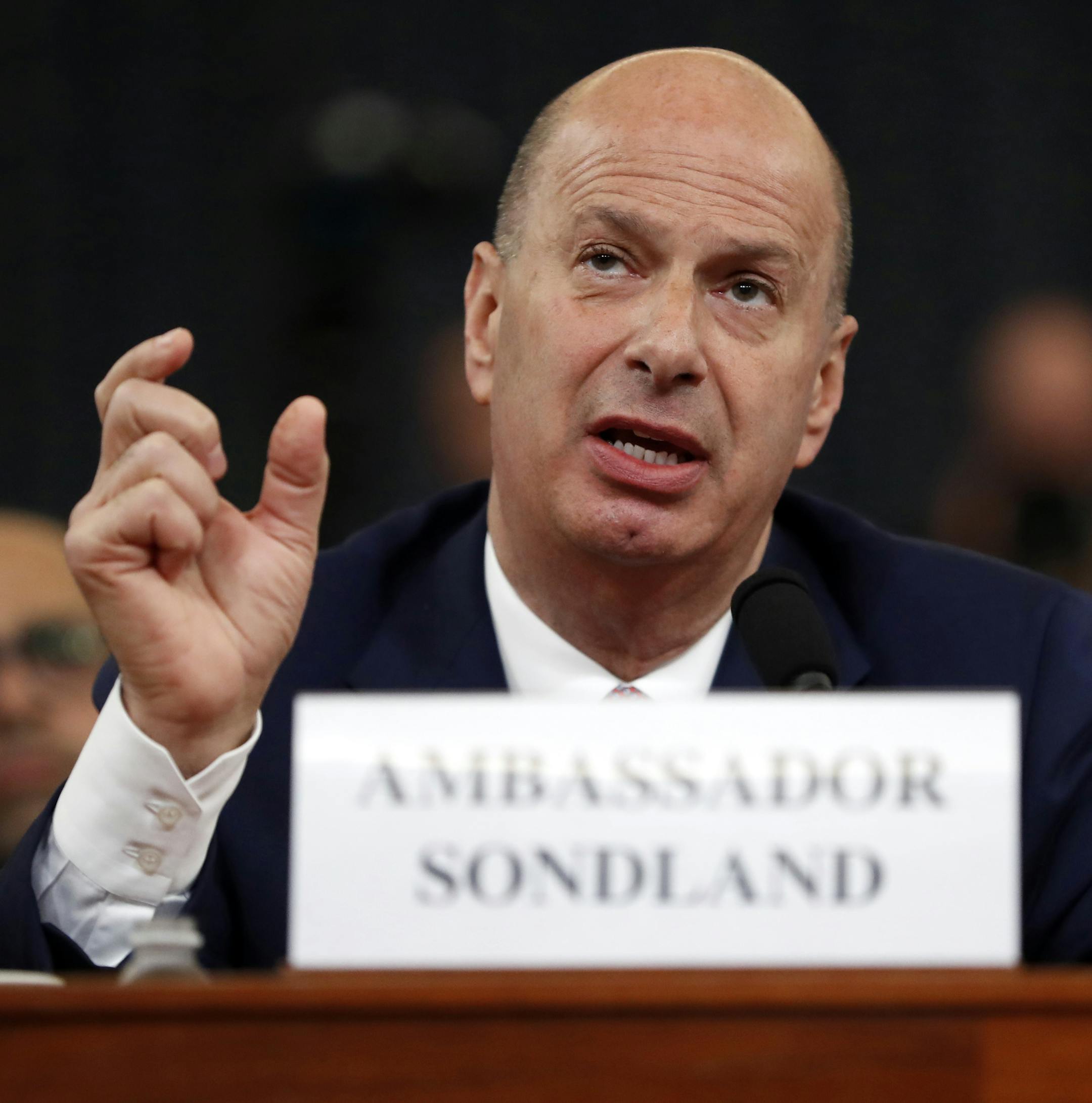
Gordon Sondland was in trouble. In the vernacular of the Trump impeachment inquiry that riveted at least part of the nation this week, he had "a Gordon problem" — that is, himself. A multimillionaire hotelier-turned-President-Donald-Trump-donor-turned-ambassador-to-the-European-Union, Sondland had not only been implicated as a key figure in a scheme to extort the Ukrainian government, but now he was appearing before the congressional inquiry to clean up past closed-door testimony that (in the vernacular of Watergate) was "no longer operative."
To save himself, Sondland fell back on the ultimate American story: immigration.
"My parents fled Europe during the Holocaust," the 62-year-old ambassador said, hot TV lights bouncing off his shaved head. "Escaping the atrocities of that time, my parents left Germany for Uruguay, and then in 1953 emigrated to Seattle, Wash., where I was born and raised. Like so many immigrants, my family was eager for freedom and hungry for opportunity." Sondland wanted the world to understand his story — away from tyranny toward wealth and a prestigious posting — as the American dream, not the nightmare now enveloping the nation's capital.
Time will tell whether Sondland's gambit worked, but the troubled witness was clearly tying his fate to what has emerged as the subliminal theme running through two weeks of impeachment drama. It's a story about a U.S. that was a safe haven for refugees fleeing totalitarianism and genocide, and how the people saved by that generosity became zealous defenders of America — only to see a dangerous demagogue threaten to drag their country into a muck that looked much like the faraway lands they'd escaped.
Thursday's star witness, former top White House Russia analyst Fiona Hill, spoke in her native accent about growing up in England and becoming "an American by choice" after her dad, a coal miner, was too sick to achieve his own dream of immigrating to the United States. She testified that her father "loved America, its culture, its history and its role as a beacon of hope in the world. He always wanted someone in the family to make it to the United States."
Hill thus echoed earlier witnesses like ousted U.S. Ambassador to Ukraine Marie Yovanovitch, who said she was grateful to America because her parents — who fled both the totalitarian USSR and, in the case of her mother, Nazi Germany — "did not have the good fortune to come of age in a free society." Sandwiched between them was Lt. Col. Alexander Vindman, the National Security Council's Ukraine expert, who was born in that country when it was part of the USSR but whose dad brought him and his siblings (including a twin brother, who also became a military officer) to Brooklyn's "Little Odessa" in 1979, after their mom died.
In 1986, the young Vindman twins were even featured briefly in a Ken Burns documentary on the 100th anniversary of the Statue of Liberty as an enduring symbol of America as an immigration refuge. This week, as Vindman addressed the House Intelligence Committee, he had some moving words for his late father: "Dad, I'm sitting here today, in the U.S. Capitol talking to our elected professionals. proof that you made the right decision 40 years ago to leave the Soviet Union. Do not worry, I will be fine for telling the truth."
These testimonials to America as a promised land taking in the world's refugees "yearning to breathe free" are almost as old as the nation itself, but suddenly they took on brand-new power and import in the willingness of people like Hill, Vindman and Yovanovitch to speak out and risk their careers for what they saw as our founding principles.


