

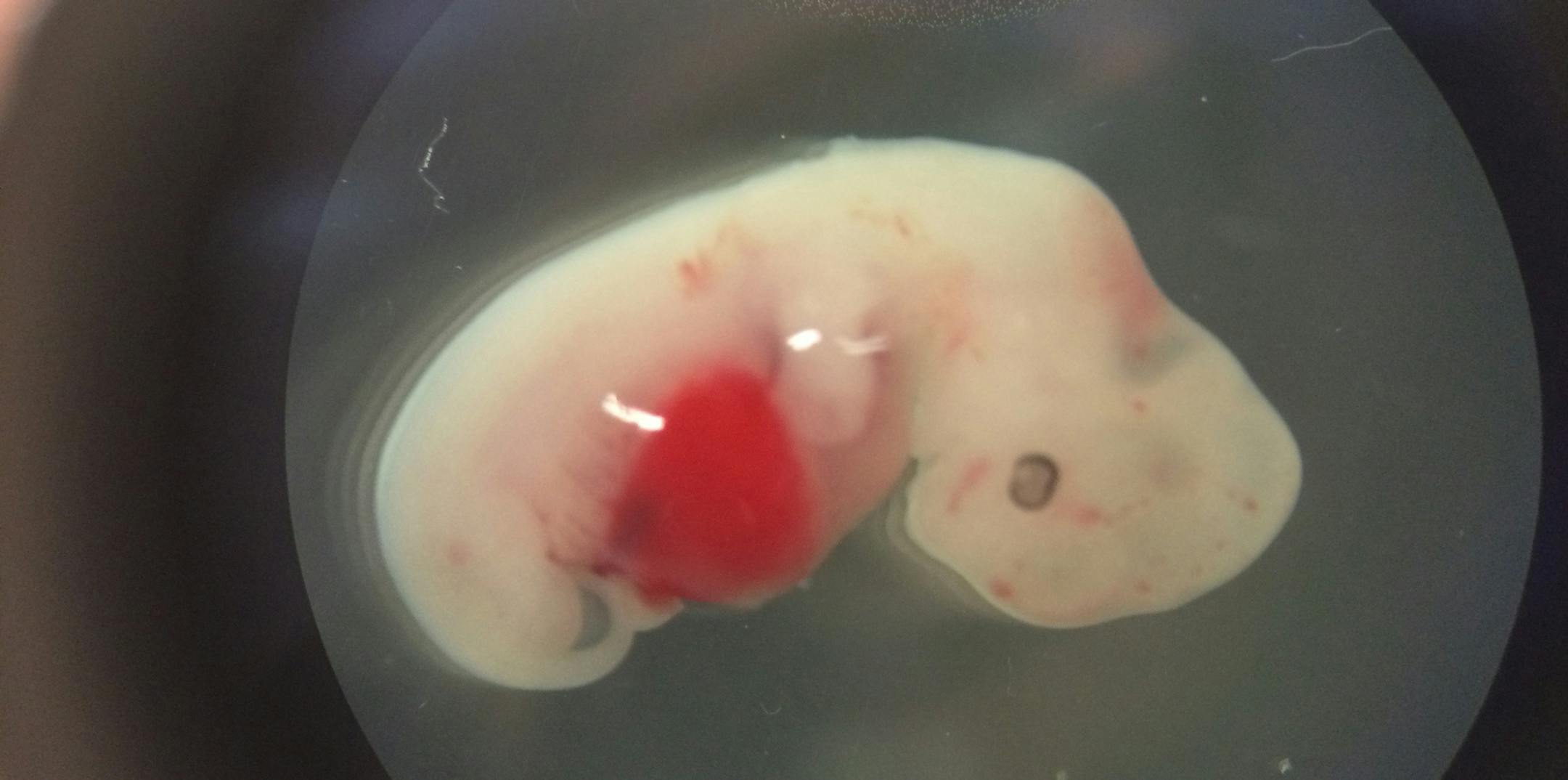
Last month, scientists announced that they'd created an unusual form of life. They started with pig embryos produced through in vitro fertilization, then injected them with a few human cells, then implanted them into sows, where they developed for three to four weeks. Most of the hundreds of embryos they created this way died, but 186 survived. For these, researchers reported, one of every 100,000 cells were human.
What they had produced is technically called a chimera — an organism made of a composite of cells with different genetic codes, and in this case from different species. News stories raised the hope of breeding pigs with "humanized" organs, promising to fill the growing need for transplants. Some also raised fears that scientists had ventured into an ethical morass by producing something part-human.
Ethicists have been pondering this kind of experiment since the 1990s, when biologists realized that such human-animal blending was possible. Back then, the standard narrative was that the science was moving too fast for ethics to keep up. But 20 years down the road, it looks like the problem isn't that science is advancing too quickly, but that the questions it raises are too profound to answer with a few committee meetings. Does adding human cells to pigs entitle them to human rights? What rights do ordinary pigs deserve? If humans deserve more rights than other species, is it because we're fundamentally superior to other animals, as was believed for centuries, or simply because we should give preferential treatment to our own kind?
These questions can become entangled in what New York University medical ethicist Art Caplan has called "the yuck factor." Research may repel people without posing any harm to them. Human-animal chimeras confront people with an uncomfortable truth about our similarity to our livestock.
Biologists who study pigs describe them as playful, inquisitive and sensitive to the feelings of other members of their species — which is more than we can say about some humans. In experiments, pigs have demonstrated various feats of intelligence, including figuring out how to use a mirror to find food. And pigs aren't unique in this regard: New evidence has shown that many animals display empathy and other emotional and cognitive traits once thought exclusive to humanity. So the boundary between human and animal may be blurrier than we once thought.
The latest species-bending work, which was published in the journal Cell, has roots in the late 1990s and early 2000s. That's when scientists learned to isolate cells from embryos created in fertility clinics and turn them into a sort of universal replacement tissue for damaged hearts, livers, skin, bones or brains. Scientists were interested in using neurons produced this way as transplant tissue to treat Parkinson's disease, and they considered the need to test such therapies on animals. That would mean transplanting human brain cells into mice or other test creatures.
At the time, Jason Scott Robert, a biology professor and ethicist at Arizona State University, looked into the prospect of what was being called a human neuron mouse. Doctors had helped some people with Parkinson's disease by implanting human fetal tissue, he said, but the results were uneven. These newly isolated cells from embryos looked promising, but scientists worried that they may not be able to force them all to remain brain cells. What if a few rogues converted to other kinds of tissues, seeding brain tumors?
Animal experiments seemed prudent, but the researchers realized the prospect raised new ethical issues. "There was a concern we'd be endowing creatures with cognitive and emotional characteristics that were decidedly human and this would be an inappropriate way to treat animals and a violation of human dignity," Robert said. Eventually, he and other ethicists reasoned that adding human cells to rodents was justified. But for technical reasons, work on the human neuron mouse stalled.


