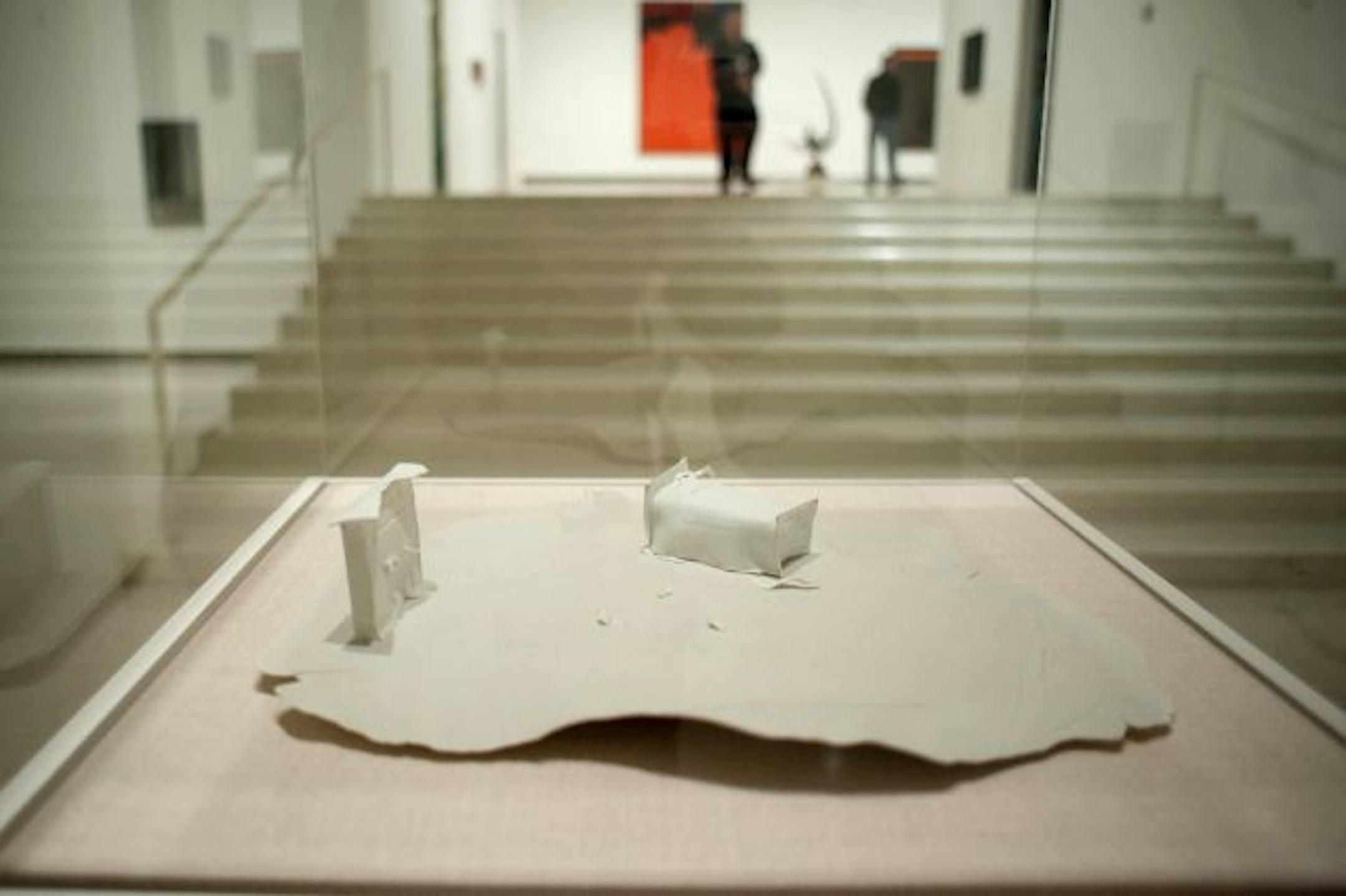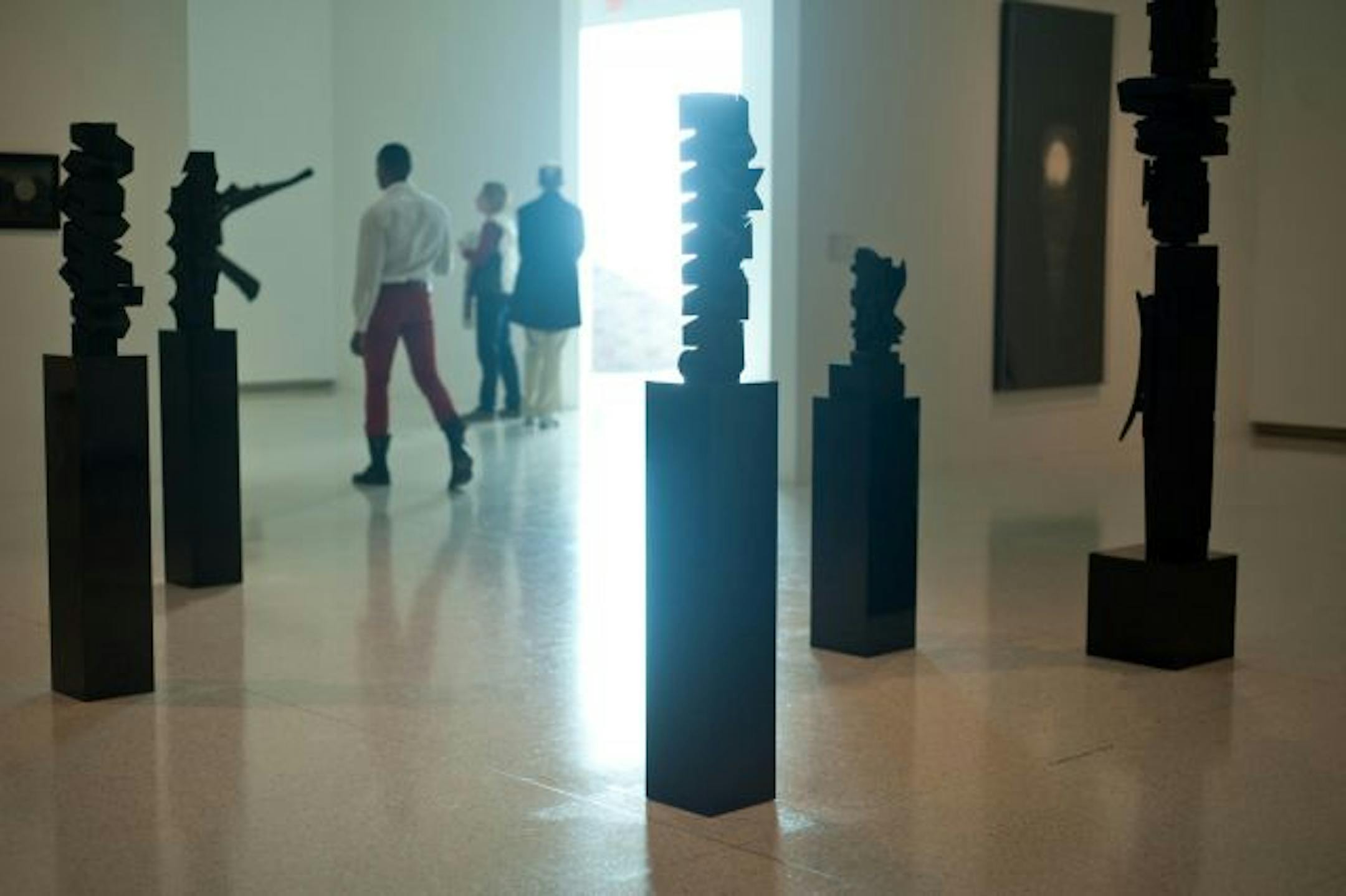
Be sure to pause at the entrance to "Midnight Party," Walker Art Center's enchanting new exhibit, to watch the brief film from which the show's title comes. Confected by hermetic American surrealist Joseph Cornell, the 1938 film is a four-minute fantasy comprising snippets from early silent movies. Charmingly innocent, it features all sorts of improbable encounters, dreadful dangers and magical escapes for a little ballerina and a prepubescent Lady Godiva around whom birds flap, flames flutter, tunnels loom and Zeus hurls thunderbolts. Nothing bad happens to the girls, of course, because they're in a dreamworld where "mystery trumps logic," as a text panel explains.
Like the film, the exhibit unfolds as a stream of fanciful images and objects -- paintings, drawings, films, sculptures, photos -- that tap those deep psychological undercurrents rippling through the somnambulant mind. Most come from the Walker's collection, including many pieces by new artists, and treasures (by Louise Nevelson, Jean Arp, Lee Bontecou, Kay Sage and more) that haven't been shown for years. Curator Joan Rothfuss has smartly added loans from other museums and private collections, including a stellar gallery of early-20th-century prints by Edvard Munch, Paul Klee, Odilon Redon, Ernst Kirchner and others.
Deftly installed, the show uses cinematic techniques -- subtle shifts of scale and mood, light and dark, enclosure and expansion -- to enhance the effect of the art. Add the maze-like layout of the galleries, the mysterious sounds and twinkling nickelodeon music from films that run continuously, and "Midnight Party" casts a mesmerizing spell.
For decades the Walker has built film booths into its exhibitions, but they've never been so integral or inviting as they are in this show, nor have previous exhibitions tapped such a rich vein of the museum's renowned film collection. The most astonishing is "Le Voyage dans la Lune," a 1902 short (yes, 1902!) by George Méliès in which top-hatted Victorians squeeze themselves into a tin-can spaceship and blast off to a blue-cheese moon that melts, a la Salvador Dali, while Gibson Girl rockettes dance in short shorts. You can't make this stuff up. But be sure to see it soon, because while the show will continue for the next three years, the films will change every few months.
Dream light
So how does all this hold together through three galleries? Beautifully. A dreamy darkness suffuses the first gallery. There stand five of Nevelson's elegant black totems from the 1960s, looking like abstracted African fetishes. Bontecou's fierce wall sculpture, a razor-toothed maw of stained canvas and grommet holes, hangs near a sketchy Susan Rothenberg painting of insect-like black figures suffused with a lemony Martian glow.
Around the corner is an incredibly elegant 1956 black-on-black painting by Jimmy Ernst, whose better-known father, Max Ernst, was one of the original Surrealists. A faceted, modernist landscape that suggests perhaps communication towers or surveillance equipment, Ernst's painting is a rarely shown gem. Beside it, Sage's enigmatic abstraction of a hooded figure recalls the haunting marble mourners on medieval tombs (a set of which are now on view at the Minneapolis Institute of Arts). And Robert Mallary's 1962 "Parachutist" sculpture, consisting of a stiffened tuxedo falling below a broken umbrella, is a comic nightmare. Plus, there's much more by Joan Miro, De Kooning, Bruce Conner, Carter Mull and myriad others.
In true dream-party fashion, there's also a diversion in the first gallery. It's a little deep-green room, decorated with a chandelier and a cushy boudoir-pink sofa, on the walls of which hang an amazing collection of color photos by Eugene Von Bruenchenhein, a marginally employed Milwaukee baker who amused himself for decades snapping pictures of his wife in fanciful get-ups ranging from leopard spots to Tahitian princess skirts and Hollywood cheesecake poses.