

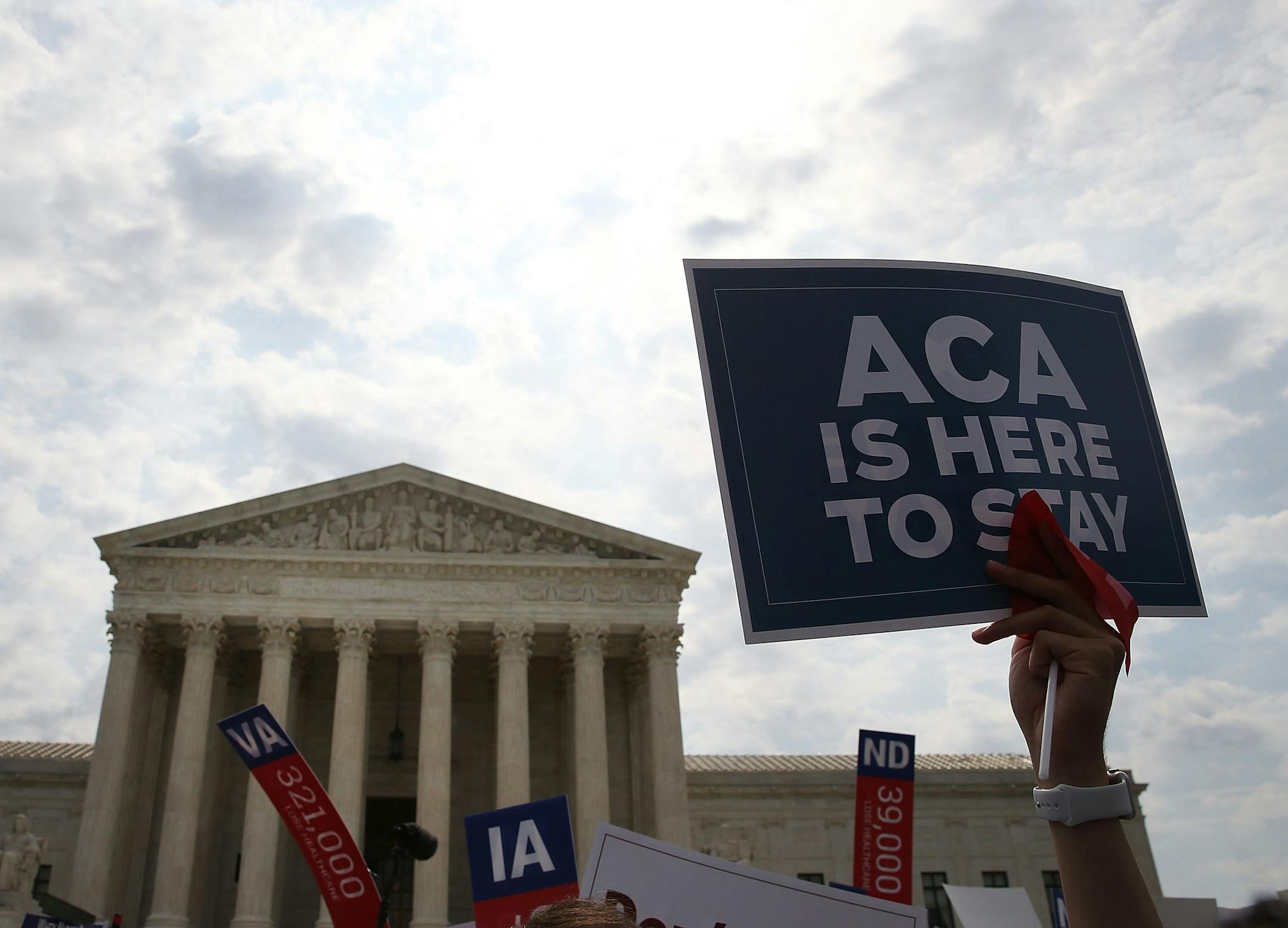
The Supreme Court signaled Tuesday during oral argument that it won't be striking down the whole Affordable Care Act as the Trump administration has asked it to do. The swing justices did seem especially eager to make their views clear — and to dispel any public fear that the court's ever-deepening conservative majority would do now what it failed to do back in 2012 and undo "Obamacare" altogether.
That's probably good news for Republicans, given that the 10-year old ACA is politically popular. And it's especially good news for Republicans facing runoff elections in Georgia, which will determine control over the U.S. Senate. It will now be much harder for Democrats to argue that Georgians should give both seats to the Democrats to protect or, if necessary, re-enact the ACA.
In truth, the possibility that the court might listen to the legal arguments of the Trump Department of Justice was always far-fetched. So it isn't totally fair to quote Mr. Dooley's famous observation that the Supreme Court follows the election returns.
The issue before the court is a little arcane, but it can be summed up with only a little bit of oversimplification. When Chief Justice John Roberts upheld the individual mandate provision of the ACA in 2012, he said the mandate was a tax that must be paid by anyone who didn't buy health care insurance in the private market or on a public exchange. Subsequently, Congress eliminated the penalty entirely. In effect, there is now no longer any penalty for not buying health insurance.
Trump's Department of Justice argued that, since the individual mandate is no longer a tax, it is now unconstitutional for the law to say you must have health care. To be sure, the law now says so without applying any penalty for nonobedience. So the question of whether the law is unconstitutional would seem to be pretty academic.
But here the Trump lawyers got creative. They argue that if the mandate is unconstitutional, then the entire rest of the ACA should also be struck down as unconstitutional. Nearly every legal commentator I know considered this argument preposterous. Yet the arguments made a decade back about the unconstitutionality of the individual mandate also seemed implausible when they were first made — yet went on to garner five votes at the Supreme Court.
On Tuesday, Roberts made it pretty clear that he thinks the correct legal result is to leave the rest of the ACA in place. He said in oral argument that "Congress left the rest of the law intact when it lowered the penalty to zero." Can't get much clearer than that.
As for Justice Brett Kavanaugh, the court's newly most powerful member, he said during the oral argument that "it does seem fairly clear that the proper remedy would be to sever the mandate provision and leave the rest of the law in place." The word "sever" here is legalese for separating the question of the legality of the individual mandate from the rest of the law. Kavanaugh was saying that the rest of the ACA should stay in place.


