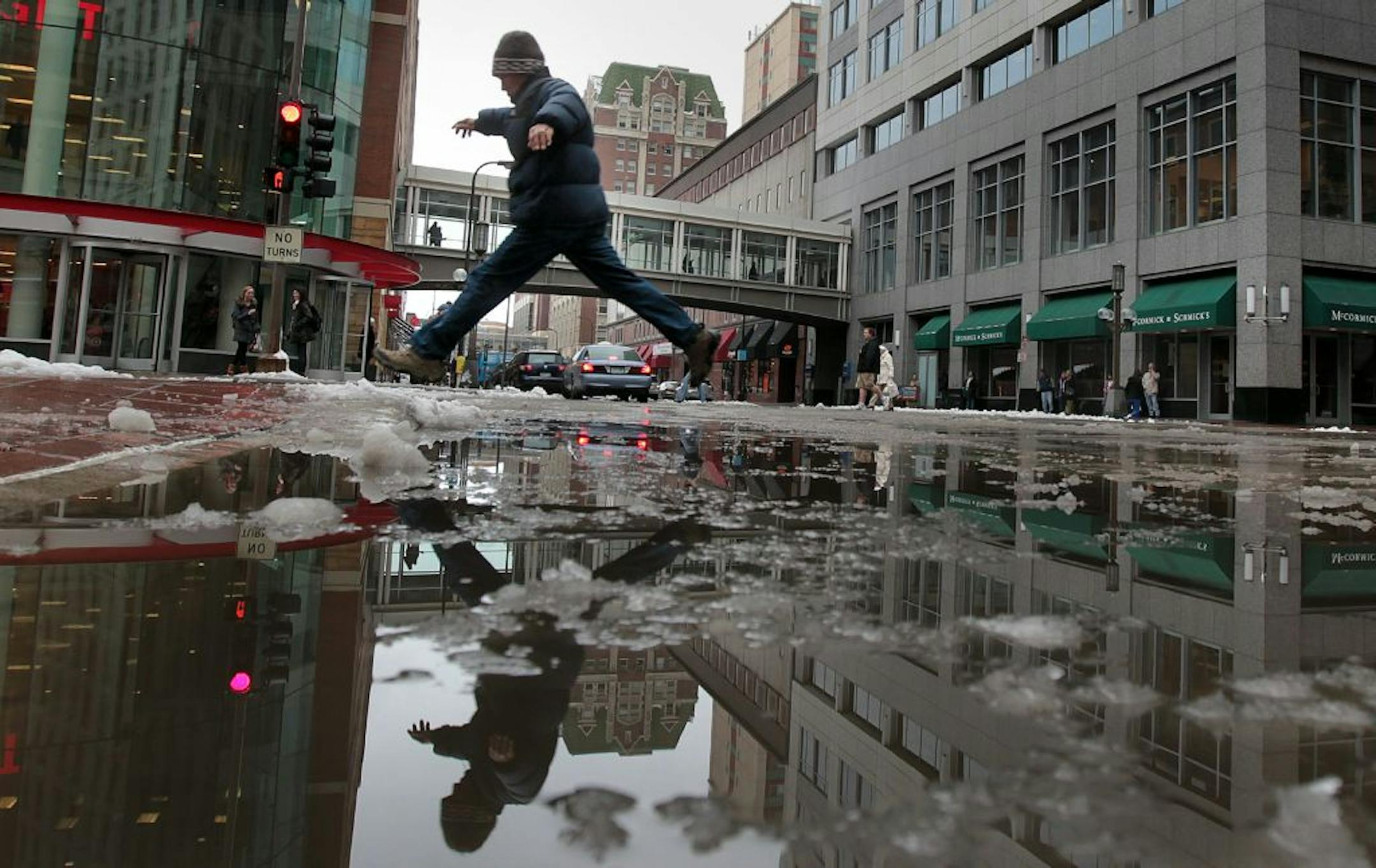
The Great Leap Day Snow Day might have brought headaches for commuters and backaches for shovelers, but it also provided a good preseason watering for the Minnesota landscape.
The blanket of wet snow and puddles of meltwater left by the storm tripped up the region's long-running drought and may be more likely than other snowfalls to nourish the buds of spring.
Mark Seeley, climatologist for the University of Minnesota Extension, said soils across Minnesota were so dry when they froze last fall that they might be able to absorb as much as half of the moisture that melts out of the new snow. In most years, he said, soils have more moisture in them when they freeze and thus can absorb only about 20 percent of what comes from winter snow cover. The rest runs off into lakes, streams and sewers.
This week's moisture may particularly benefit native plants, trees and grasses that have growth spurts early in the season, said Peter Moe, director of operations for the University of Minnesota Landscape Arboretum in Chanhassen.
Either as snow or rain, it was an extraordinary drenching.
In the Twin Cities, more precipitation fell Tuesday and Wednesday than in any entire month back through August. There was more precipitation each day than during the entire months of September, November or January. The burst pushed February precipitation to 1.71 inches, more than twice the normal amount, making it the first month with above-normal precipitation since July. The totals for Tuesday (.70) and Wednesday (.65) were both records for those dates, with Wednesday's being a Leap Day record that "might stand a pretty long time," said assistant state climatologist Pete Boulay. As the last day in February, Wednesday was also the final day of "meteorological winter," which comprises December, January and February.
The 2.2 inches of wet snow that fell at Minneapolis-St. Paul International Airport was also a Feb. 29 record. Other totals across the state were far more respectable, with double-digit depths from Alexandria to Duluth and on into northwestern Wisconsin.
Water for a wetland