

Raymond Rogers has made numerous trips to Madagascar over the past 25 years to study the island's rocks and fossils. Working with a team of international researchers, the chair of Macalester College's geology department has helped make discoveries about all sorts of ancient animals, including a giant predatory frog and a cannibalistic dinosaur.
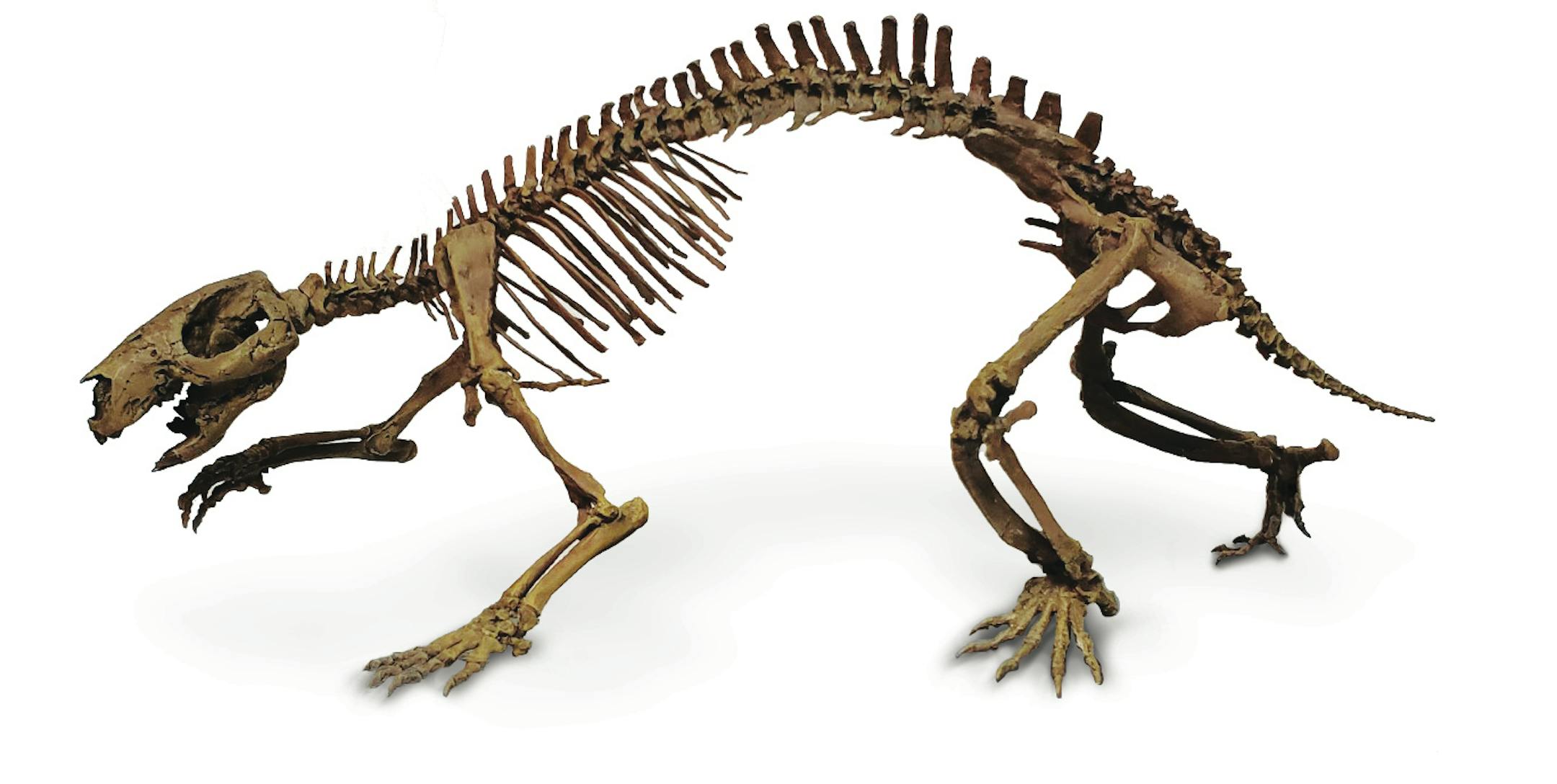
But the team's most recently published find, announced in the science journal Nature last month, is especially unusual: a 66-millon-year-old skeleton that is the most complete of any Mesozoic-era mammal ever discovered in the Southern Hemisphere.
The previously unknown creature had a cat-sized body, even though most mammals that lived among the dinosaurs were no bigger than a mouse. It also had an extremely sensitive snout and legs designed for both running and digging. The animal's anatomy was so bizarre that the team dubbed it Adalatherium, or "crazy beast."
Adding to the creature's mystery was the fact that the researchers didn't initially know they'd found it. The ancient skeleton was a "stowaway," Rogers said, that they'd unknowingly collected in the material surrounding another fossil.
Rogers has done fieldwork all over the world, from Montana to Zimbabwe, often with his wife, Kristi Curry Rogers, a paleontologist and Macalester professor.
Madagascar has been a primary focus for the couple, who were both part of the 1999 dig during which the team excavated a large sediment block around a small fossilized crocodile. It wasn't until the block was shipped back to the United States that a CT scan revealed Adalatherium's presence.
If 1999 seems like a long time ago, that's because scientific discovery is a painstaking process. After the skeleton was meticulously processed, it took years to study its anatomy. That work, led by paleontologist David Krause of the Denver Museum of Nature and Science, took a particularly long time in part because the fossil was so complete. And because scientists had never seen anything like it.
As the project geologist, Rogers' role is to date a fossil by figuring out the age of the rocks that surround it. He also reconstructs ancient ecosystems to determine how a particular organism became fossilized — a branch of paleontology called taphonomy, which he likens to the work of a crime scene detective.


