

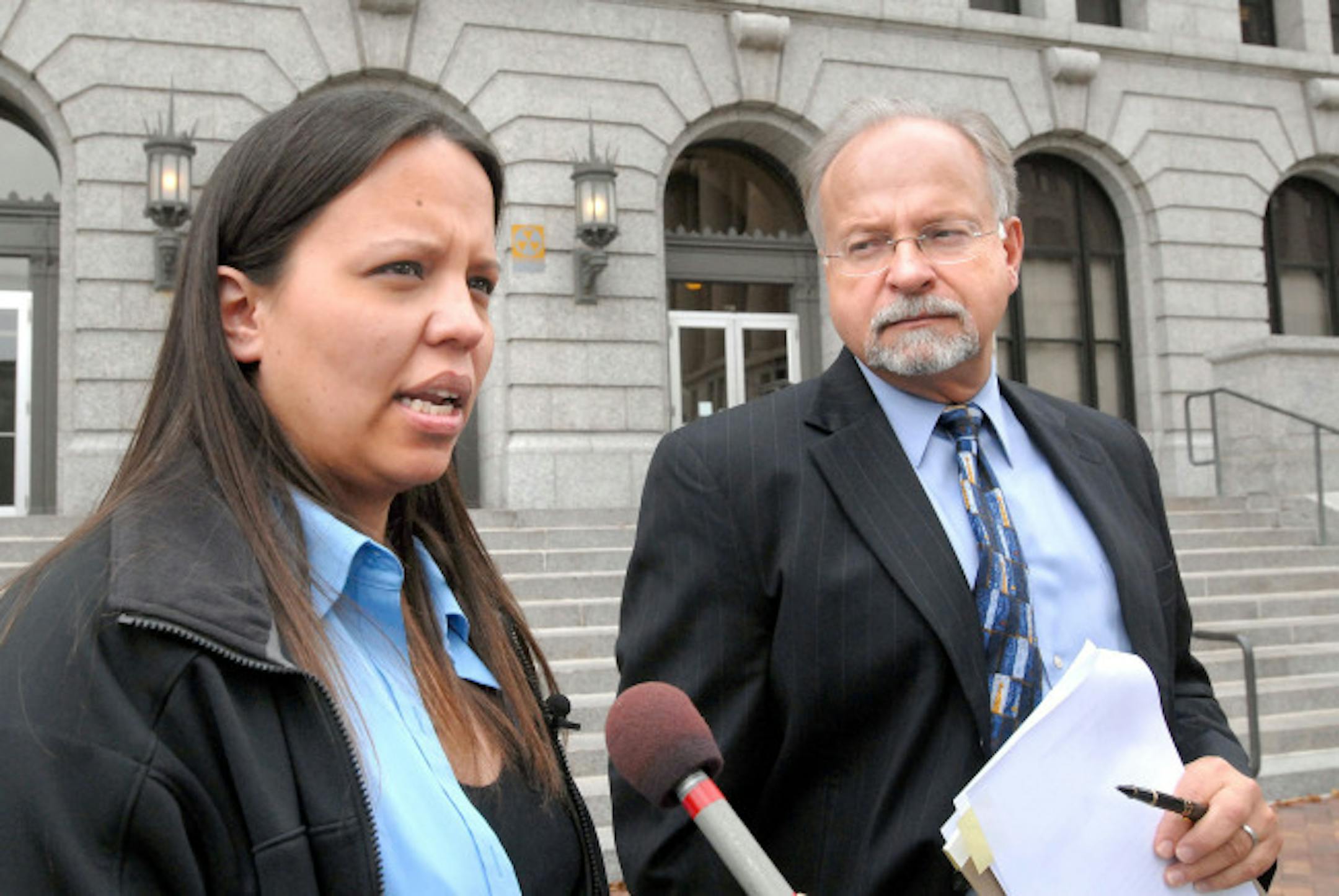
A six-year battle over illegal music file-sharing was revived Tuesday when the Eighth U.S. Circuit Court of Appeals sent the case of Jammie Thomas-Rasset back to court in Minneapolis.
A panel of three appellate judges ordered Chief U.S. District Judge Michael Davis to reinstate a $222,000 civil jury award against Thomas-Rasset, of Brainerd, Minn. Davis had cut the award to $54,000.
The music recording industry praised the appeals court's ruling, which could potentially give record companies more leverage to extract settlements from file sharers. However, the appellate court sidestepped the key issue of whether making recordings available for download violates federal copyright law, and some experts were skeptical that the latest ruling would further deter people from sharing files they download illegally.
Although Thomas-Rasset said her attorneys plan to appeal the ruling to the U.S. Supreme Court, there's no guarantee the high court will take the case.
Thomas-Rasset became the face of the music industry's fight against illegal downloading in 2006 at age 28. Several music industry organizations sued her when an online investigative firm alleged that she had used a file-sharing program called Kazaa.
Unlike many others facing such suits, Thomas-Rasset refused to settle with the organizations. A jury awarded the plaintiffs $222,000 in October 2007, charging her $9,250 for each song. But Davis concluded that he erred in a jury instruction and granted a new trial. He held that making a copyrighted work available to the public is not "distribution" under the law. That issue has divided the courts.
A second jury awarded the plaintiffs $1.92 million, or $80,000 per song. Davis found that amount "shocking" and cut the award to $54,000, or $2,250 a song. The plaintiffs refused the award, and after a third trial in November 2010, jurors awarded the plaintiffs $1.5 million, or $62,500 per song.
Thomas-Rasset appealed, arguing the award violated the due-process clause of the Constitution. Davis agreed and reduced it to $54,000 again. The appellate panel reversed his decision in an 18-page opinion and remanded the case with instructions to reinstate the $222,000 judgment. Thomas-Rasset did not object to that amount on appeal.


