
Scientists take to the depths to examine elusive whale sharks

It's one of the least understood animals in the oceans, with tiny, useless teeth.

The Associated Press
March 9, 2018 at 5:17AM
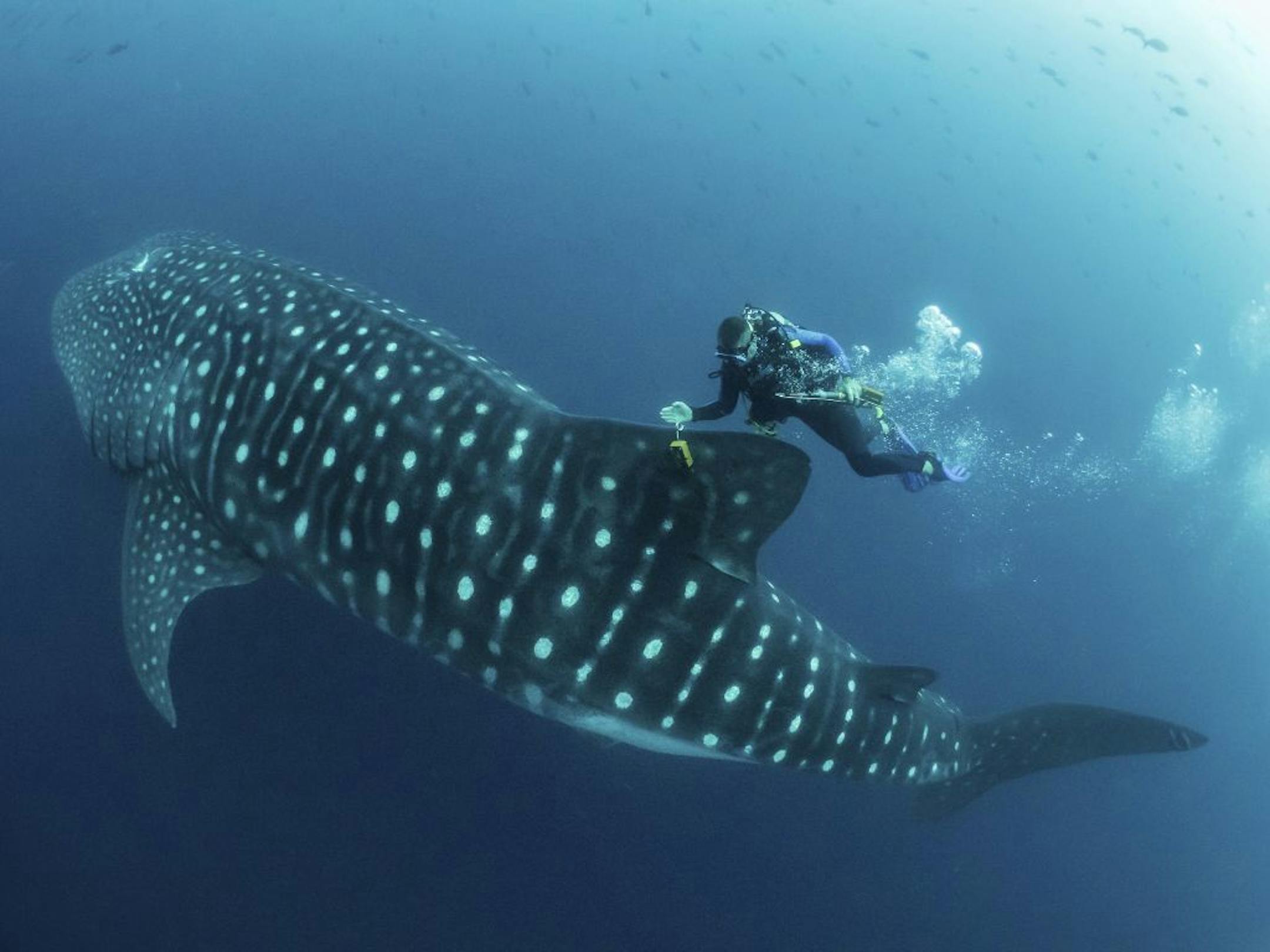
In this 2017 photo provided by Simon Pierce, Jonathan Green checks on a fin-mounted satellite tag on a whale shark in the Galapagos Islands area of Ecuador. Despite typically being bigger than a double-decker bus, the elusive whale shark has only tiny, almost useless teeth. It's also one of the least understood animals in the ocean.
In this 2017 photo provided by Simon Pierce, Jonathan Green checks on a fin-mounted satellite tag on a whale shark in the Galapagos Islands area of Ecuador. Despite typically being bigger than a double-decker bus, the elusive whale shark has only tiny, almost useless teeth. It's also one of the least understood animals in the ocean. (Associated Press/The Minnesota Star Tribune)

GALÁPAGOS ISLANDS, Ecuador – It's the biggest shark — and the biggest fish — in the sea, often found roaming in warm waters around the globe.

Yet despite its hulking appearance, the endangered whale shark has only tiny, almost useless teeth. While they are comparable in size to whales — bigger than a double-decker bus — whale sharks are sharks. It's also one of the least understood animals in the oceans.

While marine biologists have been tagging whale sharks in recent years, only one pregnant whale shark has ever been found: In 1995, a dead whale shark was found off Taiwan with 300 embryos inside. "The million-dollar questions are where are they mating, hunting and where do their young live?" said Jonathan Green, director of the Galapagos Whale Shark Project.

In an attempt to solve some of the most enduring mysteries, scientists tried never-before-used techniques on the species in the wild: taking blood samples and doing ultrasound exams, all while swimming with them in the Galápagos Islands. Because of the difficulty of conducting an exam on a whale shark — a wave of their tail propels them faster than any human — researchers only obtained two blood samples. "Nobody knew how to go about it," Green said. "Now that we have better technology and more experience, we will hopefully be able to answer some of the fundamental questions soon."

about the writer

about the writer

More from No Section

See More
FILE -- A rent deposit slot at an apartment complex in Tucker, Ga., on July 21, 2020. As an eviction crisis has seemed increasingly likely this summer, everyone in the housing market has made the same plea to Washington: Send money — lots of it — that would keep renters in their homes and landlords afloat. (Melissa Golden/The New York Times) ORG XMIT: XNYT58
Melissa Golden/The New York Times

It’s too soon to tell how much the immigration crackdown is to blame.