

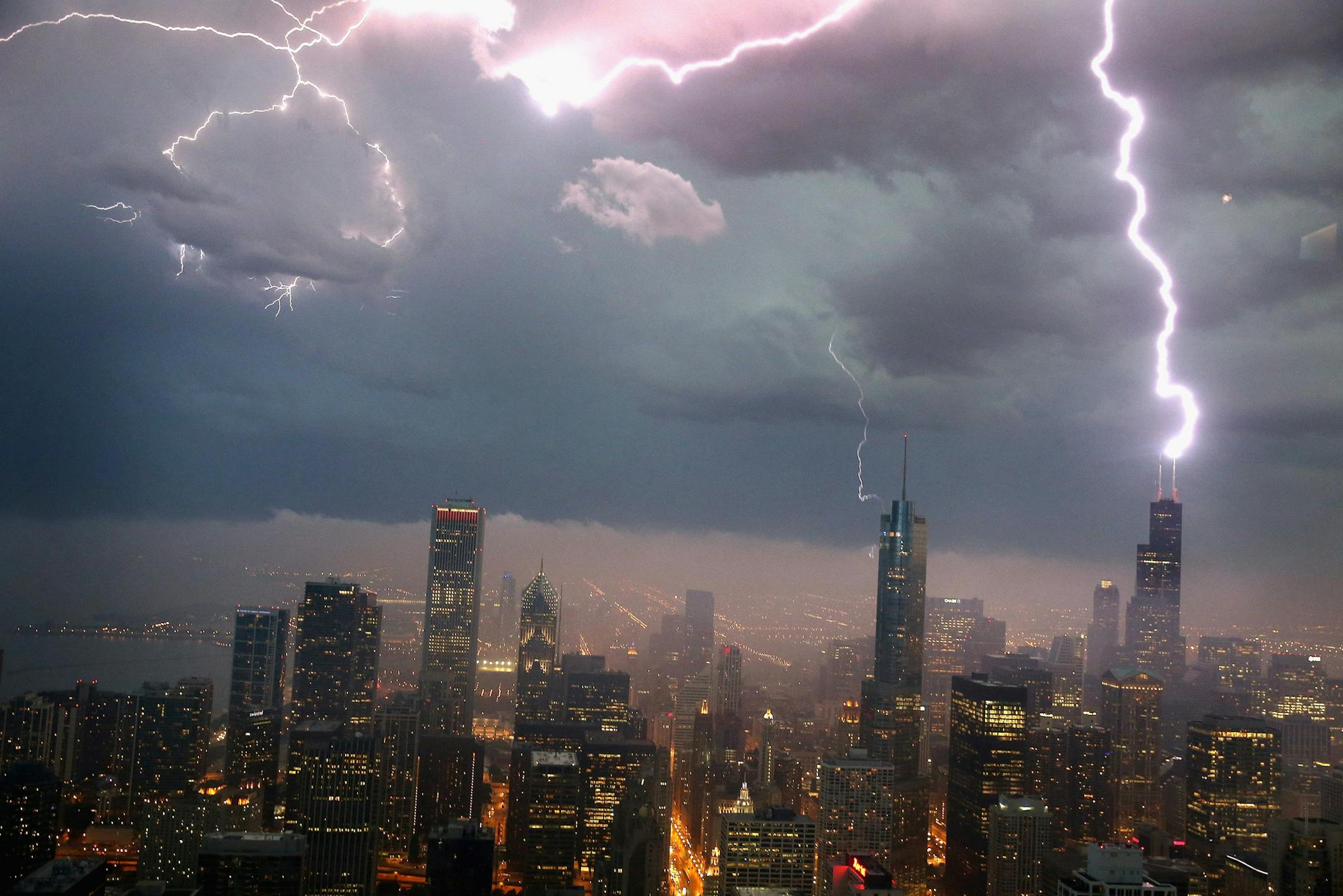
solar winds may spark lightning
The activity of the sun may have more of an influence on lightning storms on Earth than was previously thought.
Researchers at the University of Reading in England reported in the journal Environmental Research Letters that when an especially fast-moving solar wind washed over the Earth, there was a corresponding uptick in the number of lightning storms recorded on the planet.
Lightning strikes worldwide about 4 million times a day, and yet it remains a bit of a scientific mystery. Researchers said one possibility is that charged particles from the sun are riding the wave of fast solar winds. While they don't move quite as quickly as cosmic rays, they may move fast enough to serve the same function as the cosmic rays with the aid of a speedy push from the solar wind. "They aren't moving fast enough to hit the ground, but they can penetrate to where the thunder clouds are," said lead author Chris Scott, a professor of space and atmospheric physics. "So they could be making the air slightly more electrically conductive so that a spark can start and jump more easily."
Kepler canoes with light of sun
The planet-hunting Kepler spacecraft, unable to aim at the stars after two of its steering wheels broke down, is back on its celestial mission again, thanks to the power of sunshine.
During its four years in orbit, Kepler has detected 3,845 objects in distant space. But when two of its four reaction wheels jammed, the telescope couldn't aim properly. Engineers, however, have figured out an answer to the stability problem, said Charlie Soback, Kepler's project manager, one he called "canoeing with the sun."
Scientists have known that the sun constantly sends out bursts of high-energy, subnuclear particles known as the "solar wind." Now engineers have devised a system that uses the pressure of photons in sunlight alone — not the solar wind — to keep Kepler balanced as its two remaining reaction wheels keep it steady.
news services


