![TPT president Jim Pagliarini in Studio B in the TPT building. Studios are one thing that are not getting a massive makeover in the renovations in the downtown St. Paul, Minn. building photographed on Tuesday, December 17, 2014. ] RENÉE JONES SCHNEIDER reneejones@startribune.com](https://arc.stimg.co/startribunemedia/OOEW2QM2THLCNHN2I5OMRRZNVU.jpg?&w=1080)
Twin Cities Public Television's 25-year-old headquarters and studio building in downtown St. Paul has always had a pretty low profile despite being the nerve center of a highly visible media operation.
Its only real public-facing presence has been a small lobby off its skyway-level entrance. And even that was on a quiet spoke of the city's enclosed walkway system.
But much has changed since its construction in 1989. Lowertown has emerged as a full-fledged cultural phenomenon, the Green Line light rail now runs right by its front door, and the nearby Union Depot has been transformed into a transportation and community hub.
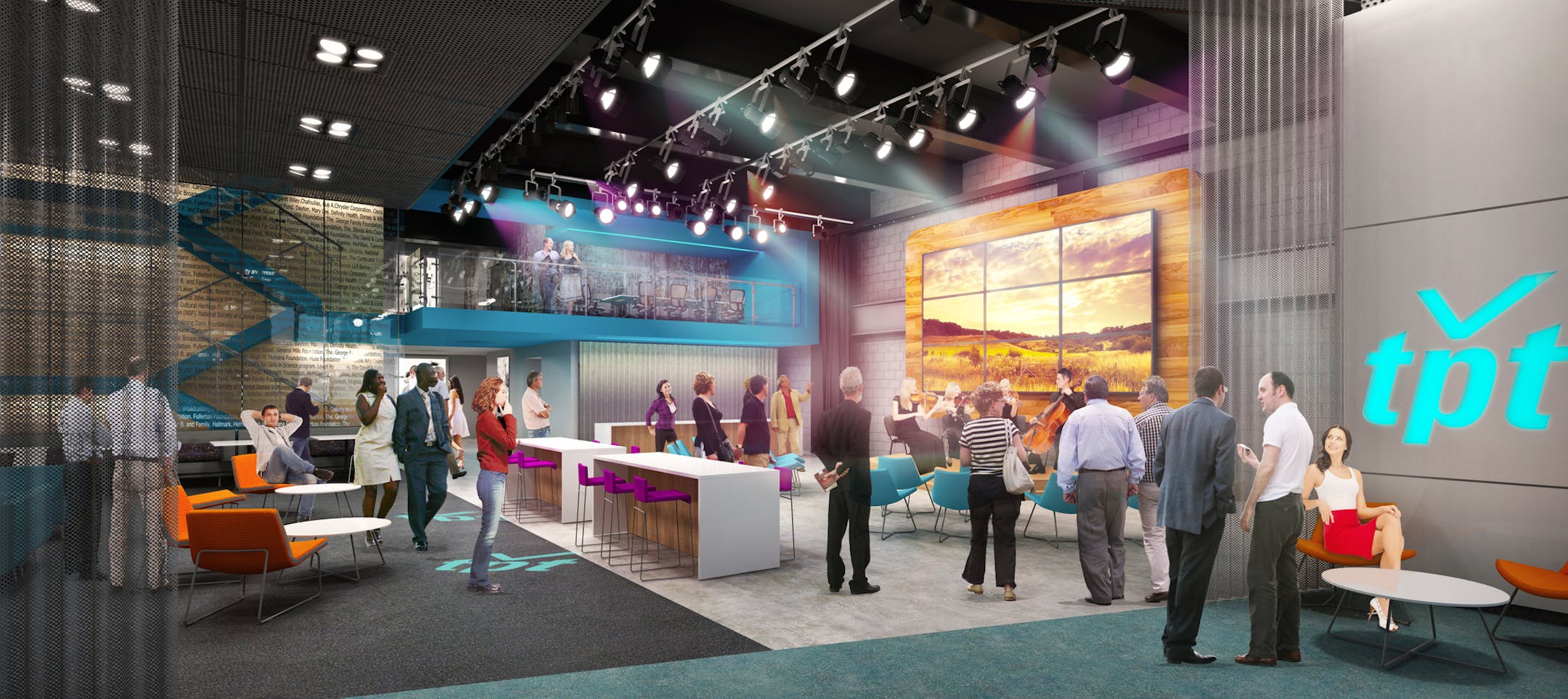
This fall, after 12 years of planning and dreaming, TPT finally began renovations that will transform the dated interior of its 105,000-square-foot headquarters, opening it up to the public and tapping the new creative energy and traffic of the surrounding Lowertown neighborhood.
"Years ago, we were kind of anticipating the revival and renaissance of Lowertown, and so we began planning for this," TPT President and CEO Jim Pagliarini said during a tour of the renovations this week. "What it represents, really, is the tangible evidence of a new covenant we've committed to with our nonprofit partners. For us, it's about openness, collaboration and community."
In all, the renovation work will cost about $20 million, with $11 million of the total coming out of a $40 million capital fundraising campaign led by General Mills Inc. CEO Ken Powell and retired Best Buy Co. Inc. CEO Brad Anderson. The other $9 million is from state bonding money. The renovation team is led by project architects the Cuningham Group and general contractor McGough Construction.
A 5,000-square-foot space on the building's 4th Street level — previously an underused storage area — will be transformed into TPT's new public entrance, doubling as an acoustically engineered performance space. Pagliarini said the big new room will be programmed by TPT's nonprofit partners, such as the St. Paul Chamber Orchestra and the Schubert Club, and will mostly cater to downtown lunchtime audiences.
"The idea is to try to really make this as accessible as possible, and my vision is that people bring their brown-bag lunches, hear something nice, and really feel good about being a part of this community as well as about TPT," Pagliarini said.