

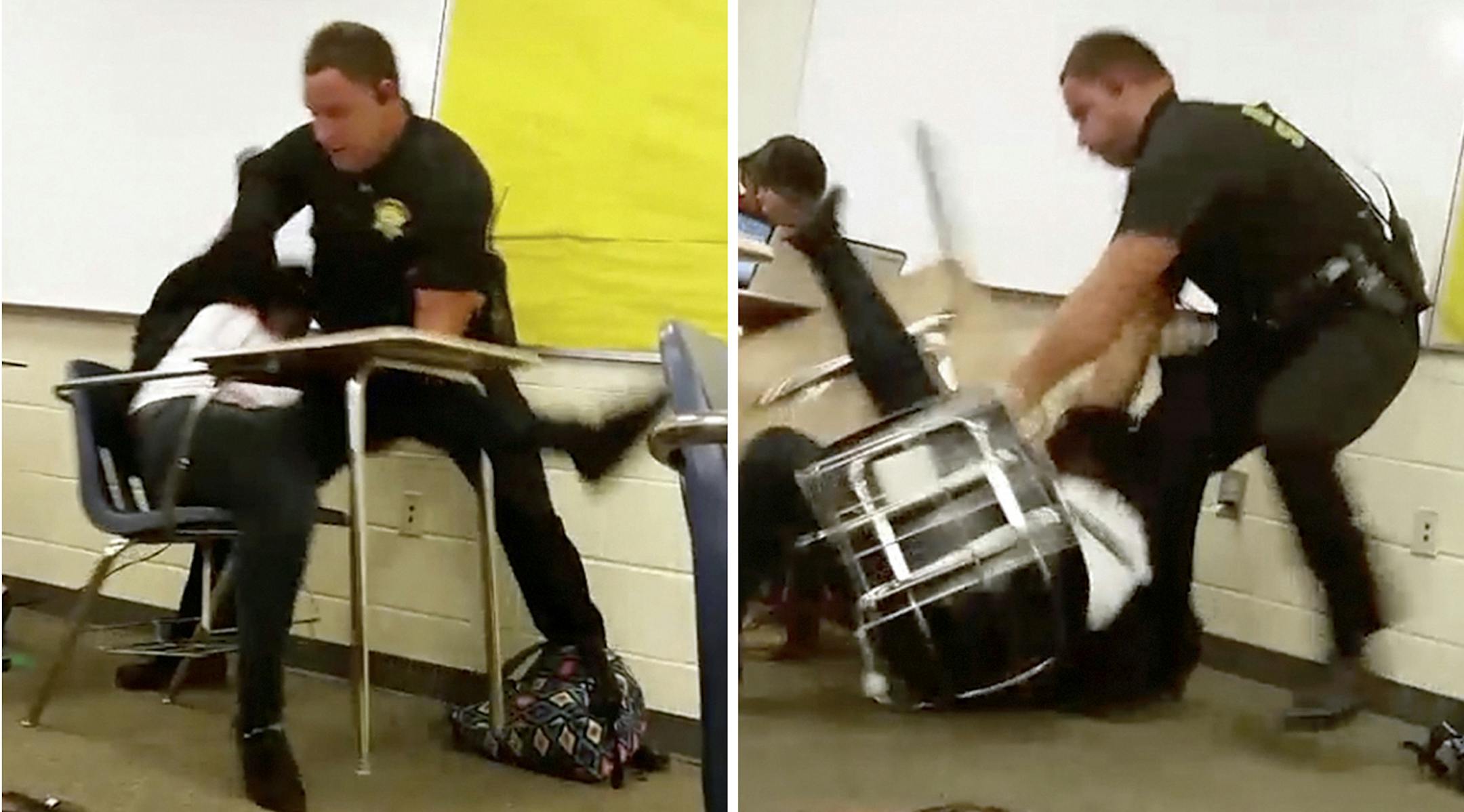
Once again, we see a police officer in trouble ("Sheriff fires deputy for tossing teen across classroom floor, saying she posed no danger," StarTribune.com, Oct. 28). And once again we see the news media all over it, making the student the poor victim and the police officer the ogre. All of the interviews are people talking about the poor student and blame being put on the police force. The news media covers a group of angry people protesting at a school board meeting and represents them as the voice of the entire community. And all of a sudden the perpetrator of the problem, the student in this situation, instead of being punished, becomes more popular in the eyes of her peers because of all the attention she drew. It doesn't matter that she was disrupting a whole class of students and now is responsible for a police officer losing his job.
The only meaningful interview was with the police chief, who said the officers shouldn't have to be in the schools. So who is to blame? There are several possibilities: parenting, schools lacking severe enough discipline policies, the police, the community, and on and on. I say all of the aforementioned must be looked at and the true problems addressed. And who represents one of the worst problems and is the least helpful in all of these situations? I say the news media. They are there like piranhas trying to outdo one another at sensationalizing all of these situations. News reports are now more like "Entertainment Tonight" than news reporting. Where is investigative reporting, in which, in the past, a reporter would investigate in detail and report on all the facets of the problem and become part of the solution instead of part of the problem? Yes, the news media are a big part of the blame, but we all share part of it because we have allowed this type of coverage to go on by giving the highest ratings to the most sensational headlines and stories. Shame on us!
Bill Koch, Blaine
• • •
I don't want our students being manhandled and bullied by the police (or suspended or expelled and thrown out in the street). I expect, starting with the principal, that there are competent and well-educated professionals capable of handling the emotional, psychological and conceptual problems associated with the maturation process. I demand that they exercise patience and use all of the acumen afforded by their considerable education and the resources of the state. Student misbehavior is entirely an administrative problem. It's not an easy job. It's like being a policeman. Not everyone can do it well, and some should step aside.
John Crivits, St. Paul
• • •
FBI Director James Comey has stated unequivocally that Black Lives Matter is causing an increase in crime because (and can you believe this?) police officers are intimidated by the fact that their actions are being scrutinized and excessive use of force and racial profiling are being criticized. Perhaps Comey would prefer a police state — an environment where Gestapo-like behavior is the rule.
The clear facts are that racism is rampant in today's police forces and the use of force is excessive far too frequently. How many unarmed black people have been shot down in just the past 12 months? One would be too many, but it has been far more than that. We have seen the videos of white police officers smashing down black women half their size. Put the YouTube videos together and you witness a level of racism greater than exists anywhere else in the industrialized world.
Every police officer everywhere needs to be continuously asking himself or herself: "Would I make this stop or take this action if the person was white?" The job is to "protect and to serve." And that applies to every citizen of every race, creed, color, gender or sexual preference. Frankly, we need far more scrutiny to bring about a world where the police officer can again "be our friend."


