

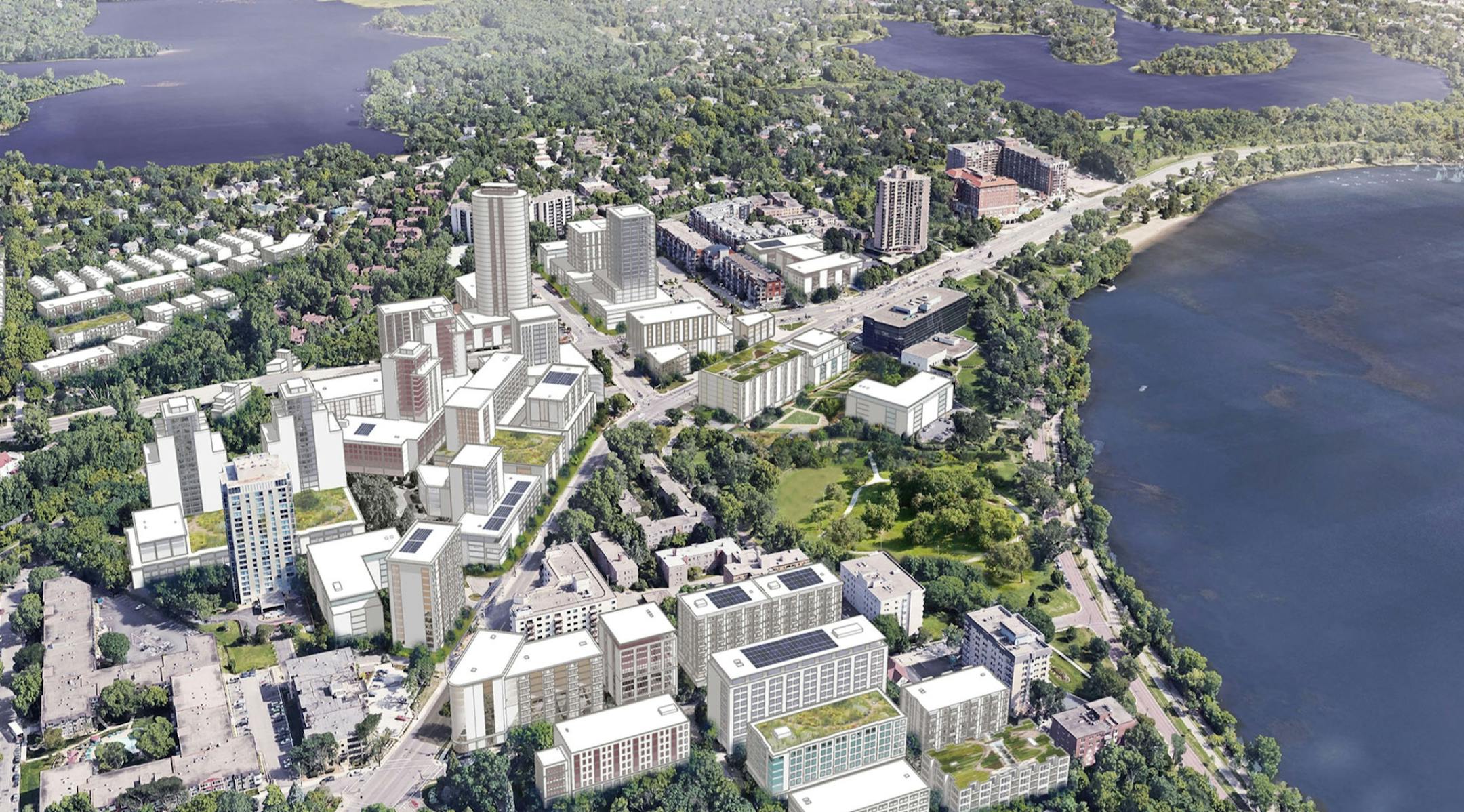
Thank you for the recent article on citizen concerns regarding density in the Minneapolis 2040 plan ("As Mpls. touts density, residents push back," May 21).
Specifically, the Minneapolis 2040 plan envisions a 33-story building and four 22-story buildings near the already congested Lake and Excelsior interchange. In total, 19 buildings would be 10 stories or more, some two blocks from the lake.
Density has its place, but should density destroy destination? Is it OK to allow developers to permanently alter the views of three of our most beautiful lakes?
It is ironic that the same city that so empathetically changed a lake name to honor our Native American ancestors is now so anxious to destroy the visual serenity of the same lake. City planners' Bde Maka Ska of the future: Lake. Trees. No more sky.
John S. Berestka, Minneapolis
• • •
Outside of downtown Minneapolis, the Minneapolis 2040 Comprehensive Plan envisions linear growth — bigger mixed-use buildings strung out along arterial streets. Fantasy arterial streets, actually. In a series of sketches showing different densities, the common element is a scarcity of vehicles on the arterial streets, and not many pedestrians, either. It envisions a growing city turned into a ghost town.
This is proposed in the name of creating economically and culturally diverse neighborhoods. But the needs of a successful neighborhood and the needs of a successful arterial street are different, and incompatible. The primary value of an arterial street is to move people from one part of the city to another as quickly and efficiently as possible. The primary value of a neighborhood is to move people short distances in a way that is as pleasant as possible, that promotes encounters with neighbors and that creates a sense of social vitality.
Rather than creating a city full of big new buildings in strips a block wide and miles long, the city should focus on creating "nodes" or neighborhoods a few blocks wide and a few blocks deep, where residents on the upper floors of the new mixed-use buildings can become street-level pedestrians, circulating among shops, offices, services and amenities in an area with only local vehicular traffic. Each such "node" should adjoin an arterial, so individuals can use mass transit or driverless Uber cars to reach more distant destinations.


