

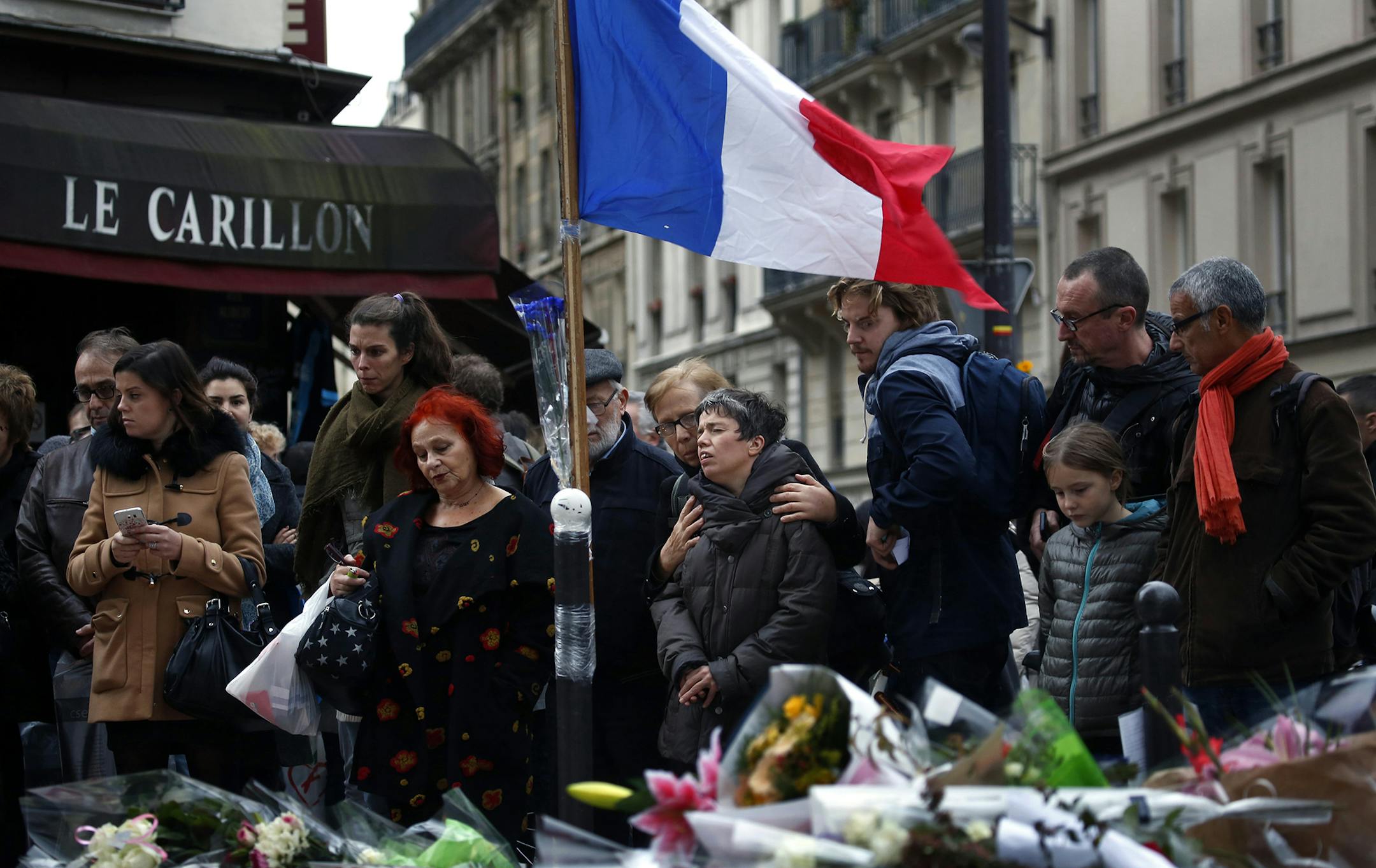
While the Islamic State of Iraq and the Levant (ISIL) has now proved an unexpected capacity for overseas attacks, the end result will almost certainly be a quicker demise of the original political-messianic project. Why did striking out at foreign powers suddenly become a priority?
The battle to carve out the new homeland has hit some rough patches. The euphoria after the taking of Mosul in June 2014 has faded, and the conquering of Fallujah last summer has yielded no real strategic advantage. Indeed, it has begun to unite ISIL's fractious enemies: the Iraqi military, Iranian-backed militias and Kurdish forces.
Meanwhile, Russia's military intervention to prop up Syrian dictator Bashar Assad, even if it has been more directed at U.S.-backed Syrian rebels than at ISIL forces, bodes ill for the jihadis. Most important, even as the terrorists were carrying out their spree in Paris, Kurdish Peshmerga forces were mopping up after successfully taking the key Iraqi city of Sinjar this week.
All of these developments may cut deeply into the narrative of scriptural inevitability that ISIL uses to attract and keep its followers. The problem with a doomsday cult is that you have to keep your followers on edge, believing that the apocalypse is just around the corner.
In any case, as ISIL and its supporters congratulate themselves, seeing a barbaric victory in Paris, they are forgetting the fate of another extremist Muslim group, one that had actually come much closer to achieving its dream of a lasting fundamentalist political entity but got mixed up in a spectacular terrorist attack against the West. One suspects that, in hindsight, the Taliban rues the day it gave Osama bin Laden sanctuary to plan 9/11. Let's hope that someday soon, as its last adherents die or slink away, ISIL feels the same way about 11/13.
Tobin Harshaw, Bloomberg View
Like millions of people, I've been obsessively following the news from Paris, putting aside other things to focus on the horror. It's the natural human reaction. But let's be clear: It's also the reaction the terrorists want. And that's something not everyone seems to understand.
Take, for example, Jeb Bush's declaration that "this is an organized attempt to destroy Western civilization." No, it isn't. It's an organized attempt to sow panic, which isn't at all the same thing.


