

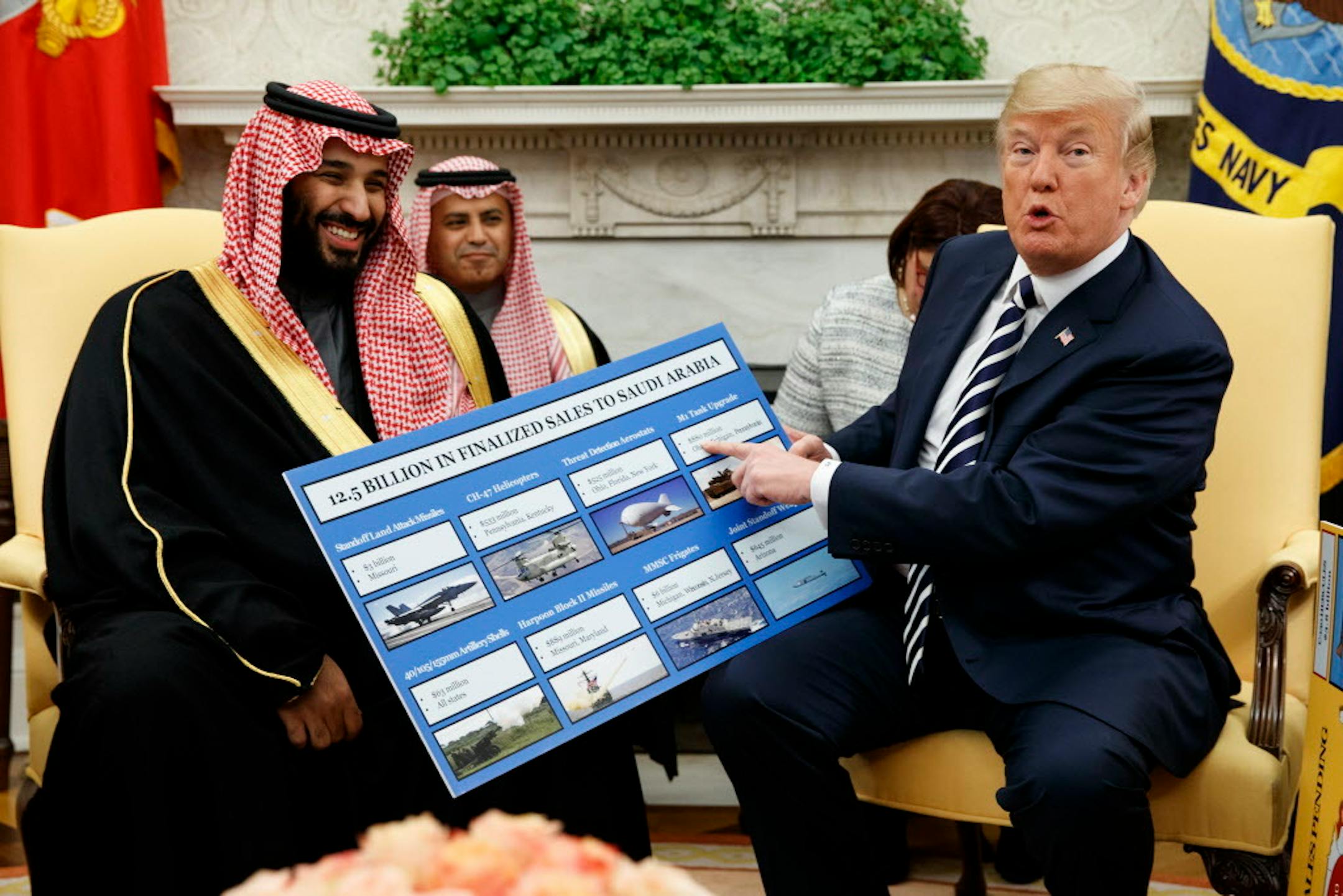
That Donald Trump has been reluctant to pressure Saudi Arabia should be clear by now. Yeah, Trump warned about "severe punishment" if it turned out the Saudi government was responsible for Washington Post contributor Jamal Khashoggi's death, but his heart wasn't in it. Despite massive corporate cancellations to Saudi Arabia's "Davos in the Desert" conference, Treasury Secretary Steven Mnuchin still planned to attend as of Tuesday. When asked over the past week about the question of pressuring Saudi Arabia over Khashoggi's disappearance, Trump has given one of two kinds of responses. The first is to stress Saudi Arabia's denial:
"Just spoke to the King of Saudi Arabia who denies any knowledge of whatever may have happened 'to our Saudi Arabian citizen.' He said that they are working closely with Turkey to find answer. I am immediately sending our Secretary of State to meet with King!" Trump tweeted Oct. 15.
As Post writer Aaron Blake observes, Saudi Arabia now joins the coveted club of inner-circle Trump cronies who, by denying things, get off the hook: Crown Prince Mohammed bin Salman, Rob Porter, Kim Jong Un, Roy Moore, Vladimir Putin and Brett Kavanaugh, among others.
The second kind of Trump response is to suggest that the United States lacks leverage because any pressure would jeopardize massive arms sales to Riyadh. There are several dubious dimensions to this. Post Fact Checker Glenn Kessler found the claim of $110 billion in arms sales to Saudi Arabia seriously wanting:
"Most of the publicly announced items had been previously announced by the Obama administration and there appeared to be few, if any, signed contracts. Rather, many of the announcements were MOIs - memorandums of intent. There were six specific items, adding up to $28 billion, but all had been previously notified to Congress by the Obama administration. . . .
"A review of the announcements on the Defense Security Cooperation Agency website since Trump's 2017 trip reveals that, besides 1/8the Terminal High Altitude Area Defense system3/8, there have been six State Department announcements of approval of Saudi sales, totaling just $4 billion.
"According to the confidential 2017 document of all of the military-sales agreements reviewed by The Fact Checker, most of the items did not have delivery dates or were scheduled for 2022 or beyond."
Meanwhile, Naval War College professor and arms sales expert Jonathan Caverley wrote in the New York Times that in the U.S.-Saudi relationship, the United States had significantly more leverage:


