

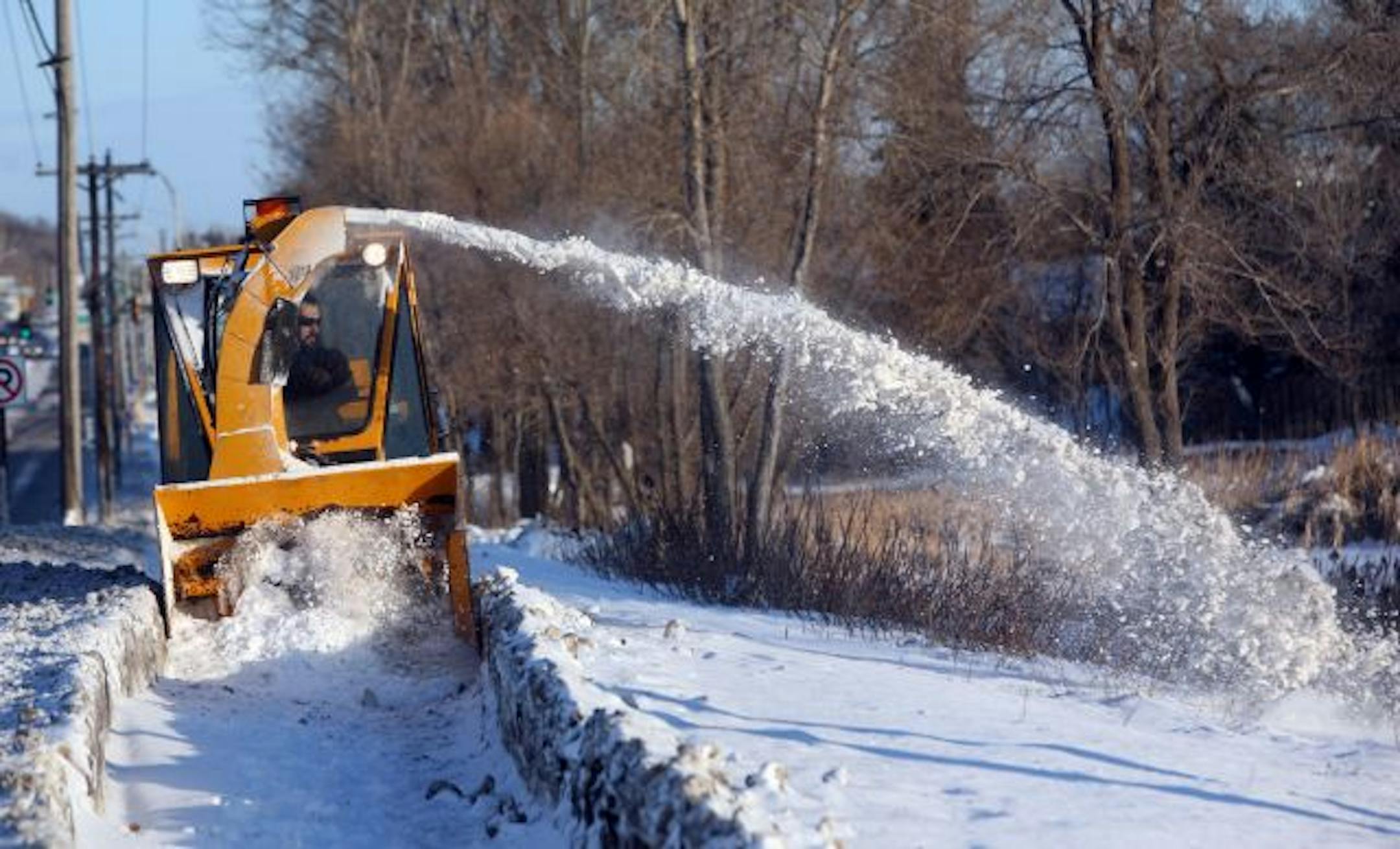
Next time you're heaving snow from your sidewalk, consider this (or maybe not): If you lived in Shoreview, Bloomington, Golden Valley or a handful of other metro suburbs, the city would do it for you.
That's just how it's been done for years, in many cases, and city officials say the service will continue, despite shrinking budgets and weather strains like the hellacious snow and ice the metro area has gotten over the past month.
Part of that is a commitment to safety and walkability, and part of it's about maintaining a service residents have come to expect.
Mark Maloney, Shoreview's public works director, is vice president of the Minnesota Public Works Association. When sidewalk snow removal was referred to as an "amenity" in a recent conversation, he begged to differ. He noted that the miles of trails and sidewalks in his city have increased by 25 percent during his 15-year tenure and that surveys have shown that residents value well-maintained sidewalks and trails they can use to get around without getting into their cars.
"In this community, it is not an amenity; in this community [sidewalks] are something that is considered essential for quality of life," he said.
So if residential service is considered essential in Shoreview, why isn't it offered in Minneapolis or St. Paul, where homeowners must clear their own sidewalks? For starters, consider scale. In Minneapolis, 2,000 miles of sidewalks line both sides of almost every city street, while in St. Paul the total is 1,007. Shoreview has 65 miles, most of it along major thoroughfares, not residential areas. In the core cities, the public works departments do clear sidewalks around municipal properties.
While Shoreview's sidewalk snow-removal budget is $55,000 a year, and Bloomington's is $150,000 for 250 sidewalk miles, comprehensive sidewalk clearing would pile about $3 million onto Minneapolis' $7 million snow-removal budget, said Mike Kennedy, the city's director of transportation, maintenance and repair. Even so, service would take 5 to 10 days, compared with the current everybody-chips-in system that is meant to result in relatively clear sidewalks within 24 hours after snow's end.
"It's about cost and livability," Kennedy said, "and a lot of it is about culture. The culture in Minneapolis has always been that way, that residents are responsible for their sidewalks. So they have always done it."


