

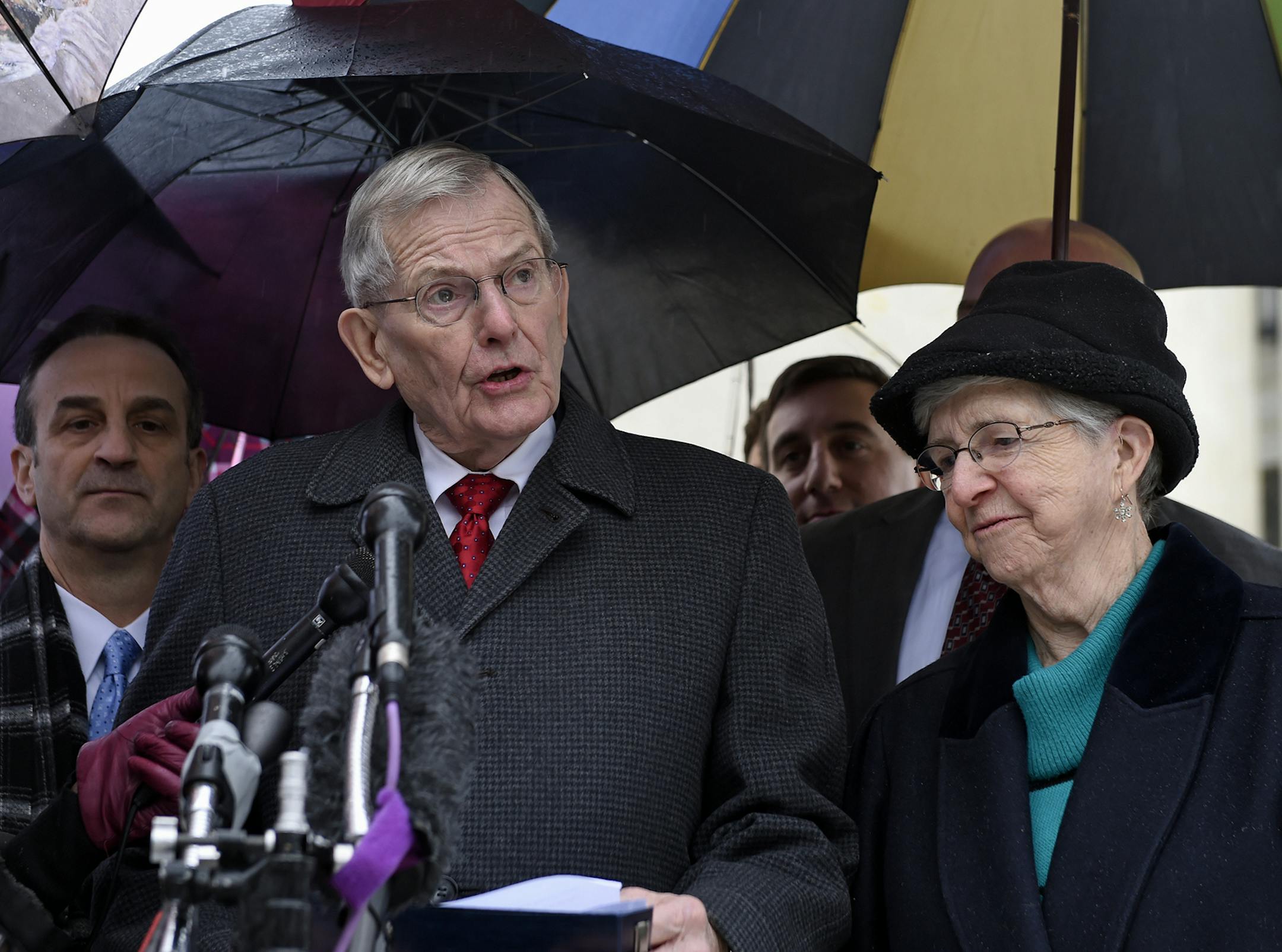
What's free speech for? There's probably no more important question in modern American public life — or so says this professor of the First Amendment. On Monday, the U.S. Supreme Court took a stab at it in a case about directional signs guiding worshipers to the Good News Community Church of Gilbert, Ariz. The oral argument showed how sometimes the most trivial laws can generate the most fundamental constitutional issues.
The case, Reed vs. Town of Gilbert, involves a municipal ordinance that regulates signs. The town's law distinguishes between political signs, ideological signs and directional signs put up temporarily to help people find an event.
Political signs can be as large as 32 square feet and can be posted anywhere, including on the public right of way — but have to come down within 10 days after the election. Ideological signs can be only 20 square feet, but they, too, can be on the public right of way — and they can be kept in place forever. Directional signs can be only 6 square feet. They can be put up only within 12 hours of the event announced — and they can't go on the public right of way at all, only on private property.
The Good News Community Church doesn't have its own building. It rents space from local institutions. The church was in the practice of putting up as many as 17 directional signs in advance of Sunday worship; the signs apparently didn't comply with Gilbert's ordinance. The town sought to require the church to comply — and the court case ensued.
The church's argument is straightforward, but also far-reaching: It says the town can't distinguish between political, ideological and directional signs without violating the First Amendment's prohibition on the regulation of content. According to the church, the town must treat the directional signs exactly the same way it treats political or ideological signs.
Here's where the case goes from silly to all-important. The basis for the town's position is that some speech is more protected by the First Amendment than other speech. The town — following the lead of an Arizona state law — is saying that political speech is perhaps the most important kind of free speech, the kind the First Amendment was designed to protect. That's why political signs get to be the largest.
The town is on fairly sound legal ground, historically speaking. As Justice Elena Kagan pointed out during oral argument, the Supreme Court has often said that political speech is the most important element of free speech. Under this theory, first clearly articulated by Justice Louis Brandeis, the point of the First Amendment is to facilitate democratic self-government. Political speech comes first because free civic discourse enables free political participation and meaningful, competitive elections.
What about ideological signs? Here the town seems to be observing a slightly later development in the Supreme Court's constitutional doctrine. After initially defining free speech in terms of politics, the court gradually in the middle decades of the 20th century came to see ideas more broadly as appropriate for First Amendment protection. Those ideas might not be political — but they were ideas all the same. Obscene speech, for example, was long denied protection on the ground that it was without redeeming social importance; obscenity was thought to be lacking in ideas. Ideas aren't tied to the electoral season, and so ideological signs in Gilbert are allowed year-round.


