

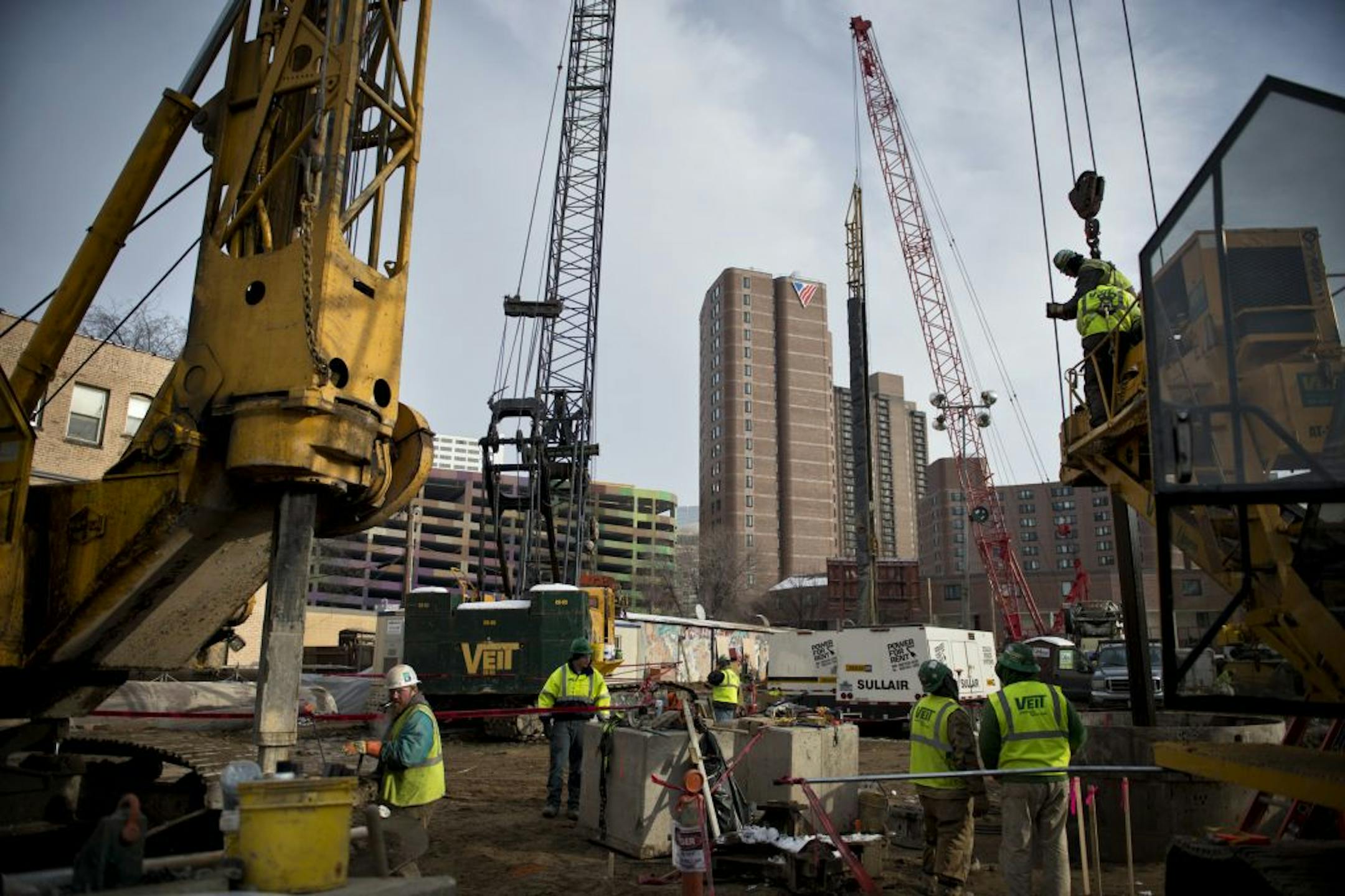
Minneapolis, the city of the single-family home on a tree-lined boulevard, sees its future in the apartment towers rising 20 stories above busy downtown streets.
Several major projects underway illustrate a trend toward tightly packed, urban living that is playing out in cities across the United States, giving Minneapolis planners hope of recapturing population the city lost starting in the 1950s. More apartments and condominiums got the green light in Minneapolis this year than any in recent history -- about 2,800 in 22 new buildings so far.
"If we're going to compete in the 21st century as a competitive global city, we have to attract people who want to live in cities. And cities are dense, urban environments," said the city's director of community planning and economic development, Jeremy Hanson Willis.
Whether the entire city is ready for it is another question. Outside of downtown, dense developments are often met with stiff resistance from neighborhood groups.
"I think there's a value in the city that we respect the single-family residential community," said Bob Corrick, who chairs the land use committee of a neighborhood group that has been sparring for years with developers who want to put more high-rise housing on the north end of Lake Calhoun.
To keep the peace, city leaders hope to appeal to people's pocketbooks -- more units mean more people paying taxes -- and steer growth to underserved areas where dense housing could revitalize commercial corridors. Mayor R.T. Rybak said they include the West Bank, the intersection of Nicollet Avenue and Lake Street, the neighborhood around the Minneapolis Farmers Market, along the Hiawatha light rail line and around the future Vikings stadium.
"People make a mistake of thinking that our desire to grow the population means putting a high-rise on every corner," said Rybak, who emphasized the connection between new transit options and housing growth.
But at Nicollet and Lake, where city leaders hope to relocate Kmart and run streetcars on a reconnected Nicollet Avenue, tension seems inevitable. Erica Christ, president of the Whittier Alliance Board of Directors, is talking with residents about what kind of dense housing they would tolerate. "The neighborhood will object to anything that's over four stories," she said.


