

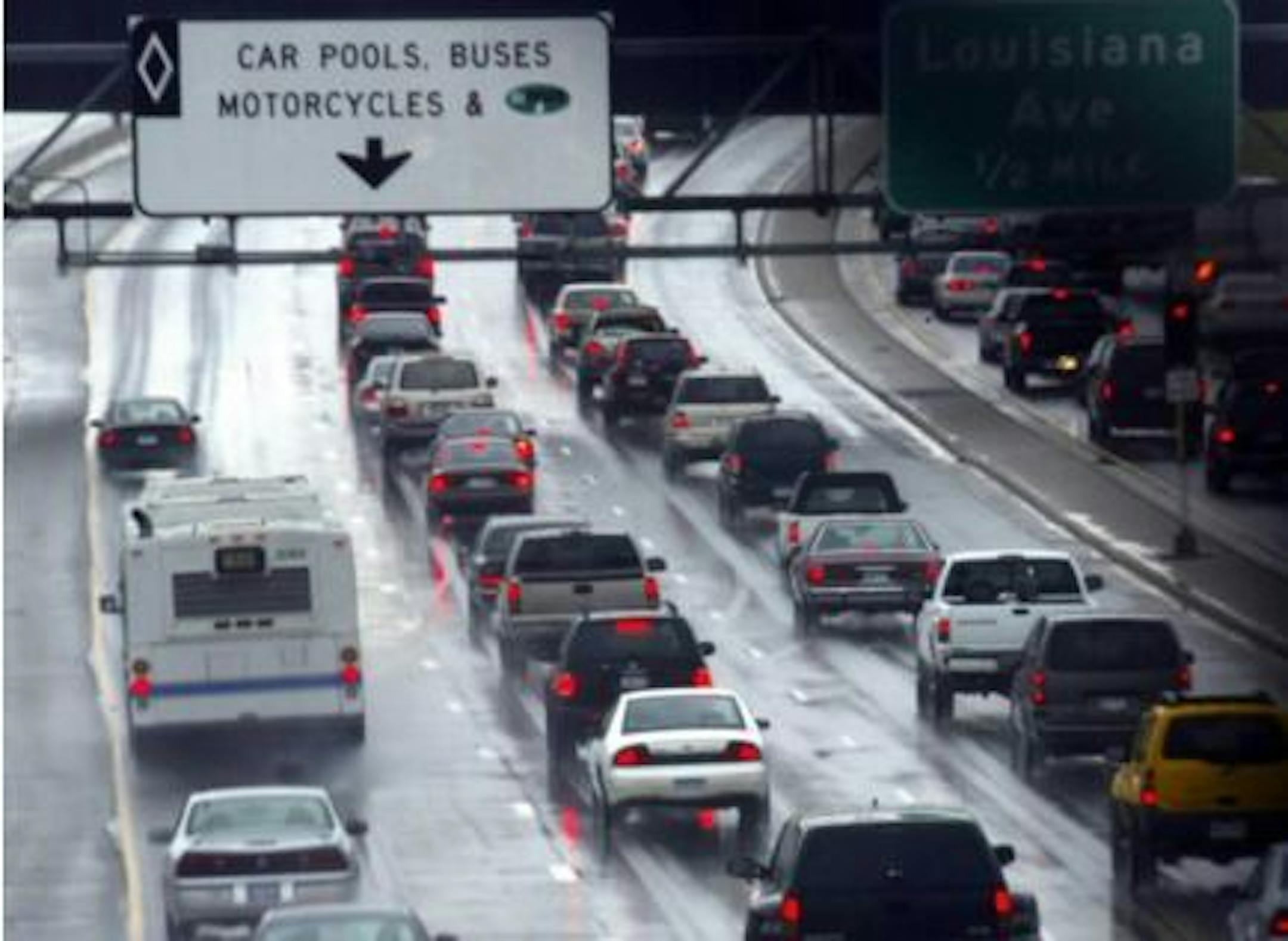
Motorists who frequently drive eastbound on I-394 likely know the freeway goes on a SlimFast diet at Louisiana Avenue where the far right lane drops. That forces traffic to shift left and squeeze into the two remaining general-purpose lanes, or three if the MnPass lane rules are not in effect.
Curiously enough, as reader Lori astutely points out, there is not much notice to tell uninitiated drivers going at warp speed that the lane abruptly ends.
"There is no signage until after the Louisiana exit that would communicate to drivers going at least 55 mph that the right lane ends at Louisiana," she wrote. "This makes for some, in my opinion, very unsafe attempts to merge left from those in the far right lane. I drive this section of I-394 two to three times each weekend, and witness near accidents almost every weekend; I can't imagine what must happen on weekdays when the traffic is much heavier. Since I am aware of this area, I try to stay well behind [other cars] if I have to take the Hwy. 100 south exit or far left if I am continuing east on 394. But at times, I am still concerned for my safety from the drivers who are not aware of the lane ending."
Aren't we all?
That's not the only place where dangerous merging from the right has drivers nervous. Try northbound County Road 81 north of 63rd Avenue in Brooklyn Park. There, the road drops from three lanes to two with nary a warning until one reaches the merge point. I've seen close calls there, especially during rush hour when everybody is jockeying to get onto I-94/694.
But back to eastbound I-394. The long and the short of it is that it's a distance factor. Here is how MnDOT explained things.
MnDOT's approach
When a lane drops, MnDOT marks the lane as "Exit Only" with an overhead sign and dotted lines on the pavement to indicate a lane is ending — provided the length of the disappearing lane is a half-mile or longer. On eastbound I-394, the right lane that drops at Louisiana doesn't meet that standard.
Excluding the HOT lane, eastbound I-394 has two general-purpose lanes east of Hwy. 169. A third lane appears at Winnetka Avenue, the point where a ramp carrying traffic from Hwy. 169 and General Mills Blvd. enters. The third lane, called an auxiliary lane, continues only to Louisiana, where it drops. The distance between Winnetka and Louisiana is one-quarter of a mile, so it is not marked as an "Exit Only" lane.


