

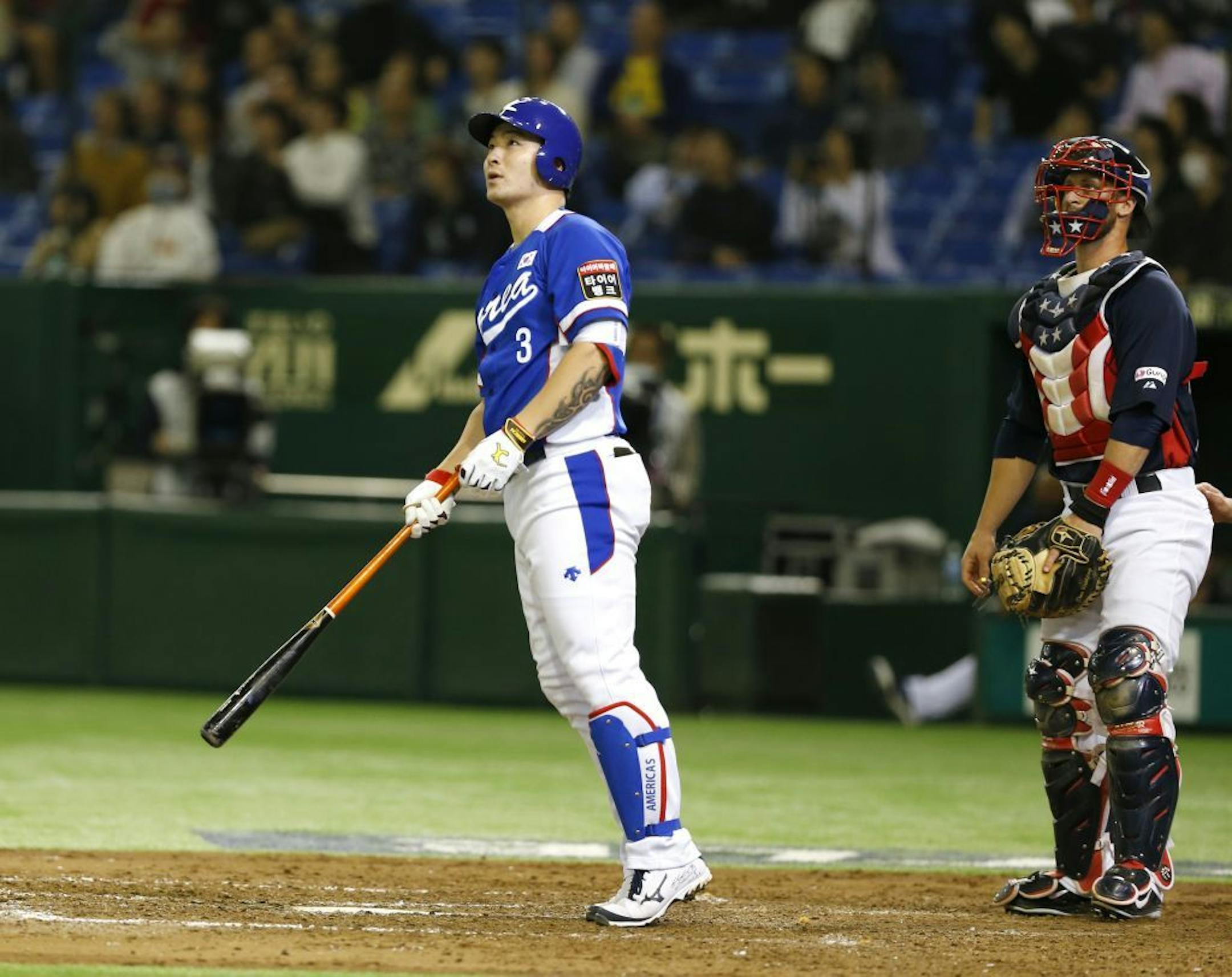
Less than an hour after they announced that Byung Ho Park had agreed to a four-year, $12 million contract to become their designated hitter next season, the Twins received a timely reminder of why they gambled on the South Korean slugger. The Red Sox on Tuesday committed $217 million over seven years to lefthander David Price, only the latest example of how expensive — or in the Twins' judgment, mostly unaffordable — elite veteran talent can be.
Power hitting is another pricey commodity, and in Park, who has crushed 105 home runs in the past two seasons, the Twins hope they have added a significant run producer at a bargain price. Nobody knows if his home-run stroke in Korea will translate to the major leagues, but if he can produce even half as many home runs as he did for the Nexen Heroes, he will be one of the most cost-effective free agents in Twins history.
Of course, that's a critical "if."
"If he can hit with that type of power, it could end up being a home-run type of sign for [Twins General Manager Terry] Ryan," said Jim Bowden, former general manager of the Reds, Expos and Nationals, and now a baseball analyst for ESPN. "But for that type of money, both in posting [fee] and in salary, this is a huge gamble for a midmarket team."
Park, 29, will earn $2.75 million in each of the next two seasons and $3 million in 2018 and 2019. The Twins will have the option to pay him $6.5 million in 2020, or buy him out for $500,000. The $12 million guaranteed to Park is on top of the $12.85 million the Twins must pay to Park's former team, the Nexen Heroes, as compensation for losing him.
Total investment: $24.85 million, or an average of $6.2 million per season. It's an incredible discount for a middle-of-the-order slugger, particularly for a team like the Twins, which has not ranked in the top half of the AL in home runs since 2004. But it's a severe overpay if Park's 161 strikeouts last year, and not his 53 home runs, prove more predictive of how he will adapt to better pitching and bigger ballparks.
"Signing these type of players is the highest risk of any move a GM makes, because you don't know how these players will react to facing top-level pitching on a nightly basis," Bowden said. "They've never seen this type of velocity or secondary stuff on a consistent basis."


